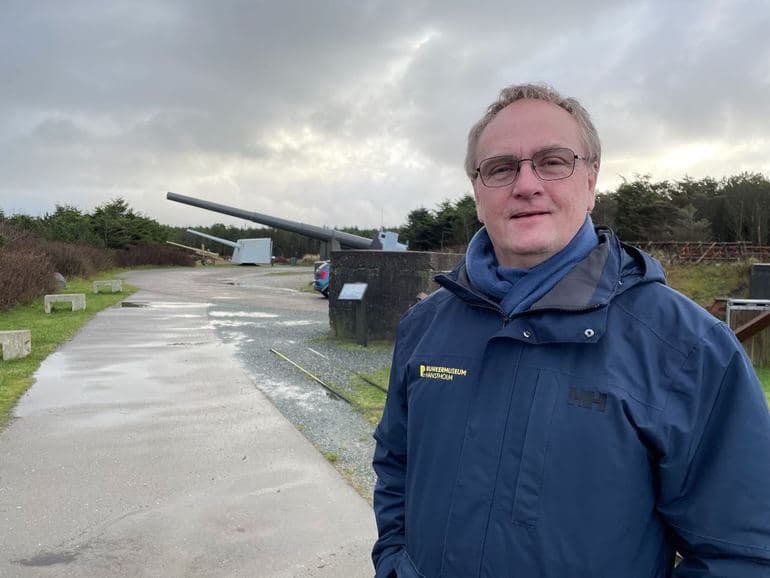
You feel somewhat transported to the film The Olsen Gang in Jutland when you come to Bunkermuseum Hanstholm. The rails for the small railway that transported the giant artillery shells in the film are still here, along with much else.
But it is not only at the bunker museum that the occupation period plays a role, because it also plays a role in the history of Hanstholm and the port. These events are to a large extent responsible for the port not being completed until 1967. Museum curator at Bunkermuseum Hanstholm Jens Andersen knows something about the town's history.
- The law that Hanstholm Port should be built was passed in 1917. At the same time, it was decided that a port should be built in Hirtshals. The work began in the early 1920s, says the museum curator.
But there was a significant difference between the two port constructions, even though it is exactly the same port.
- Hirtshals is already finished, because it is significantly smaller. In fact, it is only half as big. When the occupation comes, the Germans close the Skagerak all the way up to Kristiansand with mines in the autumn of 1940. There is only passage very close to Hanstholm, says Jens Andersen.
The passage gives the Germans the opportunity to hit passing ships with their guns from land. They are quite afraid that the Allied fleet will sail into the Skagerak. But it does not stop there.
- They begin a strong fortification of the city. In the summer of 1942, there is a demand for an evacuation of the city, but the Danes are able to delay the evacuation until the autumn, when the order for a full evacuation comes. There is a three-month deadline to leave the city, and a 500 kr. bonus is given if you leave the city within 14 days, says Jens Andersen.
For the same reason, the construction of the harbor comes to a halt in the summer of 1942.
- The Germans remove everything in front of their defenses so that an enemy would not have a place to hide during an invasion, he explains.
The war also ended up costing the city its inhabitants after the war.
- 800 civilians are forcibly relocated from the city, including 30 fishing families. They quickly found out that it is easier to fish from a harbor. When the war ended, only 500 people moved back in 1946, Andersen explains.
The port construction was not resumed, and it did not look good for one pier either, because the quality of the construction from before the war was not up to date.
- The cofferdams were made of wood, which were filled with stone and concrete. And there was only half-hearted maintenance of the pier in the 1950s, he says.
The war had a very long-lasting effect on the city for all these reasons.
- In the period from 1942 to the end of the 1950s, no houses were built in the city. When the port construction finally started, it attracted people from all over the country. Now there is again an opportunity to make a living, explains Jens Andersen about a construction project that will end with the port being completed in 1967.
Text, graphics, images, sound, and other content on this website are protected under copyright law. DK Medier reserves all rights to the content, including the right to exploit the content for the purpose of text and data mining, cf. Section 11b of the Copyright Act and Article 4 of the DSM Directive.
Customers with IP agreements/major customer agreements may only share Danish Offshore Industry articles internally for the purpose of handling specific cases. Sharing in connection with specific cases refers to journaling, archiving, or similar uses.
Customers with a personal subscription/login may not share Danish Offshore Industry articles with individuals who do not themselves have a personal subscription to Danish Offshore Industry.
Any deviation from the above requires written consent from DK Medier.