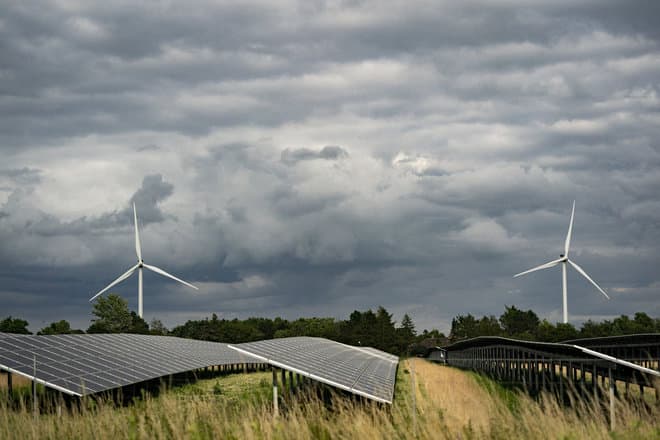
More electricity customers are showing interest in forming energy communities, where they jointly produce and consume electricity. This can reduce the load on the collective electricity grid and create financial savings over time.
To support this development, Cerius-Radius, together with the rest of the industry, has developed a new tariff model targeted at these communities, which has now been approved by the Danish Electricity Authority. Until now, all low-voltage customers have had the same tariffs, but a change in the law has opened up new models.
The new method is intended to give local energy communities a financial incentive to distribute their electricity consumption and production more appropriately. This can be done, among other things, by utilizing solar cells and coordinating electricity consumption during periods when the grid is most loaded.
- Tariffing local energy communities is incredibly complex, and that is why I am really proud that we have come to this point where we now have an approved method. It has required a lot of work, and it would not have been possible without a good and constructive dialogue with both the authorities and all the many players who are passionate about this topic. We now look forward to putting the method into operation for the joy and benefit of customers, says Jens Fossar Madsen, CEO of Cerius and Radius, in a press release.
The method has been provisionally approved until the end of 2027. Cerius-Radius expects that the first customers can be tariffed according to the model from 1 January 2026.
About the model
- The legislation defines local associations of network users as an association of electricity customers who together control both consumption and production. The method is relevant for grid customers connected to the distribution grid at 0.4 kV level in the low-voltage grid and directly in a 10/0.4 kV transformer station on the low-voltage side.
- The purpose of the scheme is to support grid customers in contributing to a more efficient use of the electricity grid by giving local associations of grid users an incentive to optimize the simultaneity of consumption and production. This may contribute to a reduced maximum load on the electricity grid and a potentially reduced need to expand the electricity grid, which will be a socio-economic gain in the form of saved investments in the electricity grid for the benefit of all customers in the grid company.
- In the new tariff method, Cerius-Radius will settle the local energy communities based on both time differentiation and their maximum power demand during the year. The new tariff principle only covers the tariff part of the energy bill, while the rest of the electricity bill continues as usual.
Source: Cerius-Radius
Text, graphics, images, sound, and other content on this website are protected under copyright law. DK Medier reserves all rights to the content, including the right to exploit the content for the purpose of text and data mining, cf. Section 11b of the Copyright Act and Article 4 of the DSM Directive.
Customers with IP agreements/major customer agreements may only share Danish Offshore Industry articles internally for the purpose of handling specific cases. Sharing in connection with specific cases refers to journaling, archiving, or similar uses.
Customers with a personal subscription/login may not share Danish Offshore Industry articles with individuals who do not themselves have a personal subscription to Danish Offshore Industry.
Any deviation from the above requires written consent from DK Medier.