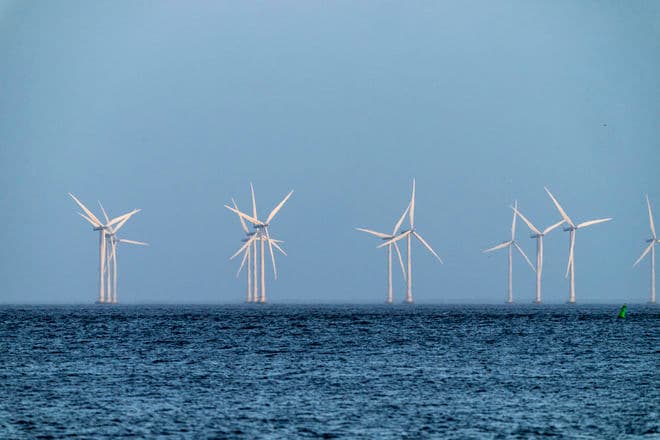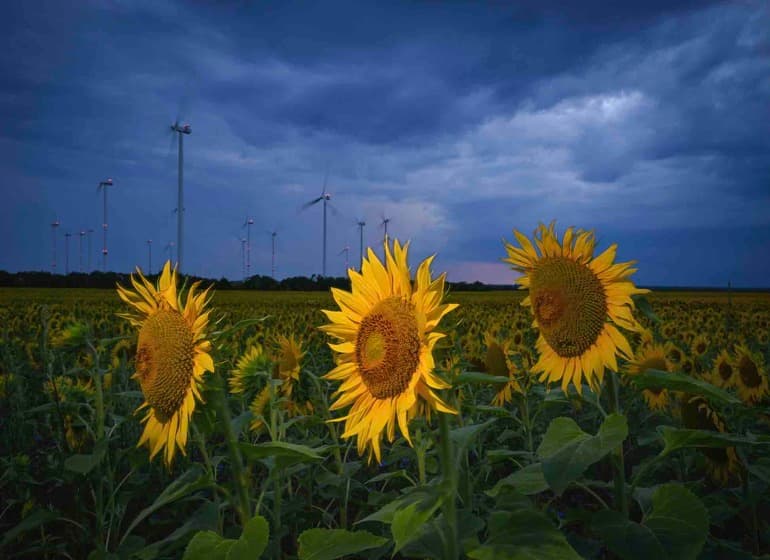
Previously, many Danish wind turbines stood still in windy weather, but new rules for counter-trading across the Danish-German border have not only proven beneficial for green, Danish electricity production. They have also proven to be an economic gain.
Not only do the wind turbines now spin when it is windy, the costs of handling bottlenecks in the electricity system have fallen significantly.
This is what Energinet writes after making a statement.
Market was expanded and prices fell
The new counter-trading model was fully implemented in July 2023, and with it, the German transmission system operator (TSO), TenneT,'s need to buy downregulation of Danish electricity production was moved from the Danish regulating power market to the cross-border intraday market. This created a much larger market with many more players.
In the first half of 2023, the difference between the average price for handling in the regulating power market and the average spot price* for electricity was on average 42 EUR/MWh. In the second half of 2023, the difference between the average price for selling countertrade in the intraday market and the average price in the spot market was on average 15.9 EUR/MWh.
The latter has, with a few exceptions, been decreasing since implementation, and in February and March this year the price difference was down to a modest 3.4 EUR/MWh.
The prices for downward regulation have therefore fallen significantly after the market has expanded.
Why countertrade
Why countertrade at all? The problem is that the German electricity grid has not been expanded in line with the green transition. Many new solar panels and wind turbines mean that when the wind blows and both Danish and German turbines produce large amounts of electricity, the German electricity grid does not have enough capacity for all the electricity to come from Denmark and Northern Germany and south, down through Germany to the large cities and industrial areas where it is needed.
If the wind turbines in Northern Germany and Denmark continued to produce, the Northern German and Danish electricity systems would "overflow". Too much electricity would be produced in relation to consumption, and the electricity system would become unbalanced and potentially collapse.
Since the German electricity grid is the cause of the problems, it is TenneT that must purchase downregulation of production or upregulation of consumption to create a balance between production and consumption. However, the German rules are structured in such a way that it is the "very last option" for Germany to reduce its own green electricity production, e.g. by turning off the German wind turbines. Therefore, Germany increasingly paid Danish players to reduce production or increase consumption, for example by paying Danish wind turbines to stop.
But the amounts of green energy that were stopped grew and grew, and so did the prices that TenneT had to pay for the downregulation.
More can deliver
In the old model for counter-trading, only Danish producers could bid and deliver the “special regulation” that TenneT needed. With the transition to the new model, counter-trading was moved from the Danish regulating power market to the intraday market, and now it is possible for both Danish and foreign players to bid, both with and without physical facilities, and thereby meet TenneT's need for counter-trading on the Danish-German border. The participating players now include both producers, consumers and traders within and outside the country's borders, which has contributed to greater liquidity in the intraday market, as more business models come into play in the market.
The transition to the new model has meant that countertrade volumes are now sold at prices that reflect the increased liquidity that the shift from special regulation in the regulating power market to the intraday market has brought.
The need is unchanged - but prices have fallen
To assess the economic efficiency of the model, Energinet has looked at the difference between the price for countertrade and the spot price for electricity. This method has been used since many factors affect both the price for special regulation in the regulating power market, the intraday price and the spot price over time, which is why a direct comparison of the prices will not be fair. However, by observing the price difference, it is possible to compare the economic efficiency of the two models and the magnitude of the economic redistribution that the two models lead to.
As the graph above illustrates, German TenneT has on average requested roughly the same amount of countertrade in the first half of 2023 as in the second half of 2022, which is why this cannot explain the reduction in the difference between the price for countertrade and the spot price. The reduction is, on the contrary, an expression of the increased competition around the countertrade volume, which has been achieved by moving the trade from the balance time frame to the intraday market. However, there is no expectation that the price difference will decrease significantly from the current level and eventually end up at 0 EUR/MWh. This is because the price difference naturally reflects the timing risk that exists between the day-ahead market and the intraday market, which is why it is assessed that the price difference is about to have found its natural level.
*The average price in the day-ahead market is for hours with completed countertrade
jel
Text, graphics, images, sound, and other content on this website are protected under copyright law. DK Medier reserves all rights to the content, including the right to exploit the content for the purpose of text and data mining, cf. Section 11b of the Copyright Act and Article 4 of the DSM Directive.
Customers with IP agreements/major customer agreements may only share Danish Offshore Industry articles internally for the purpose of handling specific cases. Sharing in connection with specific cases refers to journaling, archiving, or similar uses.
Customers with a personal subscription/login may not share Danish Offshore Industry articles with individuals who do not themselves have a personal subscription to Danish Offshore Industry.
Any deviation from the above requires written consent from DK Medier.