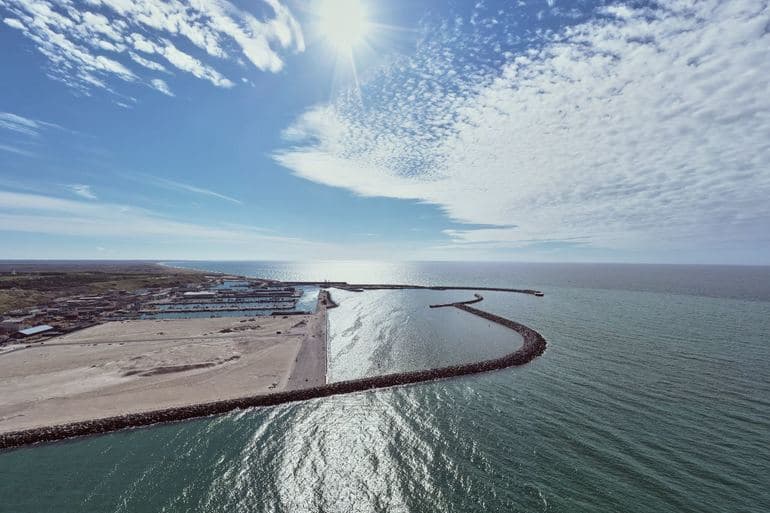
THISTED: The financial woes continue for Hanstholm Port, which has already left the owner, Thisted Municipality, with a debt of around 630 million DKK from an expansion that was completed in 2020.
The municipality took the port back from self-government on January 1 in order to repay a bank loan of 63 million DKK. This has meant that the municipal budget for 2023 had to be reopened, and welfare benefits have had to be postponed. But there may now be an even bigger bill of millions on the way to the port and thus Thisted Municipality.
Last year, the port pier broke during storm Malik. The damage has been provisionally repaired for 11 million DKK. - as Danish Offshore Industry DOI.dk has previously been able to tell. From sources close to the port, DOI.dk now also learns that the final repair could amount to at least 55 million DKK. Furthermore, the problems could prove to be even greater and involve a construction defect that could be much more expensive.
The case is complicated by the fact that there is an insurance case underway with no fewer than eight parties who are in the process of conducting an inspection and estimate. It has been ordered by the port's insurance company, which has paid the 11 million DKK in the first round.
The parties to the case are the port - and thus Thisted Municipality - Rambøll, Aarsleff, Cowi and the Coastal Directorate as well as their insurance companies. The Danish Coastal Directorate is involved because the maintenance of the caissons in front of the harbour falls under the authority of the Directorate.
From world-renowned textbook example to design flaw
At the Danish Coastal Directorate, coastal engineering manager Per Sørensen assesses that the harbour has gone from being known for its good construction to something completely different.
- It was a textbook example of how to make a harbour - we are talking on a global scale, says Per Sørensen, about the original harbour, which was completed in 1967.
But after the expansion and the breach of the harbour pier during the storm in January 2022, something has happened.
- Something has gone wrong. I sit on the board of the Danish Water Construction Technical Society (VBS). This is something that is being discussed, says Per Sørensen and adds:
- It is a design flaw. But it is often precisely the mistakes that you learn from. We are talking here about a port that is by far Denmark's most vulnerable.
He also has an idea of how to find the mistake and fix it.
- You can use laboratory tests with a wave simulator, but also computer simulations, says Per Sørensen, who does not believe that the pending insurance case complicates the case for the port with its challenged finances.
- The owner of the facility must find out what is wrong, notes the coastal technical manager, referring to the port and Thisted Municipality and referring to the project manager who is handling the case at the Coastal Directorate.
Pending case
Project manager and engineer Gitte Grimstrup at the Coastal Directorate will neither deny nor confirm the design error. The same applies to whether the directorate will have to pay if the caisson in front of the harbour needs to be renewed.
- The caissons are from 1967, when the then 'Hydraulic Engineering Service' built them. We have the maintenance, and we look after it as we should. Every year we check how the caissons are doing. That is, whether there is sand in them. They are doing reasonably well, says the engineer and adds:
- At some point they will of course no longer last. But as I said, their condition is stable and fine in relation to their age.
DOI.dk has attempted to obtain a comment from Thisted's mayor Niels Jørgen Pedersen (V).
Text, graphics, images, sound, and other content on this website are protected under copyright law. DK Medier reserves all rights to the content, including the right to exploit the content for the purpose of text and data mining, cf. Section 11b of the Copyright Act and Article 4 of the DSM Directive.
Customers with IP agreements/major customer agreements may only share Danish Offshore Industry articles internally for the purpose of handling specific cases. Sharing in connection with specific cases refers to journaling, archiving, or similar uses.
Customers with a personal subscription/login may not share Danish Offshore Industry articles with individuals who do not themselves have a personal subscription to Danish Offshore Industry.
Any deviation from the above requires written consent from DK Medier.