With the Agreement on a Green Denmark, which was concluded by the green tripartite on Monday evening, the municipalities will have a central role in Denmark's land conversion. It is the municipalities that will be responsible for planning and implementing this.
The municipalities must ensure that the land conversion supports both the fulfillment of the Water Framework Directive, the removal of 140,000 hectares of low-lying soils by 2030 and the establishment of 250,000 hectares of forest by 2045.
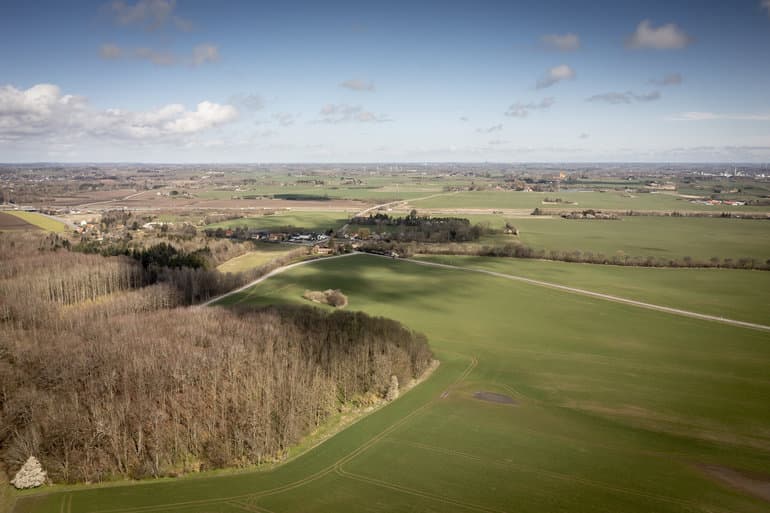
390,000 hectares of agriculture are to be converted to forest and nature, writes the Ministry of the Environment. This corresponds to approximately nine percent. of Denmark's total area.
- In the municipalities, we are ready to take the lead in ensuring that we reorganize our areas with a focus on nature, the whole and local cooperation, so that we ensure that there is room for both agriculture and nature, says KL chairman Martin Damm (V).
Responsible all the way
This is done by requiring the municipalities to "prepare a reorganization plan with a binding deadline no later than 2025," the agreement document states.
The plan will be based on a nationally announced need for action for Denmark's 23 main water catchments, including nitrogen reductions in the water areas. "Finance will be distributed according to need," it states.

The planning and initiation of the efforts is based on the preliminary water area plans, which will be sent for consultation in 2024. The municipalities are also responsible for determining the needs here.
There are already water basin steering groups (VOSs) for the 23 main water basins, which today consist of representatives from the municipalities in the catchment area. These are used as a basis for establishing new groups that will create a local anchoring.
- In the municipalities, we know the landowners and the local conditions best, and we are therefore pleased that it is also the municipalities that will be responsible for the local transition, says Birgit S. Hansen (S), chairwoman of the Climate and Environment Committee of the City Council.
The municipalities appoint the chairwoman for them and are "responsible for delivering the agreed deliveries within the deadline". It is thus the municipalities that are ultimately responsible.
A national task force will be established to assist the municipalities in removing national barriers in relation to legislation, subsidy schemes, etc. It is also the task force to which the watershed steering groups report.
"Compensation for the municipalities' total task portfolio in relation to the conversion effort will be agreed in more detail between the local government and the government", the document states at the bottom.
Priority and distribution
Part of the agreement includes the establishment of the Danish Green Land Fund, which will purchase land for approximately DKK 40 billion with a view to converting areas.
"The areas that the fund acquires through strategic acquisitions can, for example, be used as part of land distribution, sold on and contribute to large, coherent natural areas under private or public control with registered operating restrictions, installation of renewable energy, etc. and used to deliver climate and nitrogen reductions", the agreement states.
A model will be developed in this connection that gives "priority to municipalities and nature funds to purchase the areas in cases where they are areas with special natural value or potential".
In addition to the major restructuring of Denmark's land area, Denmark will set a goal in the upcoming Nature and Biodiversity Act that at least 20 percent of Denmark's land area must be protected nature. In this connection, the government will investigate whether municipalities and other parties want to contribute.
As part of, among other things, the protection of drinking water, the agreement provides that 20,000 out of the 250,000 hectares of forest will be established as urban state forest with co-financing from municipalities and/or water utilities.
In this connection, the parties also agree that the government will seek to "enter into an agreement with those municipalities where there is a potential for reducing the discharge of nutrients from wastewater". In general, wastewater treatment must be improved, and the wastewater tax for untreated wastewater in connection with overflows will also be increased.
Overall, it is expected - as a result of all the elements of the agreement - that at least two-thirds of the Danish water bodies will meet the Water Framework Directive's deadline of 2027, at least with regard to nitrogen.
Text, graphics, images, sound, and other content on this website are protected under copyright law. DK Medier reserves all rights to the content, including the right to exploit the content for the purpose of text and data mining, cf. Section 11b of the Copyright Act and Article 4 of the DSM Directive.
Customers with IP agreements/major customer agreements may only share Danish Offshore Industry articles internally for the purpose of handling specific cases. Sharing in connection with specific cases refers to journaling, archiving, or similar uses.
Customers with a personal subscription/login may not share Danish Offshore Industry articles with individuals who do not themselves have a personal subscription to Danish Offshore Industry.
Any deviation from the above requires written consent from DK Medier.