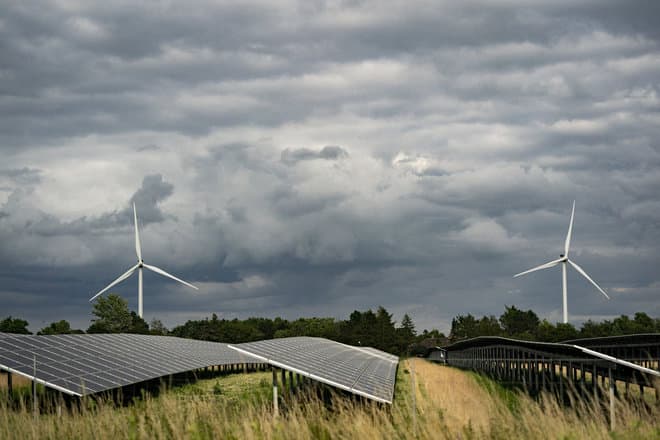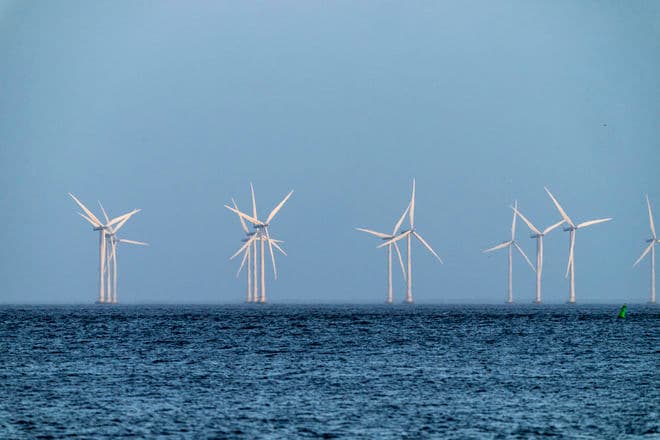

The future of energy supply is largely about ensuring the possibility of storing energy. Already today, electricity from offshore wind farms comes in large quantities at night, when consumption is low. Therefore, the problem will only become greater when Denmark's offshore wind capacity increases after the expansion of offshore wind that has already been decided.
At Semco Maritime in Esbjerg, more specifically in the company's shipyard, which is internally known as Staget due to its location at the address Staget 1, a step forward towards a solution to this problem has just been taken today.
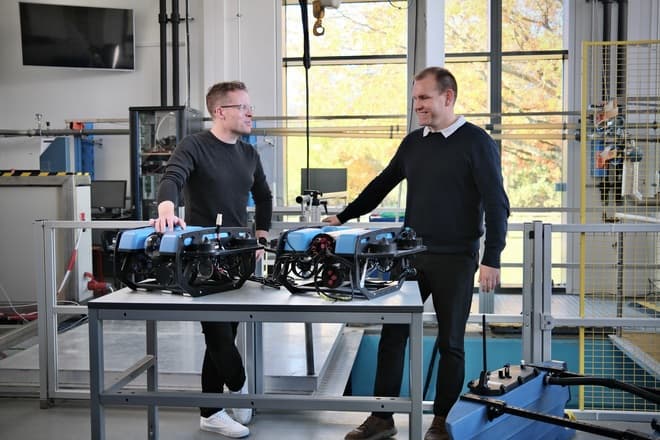
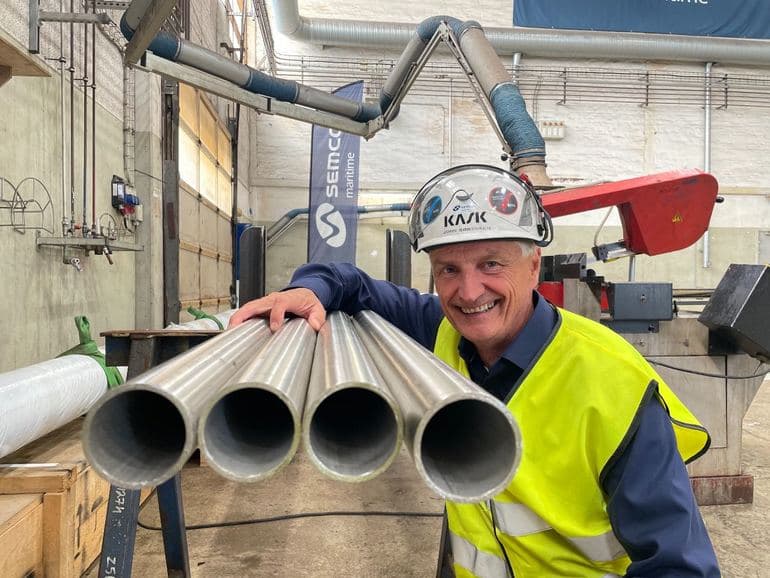
The company Hyme Energy is building their pilot plant for energy storage, which will run for six months after completion. The energy storage is done by heating something that is normally only found in households - namely caustic soda. The plant will be built at Staget at Semco, where Director John Sørensen's employees will build it.
- We are building the plant here for Hyme Energy, and it is called Molten Salt Storage (MOSS). It is done by heating NaoH, which is what we know as caustic soda for cleaning drain pipes. Here we will build two highly insulated tanks with heating elements. They each hold five cubic meters, which corresponds to 5,000 liters, says John Sørensen and explains:
- There will be a cold tank that is heated to 350 degrees Celsius and a hot one that is 650 degrees. Here there is the possibility of taking surplus energy, for example, when the wind turbines are running at night or when the sun is shining on Sundays. This is a pilot project where it will be tested how it all works. So large-scale scaling will be possible later.
If the pilot project is successful, the plans are already ready at Hyme Energy, which could become a large-scale plant in connection with Energiø Bornholm.
But first the pilot plant must be built.
- We start work today, but NaoH is corrosive, so you can't use stainless steel. It would be etched. So we use Inconel 600, which is a mixture of chromium and nickel. It is extremely corrosion-resistant but also a very expensive material, explains John Sørensen.
Although the plant is a test plant, it will be able to deliver the equivalent of approximately three MW for an hour. And the heating element is definitely not small either.
- The heating element in the tanks has an output of 1.4 MW. That's roughly equivalent to a heating plant in a small village, says John Sørensen, who as an engineer can also provide an explanation of how the plant his people are going to build works:
- You take the electricity at night and heat the NaoH up to 650 degrees, so that it becomes liquid. During the day, you can then use a steam turbine to generate electricity again from the heat in the tank. It's a thermal battery. This is the ice hockey stick, which makes it possible to store energy.
Should run for six months
Once the plant is finished, it will run for six months, and during that time Hyme Energi will have employees to run the plant.
- Hyme Energy will have three employees here. But first the plant has to be built, and it will take a few months, explains John Sørensen, whose employees will build the plant.
What will happen to the plant after that time is still uncertain, but it has a capacity that could be used by, for example, a small district heating plant with wind turbines.
- When the test period is over, it will be examined to see what the parts look like and whether there has been any wear and tear. But otherwise, it could, for example, be rebuilt elsewhere, concludes John Sørensen.
.jpg)
This is what the plant with liquid hot caustic soda will look like at Semco Maritime in Esbjerg. Illustration: KIRT x THOMSEN.
Text, graphics, images, sound, and other content on this website are protected under copyright law. DK Medier reserves all rights to the content, including the right to exploit the content for the purpose of text and data mining, cf. Section 11b of the Copyright Act and Article 4 of the DSM Directive.
Customers with IP agreements/major customer agreements may only share Danish Offshore Industry articles internally for the purpose of handling specific cases. Sharing in connection with specific cases refers to journaling, archiving, or similar uses.
Customers with a personal subscription/login may not share Danish Offshore Industry articles with individuals who do not themselves have a personal subscription to Danish Offshore Industry.
Any deviation from the above requires written consent from DK Medier.