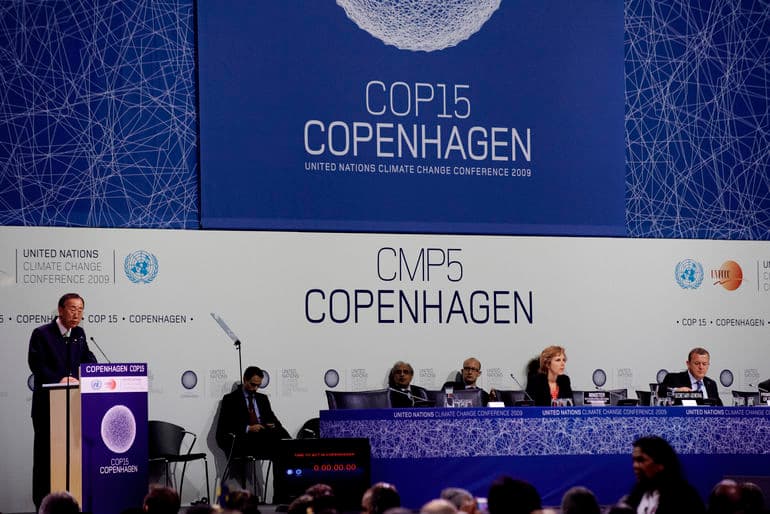
When the UN held its annual climate summit in Copenhagen in December 2009, it was arguably a piece of Danish history. Never before have so many heads of state met in Denmark to discuss climate as during COP15.
The climate summit in Denmark has since had a bad reputation as a "fiasco", as Connie Hedegaard, then Conservative Minister for Climate, has called it. Now research points in the same direction.
For 19 out of 34 countries have failed to meet the 2020 climate targets they committed to at the climate summit in 2009. This is shown by a new study from University College London, according to Videnskab.dk.
In the study, which is published in the journal Nature Climate Change, the researchers compare the countries' actual net emissions with their reduction targets set at COP15.
Among others, Australia, Spain and our Norwegian neighbors have failed to meet their climate targets. On the other hand, Denmark is in the group of countries that have successfully achieved the climate goals.
Climate researcher: "Not surprising"
The study's results are "not surprising," says climate researcher Jens Hesselbjerg Christensen, who is a professor of climate physics at the University of Copenhagen.
- It highlights that COP15 was not a success. No milestones were set, and it shows how paralyzed the countries were in action, he says.
The study also shows how different climate ambitions are today. This is what climate professor Sebastian Mernild, who heads the SDU Climate Cluster at the University of Southern Denmark, thinks:
- It may well be that some achieved the goals at COP15, but today we know that we must deliver much more than that in 2009.
It is worth noting that the study only examines 34 countries and not all participating countries.
The meeting slipped into the sand
When Sebastian Mernild himself participated in COP15 in his time, he remembers it as a summit where "things were put to the test".
- It was said that we had to act here and now. But the meeting fell through in terms of impact, he says.
They did not reach a comprehensive global agreement like the Paris Agreement, but rather a declaration of intent called the Copenhagen Accord, which was not legally binding.
- No one saw the Copenhagen Accord as anything more than a step on the way to making another agreement. They were not prepared to make a binding agreement, says climate scientist Jens Hesselbjerg Christensen.
That is why the countries set individual reduction targets, also known as NDCs, but which have varied greatly. For example, Croatia achieved its goal of reducing greenhouse gas emissions by five percent, while Switzerland was unable to meet its goal of a reduction of 20-30 percent. by 2020.
If we are to look positively at the study, there is something that is repeated both 15 years ago in Copenhagen and the subsequent climate summits: that there is broad consensus that something must be done.
- There is no doubt that the majority of the world's countries have a desire for radical changes to be made. But in terms of how to implement it, they are incredibly passive in acting on a global scale, says Jens Hesselbjerg Christensen.
The world requires more climate action today
The study sheds light on an interesting historical perspective in the climate negotiations. But it is important for Sebastian Mernild to emphasize that the main focus should be on contemporary challenges.
- We are in a completely different place than in 2009, he says and continues:
- It is positive that at that time there were countries that were on the right course. But that was far from enough countries. What needs to be done today is significantly greater. The world requires much more climate action.
In 2023, a number of boring records were broken: The amount of greenhouse gases emitted, the concentration of CO2 in the atmosphere was at its highest level, and 2023 was the warmest year on record.
When you look at the research, from 2020 onwards we must only emit 300 gigatons of CO2 in terms of emissions year by year, if the average temperature increase is to stay below 1.5 degrees, explains Sebastian Mernild. But now, four years later, we are halfway towards emitting the 300 gigatons of CO2.
- That's problematic. This shows that it is expected that within four to five years we must not emit more if we are to remain below 1.5 degrees. And this strongly suggests that we will not. We will pass 1.5 degrees in the early 2030s, says Sebastian Mernild about the Paris Agreement's limit on how much the global temperature can rise.
Text, graphics, images, sound, and other content on this website are protected under copyright law. DK Medier reserves all rights to the content, including the right to exploit the content for the purpose of text and data mining, cf. Section 11b of the Copyright Act and Article 4 of the DSM Directive.
Customers with IP agreements/major customer agreements may only share Danish Offshore Industry articles internally for the purpose of handling specific cases. Sharing in connection with specific cases refers to journaling, archiving, or similar uses.
Customers with a personal subscription/login may not share Danish Offshore Industry articles with individuals who do not themselves have a personal subscription to Danish Offshore Industry.
Any deviation from the above requires written consent from DK Medier.