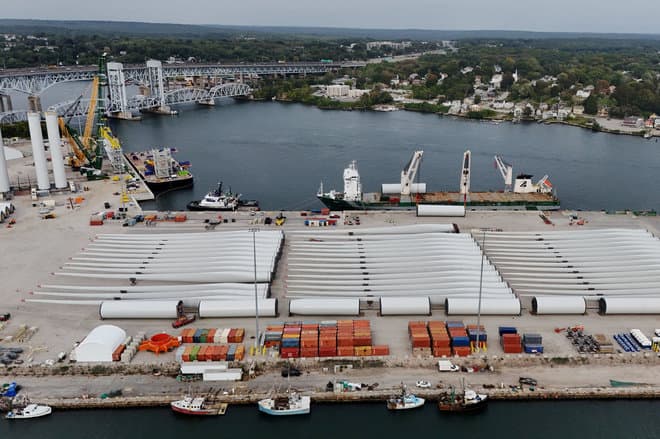
20 recommendations from the Port Partnership on how commercial ports can be as strong as possible in international competition in the future and exploit their potential for the benefit of companies, growth and the green transition were presented to the public on Monday.
Among the recommendations are, among others, that commercial ports be included in a comprehensive Danish industrial policy, where the government supports, possibly through alternative financing models such as PPP and Blended Finance" and that "predictability in planning the expansion of green technologies is ensured.
Several organizations have quickly come out and supported the recommendations, several of which are also members of the port partnership themselves. This is pleasing, among others, Green Power Denmark, which calls for the Government to quickly take note of the recommendations.
- These are not recommendations for the drawer but for political action, so that our commercial ports are geared to the green transition, and we strengthen our competitiveness. Danish ports are in a tough fight with our neighboring countries over the activities associated with the expansion of offshore wind turbines in Europe. It is therefore important that both the state and municipalities are aware of the importance of ports, so that we secure a large share of the growth, prosperity and jobs that come with the green transition, says Jan Hylleberg, Deputy CEO of Green Power Denmark.
Danish Business: Ports bind business together
The same tone is echoed by DI, which hopes that the government will follow the partnership's recommendations and emphasizes, among other things, that predictability is important, as it can make it easier to plan large investments in the ports.
- It requires large investments to keep a port business afloat, and right now the industry is facing a shift where space must also be made for green technologies while maintaining many of the activities that are already at the port - from our import and export of goods to raw materials. When investment appetite is held back, it is due to too much unpredictability, both in relation to the areas the port companies occupy, which are typically governed by lease contracts with the public sector. And that environmental approvals can take a completely unpredictable number of years to obtain, says Karsten Lauritzen, industry director at DI Transport.
He points out, among other things, a lengthy process in Nakskov, where an expansion of the shipping channel is dragging on.
- The most glaring example right now is the port of Nakskov, where they are still waiting for an environmental approval after a good 6 years. It is simply not reasonable and completely unsustainable if we are to imagine a healthy and competitive business community, he says.
Danish Business is also happy about more initiatives. Here they declare "generally enthusiastic" that the role of ports is proposed to be incorporated into the general industrial policy and given a special strategy.
- The ports connect the business community together in a cross-cutting manner and are essential for Denmark's exports. That is why it is really good that the infrastructure is linked to the business policy, says Jesper Højte Stenbæk, who is the head of transport at the Danish Confederation of Business.
The recommendations of the port partnership will form the basis for a new port strategy from the government, which is expected to be presented in early 2025.
amp
Text, graphics, images, sound, and other content on this website are protected under copyright law. DK Medier reserves all rights to the content, including the right to exploit the content for the purpose of text and data mining, cf. Section 11b of the Copyright Act and Article 4 of the DSM Directive.
Customers with IP agreements/major customer agreements may only share Danish Offshore Industry articles internally for the purpose of handling specific cases. Sharing in connection with specific cases refers to journaling, archiving, or similar uses.
Customers with a personal subscription/login may not share Danish Offshore Industry articles with individuals who do not themselves have a personal subscription to Danish Offshore Industry.
Any deviation from the above requires written consent from DK Medier.