


Exclusive interview & report II. :
On board Wind Osprey with CEO Mikkel Gleerup
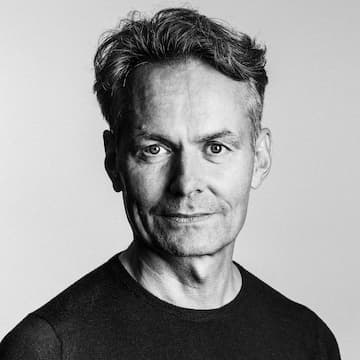
“Look out for an Audi,” the email said, but Cadeler CEO Mikkel Gleerup came in his own Suzuki Jimny Jeep. Otherwise, the electric company car would not be able to drive all the way from his home in Kolding to the shipping company’s headquarters in Ørestaden in Copenhagen. The busy meeting schedule simply doesn’t leave time for a charge on the way to Copenhagen. Yet Mikkel Gleerup is completely relaxed, focused and smiling when he picks me up midway on the E20 between Kolding and Esbjerg.
The second meeting
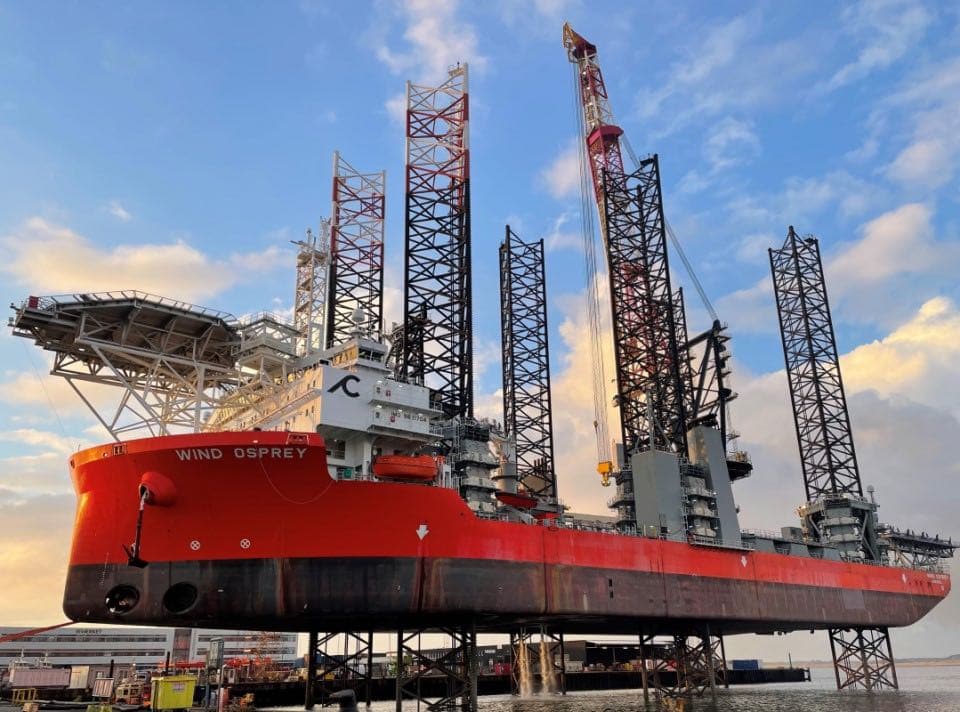
He has promised a guided tour of one of Cadeler’s two installation ships, the Wind Osprey, which is being mobilized in the port of Esbjerg, before the departure for Rotterdam. The work is located three hours' sail from the Dutch coast, where the vessel will install 69 11MW wind turbines, which are part of the Hollandse Kust Zuid wind farm.
Mikkel Gleerup quickly takes an incoming call before he can start answering my questions about his daily life as CEO.
- I love being in the office, where there is room for high fives and hugs. When I'm traveling, I always check my emails in the afternoon, typically between four and five. It's the same on Sundays and when I'm on vacation with my seven children. It's a routine, and I feel good knowing that everything is in order. There are also things that only I can approve, he explains.
Living in Kolding, more than 200 km from the company's headquarters in Copenhagen, is no problem either.
- I bought an apartment in Copenhagen many years ago, says Mikkel Gleerup.
You would think that life as a top-level CEO would mean that smaller subcontractors on the west coast of Jutland would be unknown to Mikkel Gleerup. But despite his 43 years, he is already an experienced maritime manager, and you can quickly see that.
- I know more or less everyone on the entire west coast, he says, as we approach Esbjerg and talk about the small and successful subcontractors.
In the distance, Cadeler's Wind Osprey is already visible with its six legs. A drilling rig can also be seen in the background.
- Look at the thickness of the Wind Osprey's legs, they are much stronger than those of the drilling rig. The legs of our vessels are designed to be used 25,000 times, while those on a drilling rig are designed to be used 1,200 times. Many people ask me if a rig can't be used to install wind turbines. Here's one of the reasons why they can't, explains Mikkel Gleerup.
The impressive size of the installation ship
There's a good reason why Cadeler's Wind Osprey is visible almost everywhere in Esbjerg. The legs with which the ship can jack-up are 105 meters high, and the vessel is 161 meters long and 49 meters wide.
It's hard to understand how big the Wind Osprey is until you stand next to the ship, which is jacked-up on its legs in the harbor basin. A scaffolding goes from the quay up to the gangway, before after climbing up you reach the ship's deck right next to one of the gigantic legs.
On board, registration with a valid PCR test awaits before we can continue. Inside, it's time for plastic covers for our shoes, while several of the 46-strong crew pass by and shake hands. Mikkel Gleerup seems to know them all by name, and that can't be easy with Cadeler's 216 total employees.
- All employees have my mobile number and can call me directly. Normally in shipping companies there is a distance between onshore and offshore, but at Cadeler we are one company, explains Mikkel Gleerup, as he greets a tall British employee with a big smile and asks about his children.
- He's in front of me. His wife is expecting their tenth child, says Mikkel Gleerup, laughing heartily with the tall Brit.
Slightly overwhelmed by the size of the Wind Osprey, I stand on the bridge with Mikkel Gleerup after a sea of stairs. There is a relaxed atmosphere here, although it is clear that they are working intensely. Just over 40 percent of the crew come from the British Isles, but it is the German master Jens Rohn who takes me on a tour, because the CEO has just arrived for a meeting. Although there are only 46 crew members, they come from 12 different nations.
Offshore feeling in the harbor basin
Jackets, helmets and safety glasses are put on, and a few moments later we are standing in front of the helideck in the bow of the ship.
- Are you afraid of heights, says Jens Rohn, as he moves up onto the helideck with a familiar and very deft touch.
- There is a safety net that can catch luggage if it is blown off the deck, he assures.
We are back inside the ship, where Jens Rohn shows us one of Wind Osprey's 111 rooms. There is a single bed, TV, sofa and bathroom – daylight shines in through a porthole. The tour continues through two cinemas and into a fitness centre.
- If something feels like working out after twelve hours of work, then the opportunity is here. I would rather talk to my children on the phone, says Jens Rohn.
- We work four weeks straight when we are in Europe, after which we have four weeks off. When we are in the Far East, we work for up to three months. When I work four weeks, my children only start to miss me the last week, says Rohn, who lives in Kiel, which is only a few hours' drive from Wind Osprey's current location in Esbjerg.
- We spend half of our lives on board, says Jens Rohn and his expression clearly shows that he loves both his family and his work.
The mobilization is in full swing
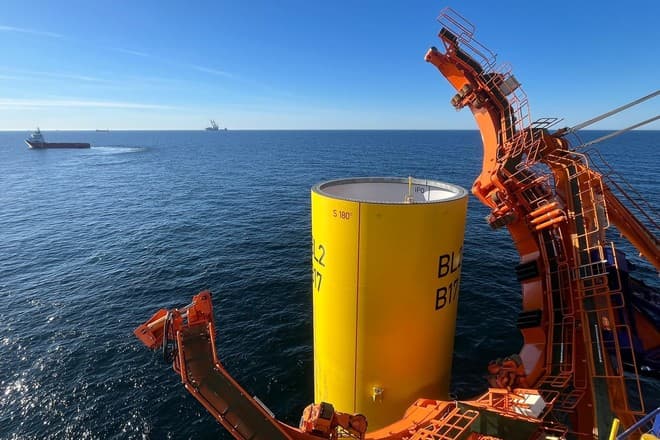
After even more stairs and floors, we are on the ship's deck. Here, the mobilization work is in full swing. In short, this means that the ship is being adapted so that it can transport and install precisely the turbines, nacelles and blades for the Hollandse Kust Zuid wind farm. The cableways that carry power to the nacelles are so stable that a forklift can drive over them. The holders for the heavy turbine parts are welded to the deck at the points where the weight is properly distributed down the ship's structure.
The deck is full of subcontractors, each working in their assigned area. I recognize the languages English, Spanish and Danish as we move towards the stern of the ship.
- We are seeing more and more that the blades are being placed hanging outside the ship, explains Jens Rohn.
Back on the bridge, Mikkel Gleerup is waiting, and it is almost time to depart for Copenhagen.
- You can stay on board and take your time. I've made sure you're taken to your office afterwards, says Mikkel Gleerup, before saying goodbye.
It's as if he senses that I haven't quite captured the experience yet.
After another tour of Wind Osprey's engine room and time for more questions on the bridge, I'm invited to a sumptuous and freshly prepared frog buffet with four hot dishes. It's just everyday life on board. When I'm dropped off at my office a few kilometers away shortly afterwards, it feels as if I've just visited another world.
This report was made in March 2022, when Wind Osprey was in the port of Esbjerg during the mobilization for the Hollandse Kust Zuid wind farm.
Text, graphics, images, sound, and other content on this website are protected under copyright law. DK Medier reserves all rights to the content, including the right to exploit the content for the purpose of text and data mining, cf. Section 11b of the Copyright Act and Article 4 of the DSM Directive.
Customers with IP agreements/major customer agreements may only share Danish Offshore Industry articles internally for the purpose of handling specific cases. Sharing in connection with specific cases refers to journaling, archiving, or similar uses.
Customers with a personal subscription/login may not share Danish Offshore Industry articles with individuals who do not themselves have a personal subscription to Danish Offshore Industry.
Any deviation from the above requires written consent from DK Medier.