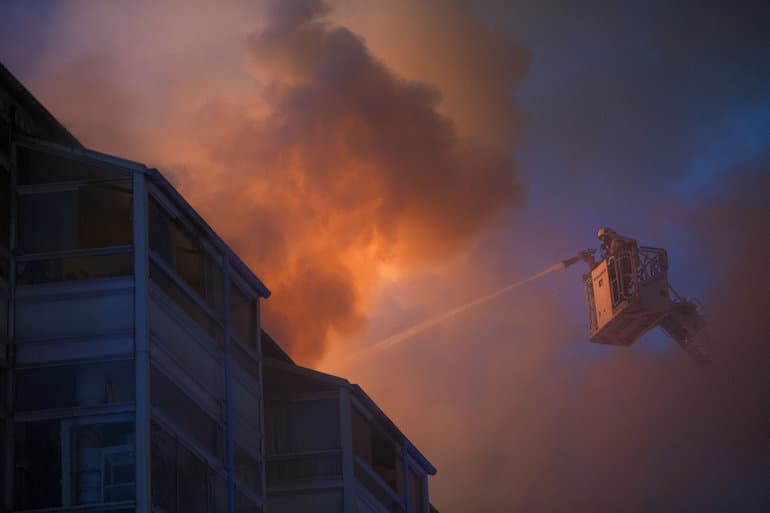
Since 2020, the number of fires in lithium-ion batteries in Danish homes has almost tripled, according to figures from the Danish Emergency Management Agency and the Danish Emergency Management Association, which is the association of municipal emergency response units.
Last year, 143 fires were registered caused by the batteries that are included in, for example, mobile phones, scooters, electric bicycles and garden tools. This was nine percent more than the year before and almost three times as many as in 2020, when firefighters responded to 55 fires caused by lithium-ion batteries.
The increasing number of battery fires is challenging the emergency services, says Bjarne Nigaard, head of the secretariat at the Danish Emergency Management Association.
- We have seen a significant increase in battery fires in the past five to six years. Unfortunately, this is not so surprising, because we surround ourselves with more electronic equipment that uses these batteries.
- But that makes firefighting more complex, he says.
The head of the secretariat points out that battery fires are associated with a large energy discharge.
- Even a smaller battery for a garden tool can trigger a fairly large and complicated fire that spreads quite quickly.
- And if the fire spreads and gets hold of another product with a similar battery, the complexity increases. It is a challenge for emergency services.
During charging
Firefighters must also be aware that battery fires can reignite.
- These fires also tend to reignite again and again. Even when you think they are completely extinguished.
- That is why it requires a completely different approach to extinguishing them, says Bjarne Nigaard.
It is the group of "smaller means of transport" that makes up the largest group of fires in the category of smaller lithium-ion products. This covers, for example, electric bicycles, scooters, hoverboards and electric scooters.
A third of fires occur in connection with charging. Therefore, you should take precautions when the batteries are charging, the advice is.
- Ideally, you should be present when the batteries are charging. But if that is not possible, charge them in a place where there is as little flammable material as possible.
- And it is always a good idea to have a smoke alarm, says Bjarne Nigaard.
/ritzau/
Text, graphics, images, sound, and other content on this website are protected under copyright law. DK Medier reserves all rights to the content, including the right to exploit the content for the purpose of text and data mining, cf. Section 11b of the Copyright Act and Article 4 of the DSM Directive.
Customers with IP agreements/major customer agreements may only share Danish Offshore Industry articles internally for the purpose of handling specific cases. Sharing in connection with specific cases refers to journaling, archiving, or similar uses.
Customers with a personal subscription/login may not share Danish Offshore Industry articles with individuals who do not themselves have a personal subscription to Danish Offshore Industry.
Any deviation from the above requires written consent from DK Medier.