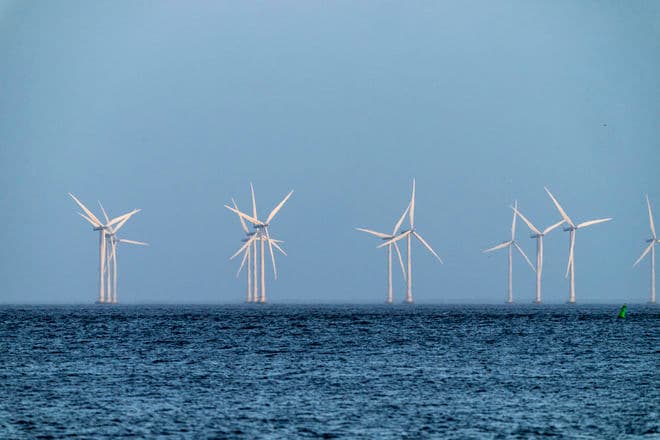
Denmark has an international responsibility to protect the many seabirds that forage in the country's shallow sea areas. Therefore, future offshore wind farms should be located so that they do not displace the birds from their habitats. This is stated by DOF BirdLife in a press release, in which the organization points to a new report from DCE, Aarhus University, which documents the most important areas for seabirds.
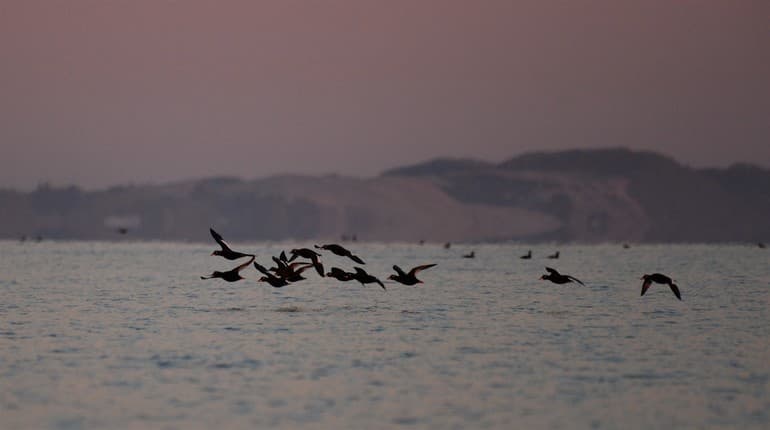
Seabirds such as eiders, black-tailed godwit and mallards spend the winter in large flocks in the shallow areas of the North Sea and Kattegat, where they dive for food. At the same time, gannets, great black-backed grebes and petrels search for food in the same areas.
- There will be a demand for many sea areas because offshore wind turbines are easiest and cheapest to place at shallow depths, but these are often exactly the same areas that are vital for seabirds. We therefore hope that politicians will read the report from DCE very carefully when they decide on the location of offshore wind turbines, because it clearly states which areas are vital for the sea's diving ducks, grebes and great black-backed grebes, says Jacob Jensen, head of the natural sciences department at DOF BirdLife.
The organisation calls for particularly bird-rich areas such as the German Bay, the northern Kattegat and the shallow areas between Læsø and Anholt to be kept free from offshore wind farms to avoid displacement and collisions.
- We 100 percent support the green transition, which will contribute to slowing down climate change, which poses an enormous threat to bird populations around the world and all of us. Wind energy from the North Sea is an important element in reducing the emissions of CO2, which are responsible for climate change. But since seabirds tend to cluster together in very specific areas, it is crucial that wind turbines are placed away from these bird-rich areas, says Jacob Jensen.
Data in the report from DCE Aarhus University on the distribution and numbers of seabirds was collected in the period 1999 to 2024. They were obtained after 243 bird counts from aircraft carried out over 203 days. In total, more than 150,000 kilometers were flown along carefully determined routes across the North Sea and the internal Danish waters to uncover exactly where and when in the year the most birds are found in which areas. 230,000 bird observations were made.
amp
Text, graphics, images, sound, and other content on this website are protected under copyright law. DK Medier reserves all rights to the content, including the right to exploit the content for the purpose of text and data mining, cf. Section 11b of the Copyright Act and Article 4 of the DSM Directive.
Customers with IP agreements/major customer agreements may only share Danish Offshore Industry articles internally for the purpose of handling specific cases. Sharing in connection with specific cases refers to journaling, archiving, or similar uses.
Customers with a personal subscription/login may not share Danish Offshore Industry articles with individuals who do not themselves have a personal subscription to Danish Offshore Industry.
Any deviation from the above requires written consent from DK Medier.