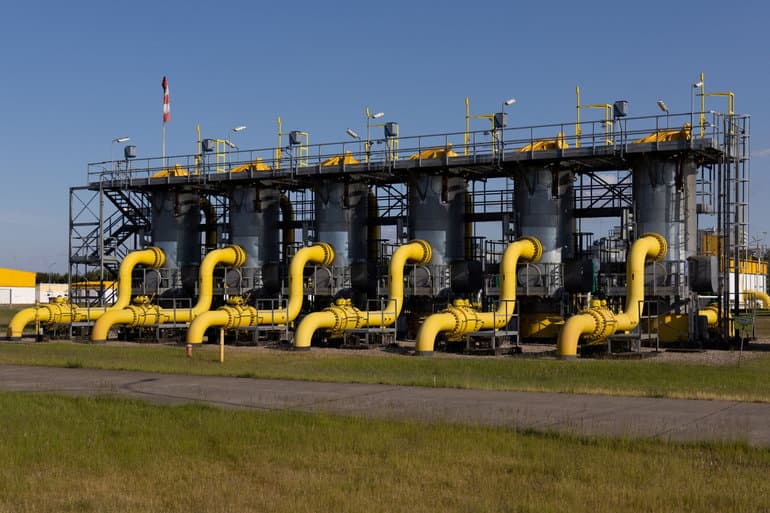
One of the markets where the Russian invasion of Ukraine has had the greatest impact is the gas market. Thus, 75 percent less gas has flowed from Russia through pipelines to Europe if you compare the first seven weeks of this year with the first seven weeks of last year.
This is shown by data from the think tank Bruegel, according to an analysis by Dansk Industri. Until the invasion, gas from Russia flowed through mainly four gas connections to Europe.
These were the Nord Stream connection in the Baltic Sea, the Yamal connection to Poland, a connection through Ukraine and Turkstream through the Black Sea. Last year, the largest of these four connections was the Nord Stream connection. Gas no longer comes here, just as the Yamal connection has also been closed.
In the first seven weeks of 2022, the Nord Stream connection, which consisted of several pipelines, accounted for around 60 percent of the import of Russian gas through the pipelines. But since the autumn of 2022, zero gas has flowed through the connections.
Gas from new destinations
In the analysis, the Confederation of Danish Industry notes that natural gas from Russia has been replaced by finding gas that is purchased from other parts of the world. For example, liquefied natural gas from the USA, Qatar and Nigeria. At the same time, Europe has managed to build up larger stocks for this winter.
- It is gratifying that it has succeeded in increasing imports from countries other than Russia. But we must also admit that it has come at a high price. The prices we saw last year on the gas market are evidence of what happens when you have to go out and find the large quantities of Russian gas elsewhere, says chief analyst at the Europa think tank, Anders Christian Overvad.
At the same time, he points out that just because Europe has come through 2022 without a major shortage of gas, it does not mean that Europe can now put the gas dispute with Russia behind it.
There were a number of circumstances present in 2022 that may not be there next year. One of the reasons was, among other things, that it was a mild winter in Europe in 2022. This resulted in a lower need for gas for heating. At the same time, Anders Christian Overvad points out that in 2022 Europe also received a helping hand from the east.
China was covered by corona shutdowns for most of the winter. Therefore, they did not have to use their gas themselves, but sold it. With the Chinese shutdowns lifted and consigned to the history books, that gas will not be left over next year.
The third circumstance is that the European countries filled their gas reserves during 2022 - but with the remaining import of gas from Russia.
- My expectation is that if things start to tighten on the European gas market, Russia will do its utmost to create panic, says Anders Christian Overvad.
Therefore, he believes that the gas situation in Europe may well remain in the headlines in the coming years.
- If we take the horror scenarios for next year as a starting point, we could well be in a shortage situation. This is a battle in the energy war that we have won against Russia. But the war is still going on. It will continue to do so for a few more years, says the chief analyst.
/ritzau/
Text, graphics, images, sound, and other content on this website are protected under copyright law. DK Medier reserves all rights to the content, including the right to exploit the content for the purpose of text and data mining, cf. Section 11b of the Copyright Act and Article 4 of the DSM Directive.
Customers with IP agreements/major customer agreements may only share Danish Offshore Industry articles internally for the purpose of handling specific cases. Sharing in connection with specific cases refers to journaling, archiving, or similar uses.
Customers with a personal subscription/login may not share Danish Offshore Industry articles with individuals who do not themselves have a personal subscription to Danish Offshore Industry.
Any deviation from the above requires written consent from DK Medier.