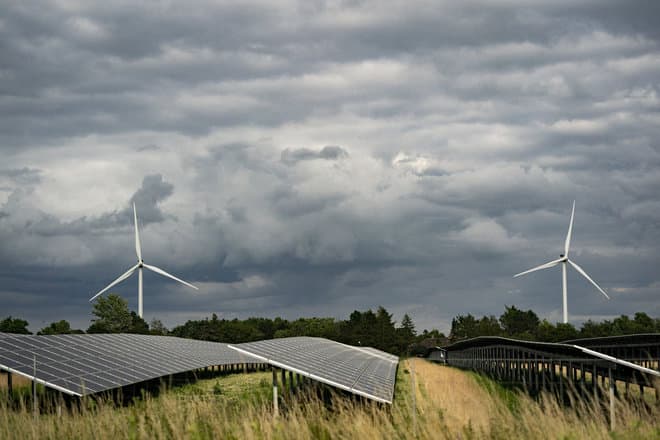
The Ministry of Urban Affairs, Land and Church Affairs was able to announce yesterday who will receive a share in the pool next year based on "new capacity and production in 2024".
Vejen and Jammerbugt will receive 22.6 and 20.2 million DKK respectively, followed by Randers, which will receive 16.1 million DKK.
Ringkøbing-Skjern, which is the municipality that produces the most green electricity in Denmark, will receive 12 million DKK.
Municipalities such as Lolland, Hostebro and Aabenraa, which are also among the municipalities with the largest production, will receive 7.5 million DKK, 5.5 million DKK and 4.1 million DKK, respectively.
It is the Jutland and Zealand municipalities in particular that will receive a share in the pool. Only two municipalities on Funen will receive a share in the pool, while no municipalities in North Zealand or the capital region are included.
- The municipalities that are best at setting up solar and wind energy on land for the benefit of all of Denmark should of course be rewarded for it, says interim Thomas Danielsen (V), who is acting as Minister for Urban and Rural Areas while Morten Dahlin (V) is on maternity leave.
Half of the subsidy will benefit municipalities with new renewable energy plants, while the other half is prioritized for municipalities that have historically contributed to the expansion of renewable energy. In the period 2031-2035, the subsidy will only be distributed based on newly connected capacity.
The new support pool was adopted in this year's economic agreement and applies for ten years from 2026 to 2035.
Money from the block subsidy
However, KL has been skeptical about the financing model behind the new pool.
It's a waste, said KL chairman Martin Damm (V) last year, when the government presented the proposal for the new renewable energy scheme in its rural development plan.
Because instead of introducing a bonus of 200 million DKK to be distributed among the greenest municipalities, the government would take the money from the municipalities' block grants.
- It's an unacceptable principle that the government is now enshrining: It has great ambitions, but is feeding the dog with its own tail. What's to stop the next ministry from having the same idea to finance its ambitions? It's a waste. We need to have a talk with the government so that we can get a model that actually has the intended effect – namely more renewable energy, said Martin Damm last year.
"This means that the money that some municipalities are to receive as a bonus must be taken from other municipalities, which then have to cut welfare," it continued in the KL press release.
In KL, people are today happy that it is being made more attractive for municipalities to set up land for renewable energy plants, but they are still not happy that it is money that is being taken from the block grant.
"It is really good that there is an incentive for the municipalities that are at the forefront of the green transition. But it is also no secret that the financing model is definitely not something that has grown in our backyard," says a written comment from the chairman of KL's Climate and Environment Committee, Johannes Lundsfryd Jensen (S).
Text, graphics, images, sound, and other content on this website are protected under copyright law. DK Medier reserves all rights to the content, including the right to exploit the content for the purpose of text and data mining, cf. Section 11b of the Copyright Act and Article 4 of the DSM Directive.
Customers with IP agreements/major customer agreements may only share Danish Offshore Industry articles internally for the purpose of handling specific cases. Sharing in connection with specific cases refers to journaling, archiving, or similar uses.
Customers with a personal subscription/login may not share Danish Offshore Industry articles with individuals who do not themselves have a personal subscription to Danish Offshore Industry.
Any deviation from the above requires written consent from DK Medier.