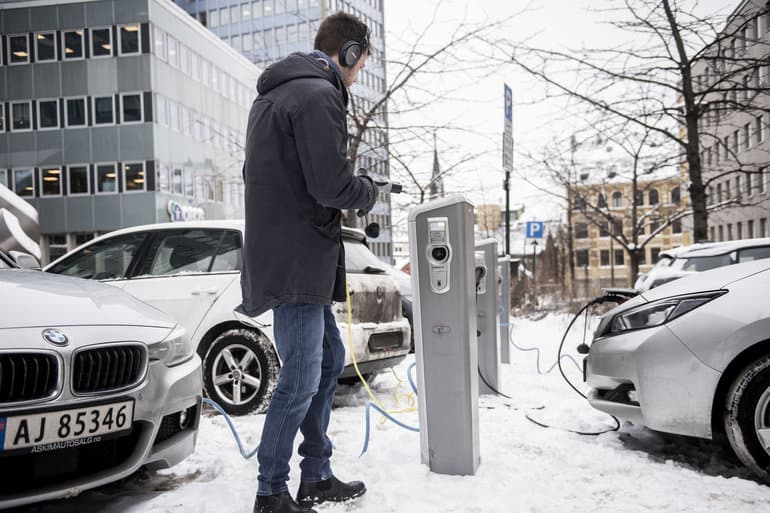
It is well known that the cold is hard on the battery and charging speed of an electric car. But in fact, how much juice and power is used up in a bend varies greatly across brands and models.
In a new study, Europe's largest motoring association, ADAC, has tested a number of models to see what percentage of range is lost in the cold when driving on the motorway. The test is simulated in a laboratory, so that the conditions are the same for all cars.
It shows that some brands lose a third, while others lose half their range compared to the standardized WLTP norm.
However, WLTP is a measure of the maximum range under optimal conditions - and therefore not what you can expect to see in reality, points out automotive technical editor Søren W. Rasmussen from the car owners' interest organization, FDM.
- It is not an expression that they are trying to cheat, but that the norm does not reflect reality perfectly, he says, referring to the fact that the test includes a lot of city driving, which does not take as much of a toll on the battery as highway driving.
That is why FDM also conducts tests itself with constant highway driving at 110 kilometers per hour.
- That is where it is interesting how far it can go. If you only drive in the city, all electric cars today can drive further than you can drive in a day. But if you drive on the motorway, you have a problem when, for example, you are going from Jutland to Zealand or vice versa.
Can decrease by 20 percent
FDM has measured the decrease in range in winter after testing a number of cars at 20 degrees and at 0 degrees.
- When we drive in winter, the range decreases as a rule of thumb by one percent every time the temperature drops by one degree. So when the temperature drops by 20 degrees, a car's range will decrease by 20 percent. So a car that can drive 400 kilometers in the summer can only drive 320 kilometers in the winter, he explains.
In the example, you can imagine that the official WLTP range is 500 kilometers, and therefore the drop will look more extreme if you compare it to that, says Søren W. Rasmussen and explains:
- It's the law of nature. It's not because they're cheating or doing anything strange.
A large part of the battery consumption goes to heating the car - both the cabin and the battery.
If you drive a gasoline car, it generates so much heat that it's no problem to warm it up.
If you're going to drive a long distance in your electric car, the car technical editor's advice is to make sure that the car starts to preheat while it's still connected to the charging station.
- Then it's warm when you get in, and the battery is still at 100 percent. In some cars, you can even set it to preheat the battery for when you have to drive at 9:00, says Søren W. Rasmussen and continues:
- If you had instead gone out to your ice-cold car and had turned on seat heating, steering wheel heating and full heating in the cabin, while it warms up the battery, then after a short time you are already down to 90 percent just getting the car ready to drive.
If you only have to drive for a short time, he suggests setting the temperature in the cabin a little lower and making do with seat heating and steering wheel heating.
/ritzau/
Text, graphics, images, sound, and other content on this website are protected under copyright law. DK Medier reserves all rights to the content, including the right to exploit the content for the purpose of text and data mining, cf. Section 11b of the Copyright Act and Article 4 of the DSM Directive.
Customers with IP agreements/major customer agreements may only share Danish Offshore Industry articles internally for the purpose of handling specific cases. Sharing in connection with specific cases refers to journaling, archiving, or similar uses.
Customers with a personal subscription/login may not share Danish Offshore Industry articles with individuals who do not themselves have a personal subscription to Danish Offshore Industry.
Any deviation from the above requires written consent from DK Medier.