Skive College has signed a cooperation agreement with the Polish Maritime University Stettin to collaborate on the competence center Centre of Vocational Excellence T-Shore Denmark. The competence center is part of a larger EU project where Denmark, together with partners in four other European countries, ensures the development of education and skills that are needed here and now.
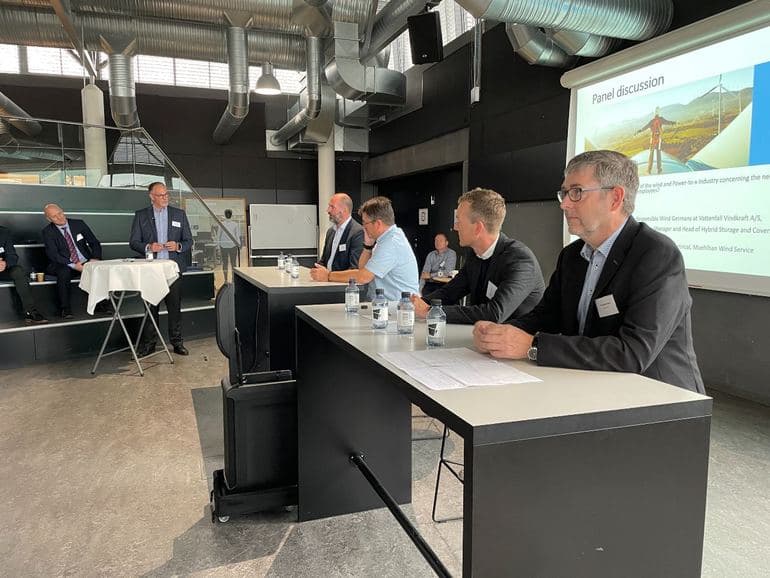
After the signatures were signed, Skive College focused sharply on the challenges that the industry sees as obstacles on the way to the green transition in a panel debate. Recruitment is a hurdle that must be solved, and there is a massive need for people if the green transition is to be successful.
- We are looking into a future where there is a need for 45,000 extra workers per year. We have a huge challenge in finding those people. Already now, 48 percent of our members, that there are projects that cannot be launched because they lack people, says Rune Ratschach Andersen.
This is something that one of the other participants in the debate knows all about.
- It is difficult to find employees with skills, especially within the high-voltage area. We have an option, which is to hire people and upskill them ourselves with training. The market is simply empty of qualified people, says Svend Brogaard, head of business unit hv & electrical at Muehlhan Wind Service.
Another challenge is a development that means that wind turbine specialists are increasingly not at home with their families every evening. It is a development that Svend Brogaard can describe very specifically.
- When I started at Bonus many years ago, the requirement was that a technician had to have 130 travel days per year. Today the requirement is 300 days, and it is difficult to make a family life work with so many working days, says Svend Brogaard.
What are today's young people like?
Here one of the professionals among the participants seizes the opportunity and asks the debate moderator, Skives College's head of education Kurt Lindholm, how to get more young people to work abroad. But the head of education's answer is not rosy for an industry that wants to send its employees on long-distance trips.
- Young people want flexibility, and they want to work six to eight hours a day and then be with family and friends in the evening. It is a flexibility that they want to have for the next decade. They don't want to be in Taiwan, says Kurt Lindholm and asks a question to a perhaps slightly surprised audience:
- How do we get young people to want the adventure of traveling and working when they would rather be at home with their friends?
Again, there is input from an audience member who puts a completely different idea on the table.
- When doctors at Odense University Hospital can operate on hearts remotely with a doctor sitting at home behind a computer, why can't the wind industry repair wind turbines remotely, asks the audience member.
What initially sounds difficult or downright impossible is taken very seriously.
- We should be open to all possibilities, and you may have a point. But we are in a reality where the OEMs do not make money, and such a solution would be expensive to implement, says Svend Brogaard.
Very few hydrogen specialists
But there are far more problems with recruitment when a future with hydrogen and PtX is to be solved.
- We only have 50 specialists working with hydrogen in Denmark at the moment. Previously, we could recruit in the oil and gas industry, but after the price of oil has gone up, we can no longer get employees there. At the same time, we are working with new wind turbines that can produce hydrogen directly in the turbines offshore, so that hydrogen can come ashore in pipelines, says Finn Daugaard Madsen, who is innovation manager and head of hybrid storage and coversion at Siemens Gamesa Renewable Energy A/S and elaborates on what is needed:
- We need engineers who started as craftsmen, so that they understand the size of what they are working with. We are now at a point where the bolts are so big that a man cannot lift them. Imagine how big a wrench you need for such a bolt. That is why we need craftsmen who are really good at some things. They need to be like a Swiss Army knife, where a large blade is the main competence.
The fact that the industry is competing for the same people has a big effect in several ways.
- We end up stealing employees from each other, and then the salaries just go up, says the last participant of the panel, Claus Lykke, who is high voltage responsible at Wind Germany, which is part of Vattenfall Vindkraft A/S.
Education is the only way forward for the industry, and we need to think unconventionally.
- We need to send the baker to training so that he becomes a wind engineer. I'm close to saying that it's about to explode in our hands otherwise with the current situation, says Finn Daugaard Madsen, before the discussion ends.
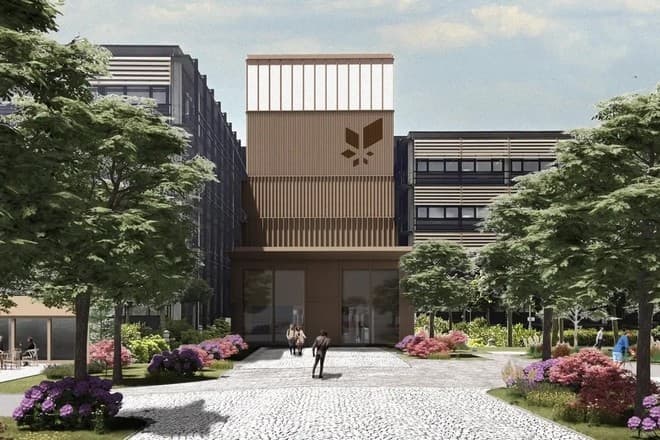
Shortly afterwards, Skive College's development manager Jens Høffner talks about the upcoming expansions in connection with the planned competence center, where work will be done with high-voltage systems, switchers for wind turbines and PtX. Now the educational institution must have found the funds, and there is no doubt that it can hardly go fast enough after the debate.
Text, graphics, images, sound, and other content on this website are protected under copyright law. DK Medier reserves all rights to the content, including the right to exploit the content for the purpose of text and data mining, cf. Section 11b of the Copyright Act and Article 4 of the DSM Directive.
Customers with IP agreements/major customer agreements may only share Danish Offshore Industry articles internally for the purpose of handling specific cases. Sharing in connection with specific cases refers to journaling, archiving, or similar uses.
Customers with a personal subscription/login may not share Danish Offshore Industry articles with individuals who do not themselves have a personal subscription to Danish Offshore Industry.
Any deviation from the above requires written consent from DK Medier.