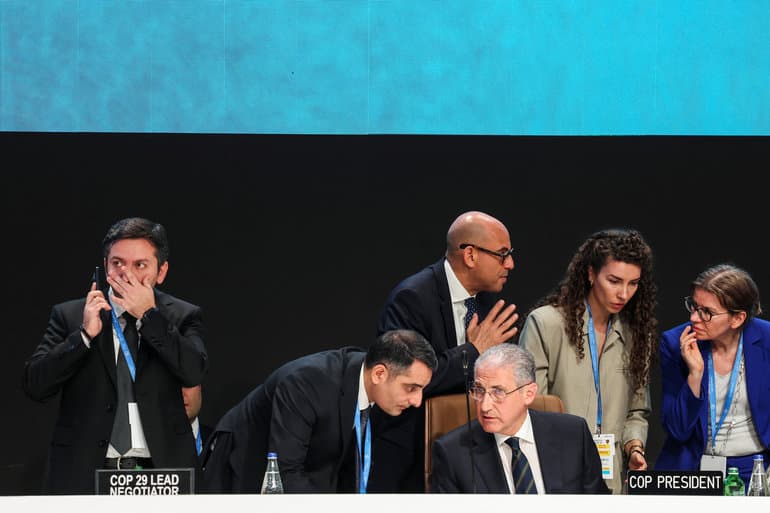
After tough negotiations, the world's countries have adopted a new target for how much money developing countries should have for their climate fight. By 2035, the amount must reach at least 300 billion dollars per year. This corresponds to 2.1 trillion kroner - or 2100 billion kroner. This was decided on Sunday night local time at the UN climate summit in Baku, Azerbaijan.
The target replaces the previous target from 2009 of 100 billion dollars per year. It is the rich countries, which are a small group in the UN system, as the definition dates from the 1990s, that must take the lead in mobilizing from public and private sources.
A declared goal for the EU countries and Denmark was therefore to expand the group, and the agreement also encourages developing countries to contribute to achieving the target. But it is also emphasized that nothing in the text changes the status that the countries have now, which means that rich countries such as China and Saudi Arabia do not have to pay.
There could potentially be even more money that developing countries will have. The agreement calls on all countries to cooperate to increase total climate financing to at least 1.3 trillion dollars per year, and a roadmap must be drawn up to make it happen.
That was the amount that the developing countries had demanded, and which a report from a group of experts under the UN during the summit mentioned as necessary. But it is only a call and not an obligation.
Conflict-filled negotiation process
The agreement will land at 2:39 a.m. in Baku on Sunday night. This is the culmination of a conflict-filled negotiation process, where the risk of collapse without an agreement for a long time looked realistic.
During Saturday, the most vulnerable countries walked out of the negotiations amid major protests that the West's offer was too small.
At the same time, the EU in particular was deeply dissatisfied with the fact that it seemed impossible to get a plan and timeframe for new CO2 reductions adopted in the run-up to the next climate summit. The two issues had the potential to cause the summit to collapse.
But late at night, the EU, the US, the group of the most climate-vulnerable countries and the island states managed to agree on a version. It was taken forward to the rest of the summit with harsh words that it was a final offer.
A few hours later, the final agreement was reached, and it is largely based on the late alliance between the West and vulnerable countries.
NGOs: Far from sufficient
Although the countries have reached the agreement by consensus, according to NGOs, it is far from sufficient.
- The agreement is a failure. The target of $300 billion in climate aid is far too low in relation to the need, and it will not be paid for until 10 years later - all the while the climate crisis is escalating, says John Nordbo, climate advisor at the NGO Care and a long-time observer of climate summits.
The International Cooperation is also critical.
- COP29 ended with an agreement, but the price is a broken trust between the world's poorest and richest countries, and a missed opportunity to deliver a climate agreement that truly ensures green transition and the ability to handle the new climate in the most vulnerable countries, says Katrine Ehnhuus, senior advisor at the International Cooperation.
FACTS: Targets for climate aid are being increased with the new COP agreement
It took more than 32 hours of overtime, but in the end COP President Mukhtar Babayev dropped the hammer at the UN climate summit in Azerbaijan. A new climate finance target was agreed - although not everyone was satisfied.
Here you can find out more about the new target:
- By 2035, climate aid to developing countries must be at least 300 billion dollars - 2100 billion DKK - per year for their climate fight.
- The rich countries must take the lead in mobilizing the amount.
- It must come from both public and private sources and can come in the form of outright grants, investments or loans.
- How the money comes is of great importance to developing countries, as they may end up having to pay interest if it is a loan.
- This therefore affects the state budget, and it is far from always the case that the loans are better than those that can be obtained from the market.
- It has been very difficult for the parties to reach an agreement on an amount, and some countries also expressed great dissatisfaction with the agreement.
- The new goal is much higher than the goal today, but since it will not be reached until 11 years later, inflation may erode purchasing power.
- The agreement also calls on all countries to contribute to ensuring that the mobilized amount is significantly higher. - at least 1.3 trillion dollars - by 2035.
- However, this is not an obligation, and all contributions are counted here.
- To make this happen, it has also been agreed that a roadmap for how climate financing will be scaled up must be looked at.
- It has been an important point for Denmark and the EU that the donor circle is expanded, as it consists of few countries, because it was decided back in the 90s.
- This means that countries such as China and Saudi Arabia, which are large today, are not obliged to contribute. However, they can easily do so anyway.
- The agreement emphasizes that it does not change the status of the various countries in the UN system.
Sources: UNFCCC.
/ritzau/
Text, graphics, images, sound, and other content on this website are protected under copyright law. DK Medier reserves all rights to the content, including the right to exploit the content for the purpose of text and data mining, cf. Section 11b of the Copyright Act and Article 4 of the DSM Directive.
Customers with IP agreements/major customer agreements may only share Danish Offshore Industry articles internally for the purpose of handling specific cases. Sharing in connection with specific cases refers to journaling, archiving, or similar uses.
Customers with a personal subscription/login may not share Danish Offshore Industry articles with individuals who do not themselves have a personal subscription to Danish Offshore Industry.
Any deviation from the above requires written consent from DK Medier.