
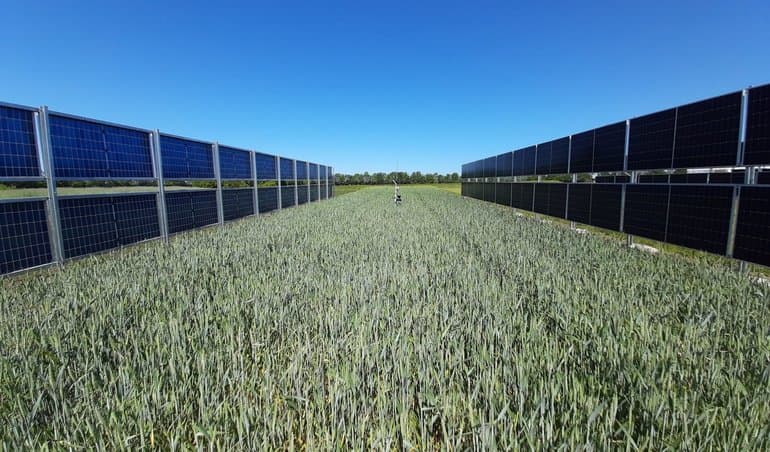
A field experiment from Aarhus University shows that vertical, bifacial solar cells can produce electricity in the middle of grain and clover fields.
Without compromising agricultural yields.
The east-west oriented panels deliver electricity at times when electricity consumption peaks, and at the same time require less area and materials than traditional solar parks.
- Our measurements show that wheat and clover grass grow just as well between the vertical solar panels as in open fields. At the same time, the panels produce electricity in a way that better matches electricity consumption in Denmark. That's a double benefit, explains Marta Victoria, lead author of the study and associate professor at the Department of Mechanical Engineering and Production, Aarhus University.
More benefits
The researchers also point out that the solar cells only take up about ten percent of the field. If electricity and food were to be produced separately, it would require up to a quarter more land.
The model also shows advantages on the climate and resource front.
The vertical panels are lighter, require fewer materials and have a lower CO? footprint than conventional systems. At the same time, the construction provides less wind resistance and protects the plants, which, according to the experiments, adapt without loss of yield.
- They (the plants, ed.) do not notice that there are solar panels in the field, and they like the protection from the wind,” says Professor Uffe Jørgensen from Aarhus University's Department of Agroecology.
Greater support
The visual impact on the landscape also appears to be less than feared.
In a VR experiment, citizens assessed that the vertical solar cells fit better into the agrarian environment and appear more like modern windbreaks than technical interventions.
Overall, the system scored higher in both experience and acceptance than traditional solar parks, and the researchers hope that the results can inspire a new way of thinking about energy placement in Europe.
ap
Text, graphics, images, sound, and other content on this website are protected under copyright law. DK Medier reserves all rights to the content, including the right to exploit the content for the purpose of text and data mining, cf. Section 11b of the Copyright Act and Article 4 of the DSM Directive.
Customers with IP agreements/major customer agreements may only share Danish Offshore Industry articles internally for the purpose of handling specific cases. Sharing in connection with specific cases refers to journaling, archiving, or similar uses.
Customers with a personal subscription/login may not share Danish Offshore Industry articles with individuals who do not themselves have a personal subscription to Danish Offshore Industry.
Any deviation from the above requires written consent from DK Medier.