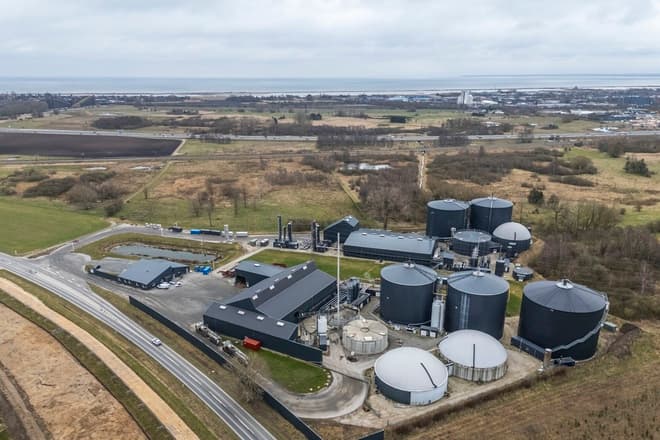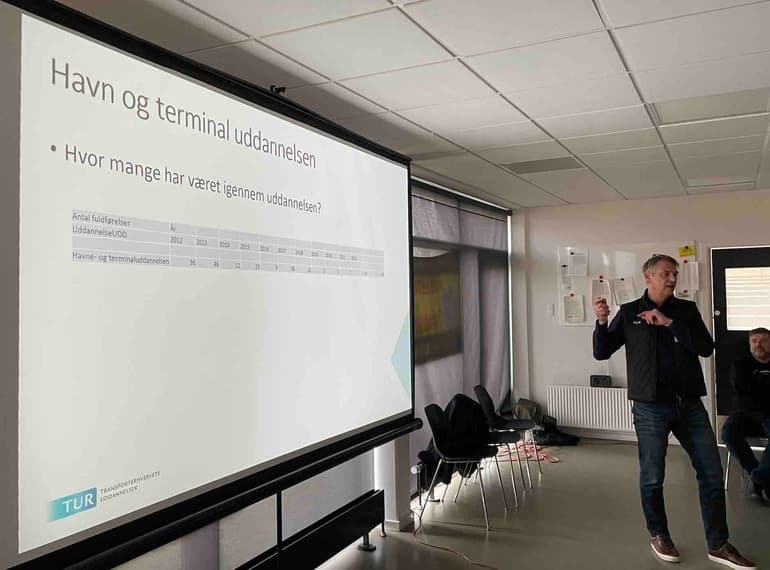
Esbjerg is the world's largest shipping port for wind turbines, and the work of handling blades, towers and nacelles requires trained labor. This much is clear after Thursday's conference for the Port and Terminal Training, which took place in the so-called Muster House at the Port of Esbjerg.
The port workers are day laborers who report in at 7 a.m., 10 a.m. or 1 p.m. - this is where the day's work is distributed. Qualifications play a big role here, because a driver's license, forklift license and crane operator's license are highly sought-after competencies. That is why the vocational training (EUD) for port and terminal workers was established in 2012. Now 12 years later, one woman is starting the training. She will be the first woman to receive the education when she finishes.
Esbjerg is the center of the education, and regardless of whether you come from Kalundborg or Copenhagen, there is no way around AMU Vest, although some modules can be taken at other AMU centers during the education.
Enormous interest in the conference
The organizers of the conference had hoped for 20 or at most 30 participants - but expectations were disappointed, and all 60 available places were filled.
- It has become a much larger conference than expected. This clearly shows the need to get young people into this education, said Jan Larsen, who is an internship consultant at the Danish Transport Industry Education (TUR), which also includes havne- og terminalarbejderuddannelsen.
One of the speakers, perhaps even the most important Esbjerg Port Director Dennis Jul Pedersen, had canceled because he was hospitalized after feeling unwell on Wednesday. However, several participants in the conference reported text message contact with the port director, who is popular and respected both among the port workers and the trade unions. The port director was, however, present in a video about the education.
- As Dennis just said, Esbjerg is number one in the world in shipping offshore wind turbines. We are because we have competent and educated labor. Our port is number one because we have a collective agreement and qualified and educated people, otherwise we wouldn't be here today, said the local 3F chairman Jakob Lykke, who also had a warning:
- If we don't continue to educate, others will take over the work in five and ten years.
The union representative had recently returned from Australia, where he had been to a meeting with other unions for dock workers from all over the world. And he sees differences in Esbjerg compared to the rest of the world.
- We are talking to Siemens Gamesa and Vestas, so we know their needs. That's why we're in the super league here in Esbjerg, said Lykke.
Young people must take the training
Education consultant Michael Ørum Henriksen from Transporterhvervets Uddannelser (TUR) painted a clear picture of who takes the training.
- They're all men, and they're over 25 years old, he said.
Here the 3F chairman came with a message to all parents.
- We need to be better at talking about this training and the work as a dock worker, so that our children also choose this training, said Jakob Lykke.
Easy to get started
Department manager John Møller Jensen from AMU Vest in Esbjerg also made it clear that it takes a lot to get young people in.
- We need to increase to 12-15 apprentices to create a study environment among the young people, says John Møller Jensen, who is doing his part to attract more people to the program:
- We offer boarding schools for young people here in Esbjerg, and the older ones are sent to Ribe.
But there is the possibility of taking parts of the program at the other AMU centers where you live.
- It is typically eight to ten weeks for adults in Esbjerg. We do what we can to make it easier for those who come far from Esbjerg, he says.
Here, you should also not hold back if you have problems with your academic knowledge.
- I have not yet experienced anyone with challenges such as dyslexia or bad school experiences who has not completed the program, says John Møller Jensen.
Text, graphics, images, sound, and other content on this website are protected under copyright law. DK Medier reserves all rights to the content, including the right to exploit the content for the purpose of text and data mining, cf. Section 11b of the Copyright Act and Article 4 of the DSM Directive.
Customers with IP agreements/major customer agreements may only share Danish Offshore Industry articles internally for the purpose of handling specific cases. Sharing in connection with specific cases refers to journaling, archiving, or similar uses.
Customers with a personal subscription/login may not share Danish Offshore Industry articles with individuals who do not themselves have a personal subscription to Danish Offshore Industry.
Any deviation from the above requires written consent from DK Medier.