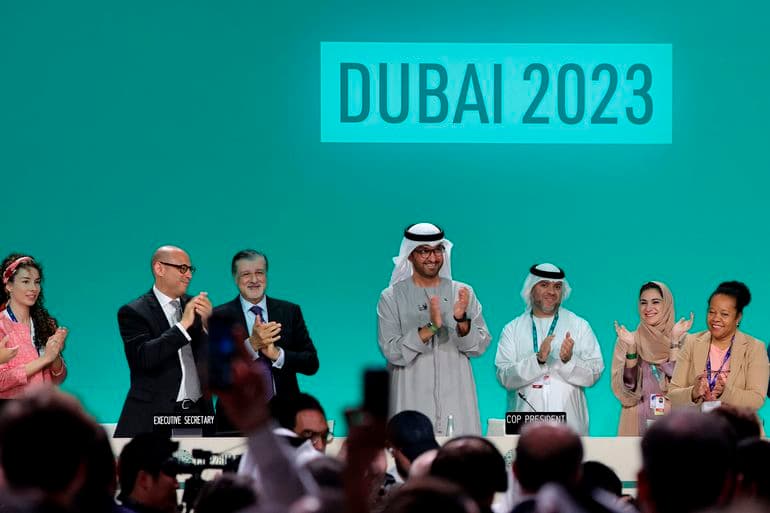
UPDATED 9:30: History was made on Wednesday when COP President Sultan al-Jaber was able to slam the gavel on the table shortly after 11 a.m. local time in Dubai.
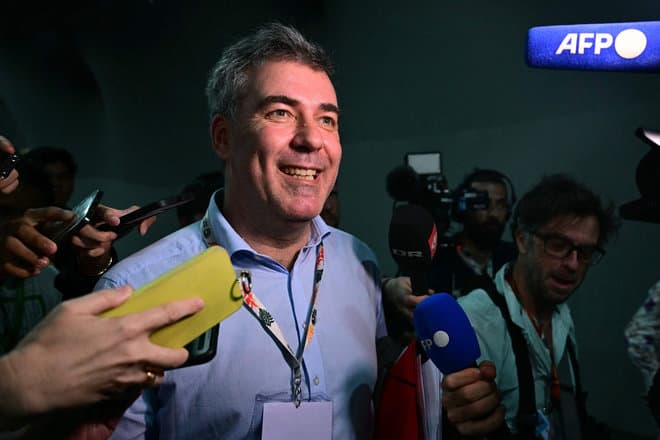
Here, the first COP agreement was adopted that mentions fossil fuels, which Denmark, the EU and small island states have fought hard to include. According to Minister for Global Climate Policy Dan Jørgensen (S), it is a historic agreement that has now been presented.
- For the first time ever, we have not only mentioned fossil fuels, but now we as a global community have agreed to move away from them, he says.
Coal has previously been mentioned in a COP agreement, but this is the first time that fossil fuels as a whole have been mentioned. However, it was not a phase-out, which has otherwise been the declared goal for Denmark and other actors, that ended up in the agreement.
Instead, the words are a "transition away from fossil fuels in energy systems" to ensure net-zero emissions by 2050. However, this is not something that the countries are obligated to do.
The preamble states that there is a call for the countries to contribute to the climate policy actions mentioned in the agreement. They also include a tripling of renewable energy and a doubling of energy efficiency by 2030, which have been among the key Danish priorities. The climate measures must be taken taking into account the different circumstances and measures that exist and are used in the countries.
- From the bottom of my heart: thank you, said COP President Sultan al-Jaber.
- We have traveled a long way together in a short time. Over the past two weeks, we have worked very hard to secure a better future for our people and our planet. We should be proud of our historic achievements, he said from the stage.
Great disagreement has characterized negotiations
There has been great disagreement among the almost 200 countries about whether the future of fossil fuels should be addressed in the agreement. Denmark, the EU, the USA and small island states have believed that this should be done, but countries such as Saudi Arabia and Kuwait have opposed it. But after lengthy negotiations, a compromise was reached.
The agreement was adopted in any case, but it apparently happened without Samoa being in the room, which annoys the island state. This is not the first time that there is elasticity in the concept of consensus. In 2015, when the Paris Agreement was adopted, concerns from Nicaragua were ignored by the COP president, before and after the agreement was adopted.
The agreement is to form the basis for the world's countries to update their national climate plans - what are called NDCs. This is to happen over the coming years. The EU as a whole has an NDC, which we in Denmark are part of.
The climate summit lasted 13 days, and although the presidency was able to celebrate a victory on the first day, tough negotiations took place.
A fund for losses and damages from climate change to poorer countries was adopted here, after it was decided last year. However, there has been criticism that many countries contributed lump sums to it - which according to studies are not enough - that it is not replenished on an ongoing basis, and that it is not new money, but comes from, for example, development aid.
/ritzau/
Text, graphics, images, sound, and other content on this website are protected under copyright law. DK Medier reserves all rights to the content, including the right to exploit the content for the purpose of text and data mining, cf. Section 11b of the Copyright Act and Article 4 of the DSM Directive.
Customers with IP agreements/major customer agreements may only share Danish Offshore Industry articles internally for the purpose of handling specific cases. Sharing in connection with specific cases refers to journaling, archiving, or similar uses.
Customers with a personal subscription/login may not share Danish Offshore Industry articles with individuals who do not themselves have a personal subscription to Danish Offshore Industry.
Any deviation from the above requires written consent from DK Medier.