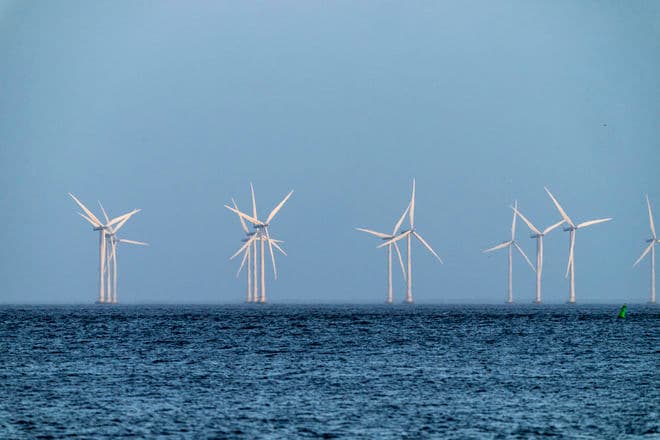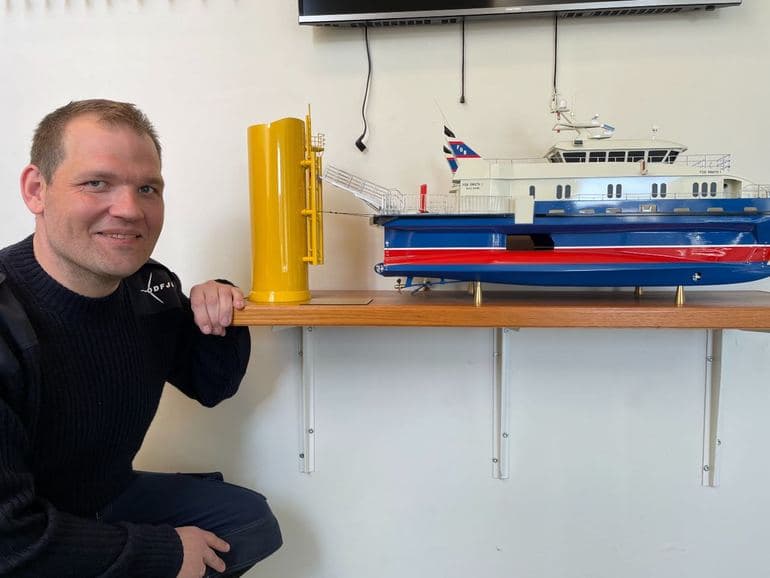

Crew Transport Vessels or CTVs, as they are called, are a large part of offshore wind farms, as employees have to be transported back and forth from land and offshore. This applies both when the turbines are to be kept in operation, but also during the construction phase.
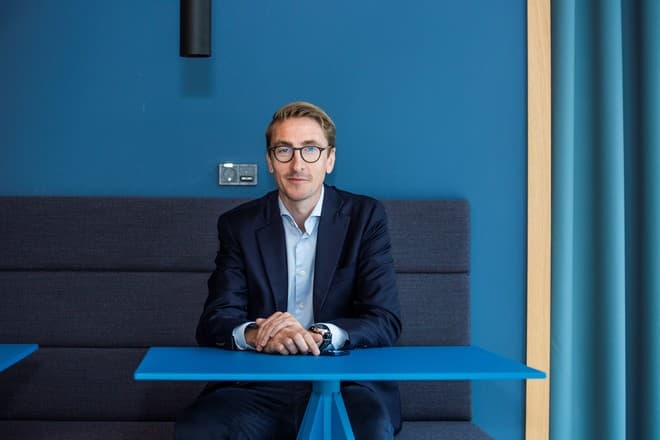
Offshore Windservice in Thyborøn, which is part of the Norwegian Odfjell, works with its ten CTVs primarily with transport to the turbines during the construction phase. The company, which is based in Thyborøn, with its 75 employed seafarers and five administrative staff. One of them is CEO Billy T. Kristensen, who would like to give an insight into the current situation in the industry, where one thing always comes first.
- Our goal is to be able to make a safe transfer, and we can do this up to a significant wave height of two meters, explains the director.
While there are cheaper CTVs that are produced in Asia and transported to Europe by the meter, Offshore Windservice has CTVs that are produced in Denmark and Norway. Six of Offshore Windservices CTVs FOB SWATH 2-7 are thus built at Dansk Yacht in Skagen, while the last four FOB SWATH 1 at Måløy shipyard in Norway. Offshore Windsservice CTVs are twice as expensive as the Asian ones, and it's not a small amount, the Asian CTVs already cost a double-digit million.
- Our CTVs are much more complicated to build because they can stay out 24 hours a day. The crew can sleep on board, and that makes our CTVs much more complicated to build compared to those from Asia, says Billy T. Kristensen.
But it is also a competitive advantage to have the opportunity for the crew to stay out at the wind turbines for longer.
- Offshore wind farms are getting further and further from land, and we have the advantage that our CTVs can stay out for longer. They don't have to go back to land every night, and that is a clear advantage. But because our CTVs are more expensive and more complicated to build, we are also more expensive, he says.
The green future
How the market will develop when the major expansion of wind comes is something that the director is following closely. There are a number of considerations related to whether more CTVs should be ordered and whether the fleet should be expanded.
- Now everything is going green. Here I am thinking both about the entire expansion of offshore wind, but also what fuel we will use. All our ships have been upgraded to be able to sail on HVO, but it is too expensive for our customers, so we sail on regular bunker oil, says Billy T. Kristensen.
HVO is biodiesel that has almost the same properties as diesel oil.
- Why not make HVO more attractive when it already exists, even though you would have to have a diesel source available in the future as well, says Billy T. Kristensen.
The very problem with which type of fuel to choose is also why Offshore Windservice is waiting to order new vessels.
- We have looked at both batteries and hydrogen, but with hydrogen we would have to have the entire ship filled with hydrogen cylinders because we cannot freeze the hydrogen down to minus 200 degrees, he says and elaborates:
- Our contracts are not signed until the end of the year, so we know relatively late what we are going to do next year, even though there are advance agreements. We are looking at new buildings, but it is difficult when you do not know what to choose. For example, work is already underway to create charging stations out by the turbines, so that we can charge out there, says Billy T. Kristensen.
He also believes that we could start by making it more attractive for ships to use shore power systems when they are in port.
- Take a look around the ships here in Thyborøn Port. Everyone uses their generators instead of using shore power systems. They do it because it is much cheaper to use their diesel generators than to buy shore power in the port, says Billy T. Kristensen, who does not want to get involved in the political discussion about whether there should be laws requiring the use of shore power systems in the ports, otherwise shore power must be made cheaper and thus more attractive for ships to buy.
Work of the year
Right now, Offshore Windservices CTVs are working abroad in Europe, and soon in Denmark as well.
- As I said, our work is mainly in the construction phases, and this year we have three ships in France, three ships in the Netherlands and two in Scotland. Later we will start first with Vesterhav Syd and then Nord. Our work is primarily done during the summer months, says Billy T. Kristensen.
While many companies in the wind turbine industry are looking at 2023 as a difficult year, it is not like that for the shipping company.
- We have a lot of activity now for the summer, which indicates that it will be a quiet year next year. But when we get to 2025 and 2026, things will pick up again, he says with conviction in his voice.
Offshores Windservices seafarers work for four weeks at a time, after which they have four weeks off. You would think that the crew members come from Thyborøn, but very few do.
- We have employees from all over Denmark and also the Faroe Islands, but there are only two employees who come from Thyborøn. They have both been fishing skippers. There are relatively few fishermen because they have to have the commercial part included in order to work with us. If the training for fishermen included the ability to sail merchant ships, we would have more of them, says Billy T. Kristensen.
Recruitment looks difficult in the coming years.
- It is really difficult to find qualified personnel such as navigators and people with engine experience. We have a lot of permanent staff and little turnover, says the director, who is good at keeping his employees for a long time.
Text, graphics, images, sound, and other content on this website are protected under copyright law. DK Medier reserves all rights to the content, including the right to exploit the content for the purpose of text and data mining, cf. Section 11b of the Copyright Act and Article 4 of the DSM Directive.
Customers with IP agreements/major customer agreements may only share Danish Offshore Industry articles internally for the purpose of handling specific cases. Sharing in connection with specific cases refers to journaling, archiving, or similar uses.
Customers with a personal subscription/login may not share Danish Offshore Industry articles with individuals who do not themselves have a personal subscription to Danish Offshore Industry.
Any deviation from the above requires written consent from DK Medier.