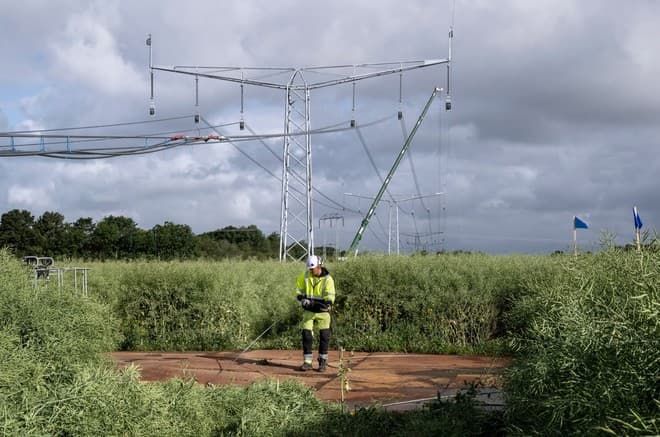
These days, Energinet is in the process of commissioning the West Coast Link - an approximately 170 km long 400 kV connection along the West Coast - from the Danish-German border to Idomlund near Holstebro. However, according to Energinet, the connection will not be sufficient if electricity consumption increases sharply as expected. Energinet states this in a press release.
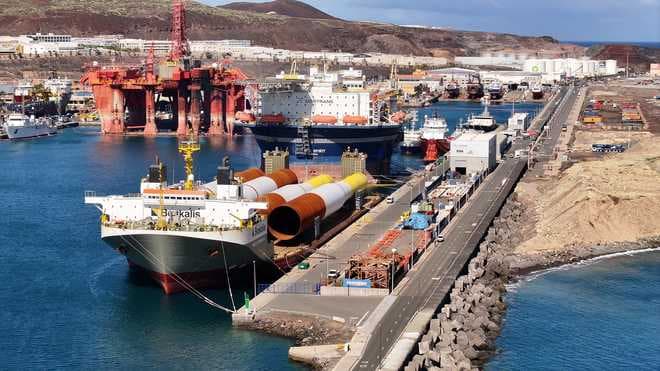
In the Esbjerg area alone, future companies could have a total maximum electricity consumption of up to 8 GW. In comparison, the total Danish electricity consumption currently peaks at around 7 GW.
New data centres, hydrogen production and other electricity-intensive industries are also being planned around the country. A planned data centre in Guldborgsund Municipality, for example, could have an electricity consumption that is six times greater than the municipality's current maximum electricity consumption.
If electricity consumption in the Esbjerg area grows as much as some forecasts indicate, it may require three or four new 400 kV double systems across Jutland. But such connections also raise questions and dilemmas.
Despite a construction time of around two years, the West Coast Connection has been almost 11 years in the making. The project has been the subject of extensive debate and criticism, partly because the large electricity pylons and overhead lines affect neighbours and local communities.
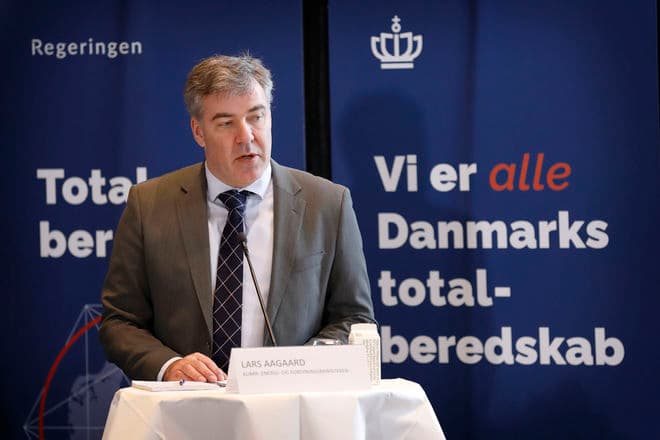
-We must cooperate, as much as we can, to make green transition and local growth happen. But we must also dare to ask ourselves the question along the way: Is there a will – nationally, locally and among individual landowners – to build, for example, 3-4 new West Coast Connections up and across Jutland to ensure new supply in the Esbjerg area. We will have to discuss this with each other, says Kim Willerslev Jakobsen, Director of Energinet Systemansvar.
According to Energinet, part of the solution may be to place electricity production closer to large electricity consumers to a greater extent. When production and consumption are co-located – both geographically and in time – the need to transport very large amounts of electricity over long distances can be reduced.
Need for more risk-taking
But in order for the new electricity connections to be delivered on time, there is also a need for changes in the approach from Energinet itself. Today, Energinet must have a certain degree of certainty that, for example, new large consumers will actually settle in a specific location before the electricity grid can be expanded – often for investments of several billion DKK. The security guarantees will have to be regulated in the future.
- Electrification is a megatrend that is here to stay, and we must support it with a faster expansion of the electricity grid. Overall, it is difficult to overinvest in the electricity grid, although it is not a simple matter to determine exactly where the electricity grid should be expanded the most. In Energinet, we will therefore in the future decide to a greater extent on expansion projects that create a significant reinforcement of the electricity grid – also knowing that some production or consumption projects risk not coming to fruition. In short, we will be more risk-averse, says Kim Willerslev Jakobsen, Director of Energinet System Responsibility.
At the same time, Energinet is working to prioritize the most mature projects. A new prioritization model means that projects that are the longest in the planning and require the least expansion of the electricity grid will be first in line to be assessed for connection to the transmission grid.
In addition, Energinet is working more closely with the grid companies to map the capacity in the transition between the transmission grid and the local distribution grids with a view to freeing up as much capacity as possible for companies that are in the process of electrifying their production.
Text, graphics, images, sound, and other content on this website are protected under copyright law. DK Medier reserves all rights to the content, including the right to exploit the content for the purpose of text and data mining, cf. Section 11b of the Copyright Act and Article 4 of the DSM Directive.
Customers with IP agreements/major customer agreements may only share Danish Offshore Industry articles internally for the purpose of handling specific cases. Sharing in connection with specific cases refers to journaling, archiving, or similar uses.
Customers with a personal subscription/login may not share Danish Offshore Industry articles with individuals who do not themselves have a personal subscription to Danish Offshore Industry.
Any deviation from the above requires written consent from DK Medier.