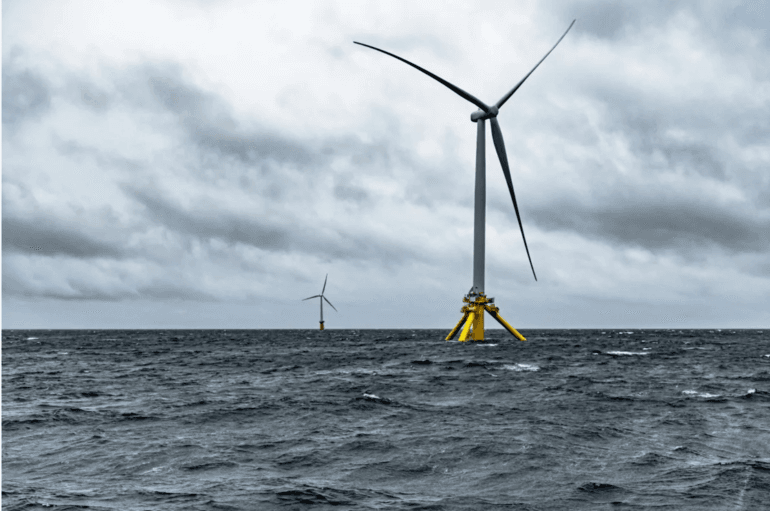
Developments in floating offshore wind are still making important progress, but at a slower pace than expected. This is one of the conclusions of the new Floating Wind Survey 2025 from the analysis company Westwood, where 166 players in the floating offshore wind sector were asked about their expectations.
Among the most striking results is that optimism among developers has plummeted since last year.
Although new concessions of 9.8 GW were awarded in 2024 and tenders launched for up to 11.7 GW, the industry expects only under 3 GW of global capacity by 2030. In comparison, previous estimates have been more than twice as high.
The forecasts for 2040 are still optimistic, but here too expectations have become more spread.
In the survey, developers, subcontractors and other stakeholders are asked about their expectations for floating offshore wind compared to two years ago.
Here, 44 percent of developers were more optimistic last year than two years ago, while now only 15 percent of developers are more optimistic about floating offshore wind than two years earlier. Conversely, the proportion of those who are less optimistic than before has increased from 25 percent last year to 63 percent.
The same trend applies among subcontractors. Here, the proportion of more optimistic stakeholders has decreased from 23 percent to 19 percent, while the proportion of more pessimistic ones has increased from 47 percent to 57 percent.
Europe maintains its leading position
Europe and Asia (especially South Korea and Japan) maintain their positions as key markets of the future, while the US lags behind, mainly due to political setbacks in the US.
In Europe, more than 60 percent of respondents expect to have connected between 0.5 and 2 GW of floating offshore wind by 2030, but just under 15 percent believe that Europe will reach 3-5 GW.
In 2040, well over half of those surveyed believe that more than 6 GW of installed floating offshore wind will be reached.
The study also concludes that floating offshore wind should be treated as a separate category in policy support schemes. A general wish from the industry is for governments to establish dedicated support programs and long-term procurement strategies that match the technology's development curve.
At the same time, there is a demand for increased cooperation internally in the industry regarding sharing experiences and standardizing platform types - something that several Danish players are already active in.
The IEA has previously emphasized in reports the need for floating offshore wind to also become part of the energy mix from offshore wind, as the technology significantly expands the market in relation to possible locations where it is otherwise not possible to install fixed offshore wind turbines.
Last year, CIP became a co-owner of Stiesdal Offshore, where one of the goals of the partnership was to establish Stiesdal Offshore as a long-term leader in floating wind energy.
Text, graphics, images, sound, and other content on this website are protected under copyright law. DK Medier reserves all rights to the content, including the right to exploit the content for the purpose of text and data mining, cf. Section 11b of the Copyright Act and Article 4 of the DSM Directive.
Customers with IP agreements/major customer agreements may only share Danish Offshore Industry articles internally for the purpose of handling specific cases. Sharing in connection with specific cases refers to journaling, archiving, or similar uses.
Customers with a personal subscription/login may not share Danish Offshore Industry articles with individuals who do not themselves have a personal subscription to Danish Offshore Industry.
Any deviation from the above requires written consent from DK Medier.