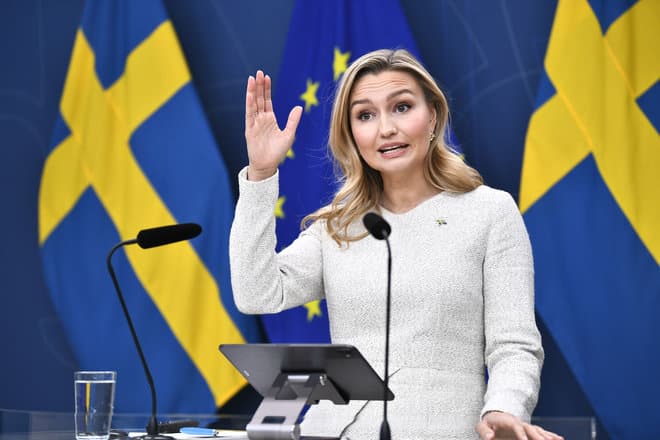



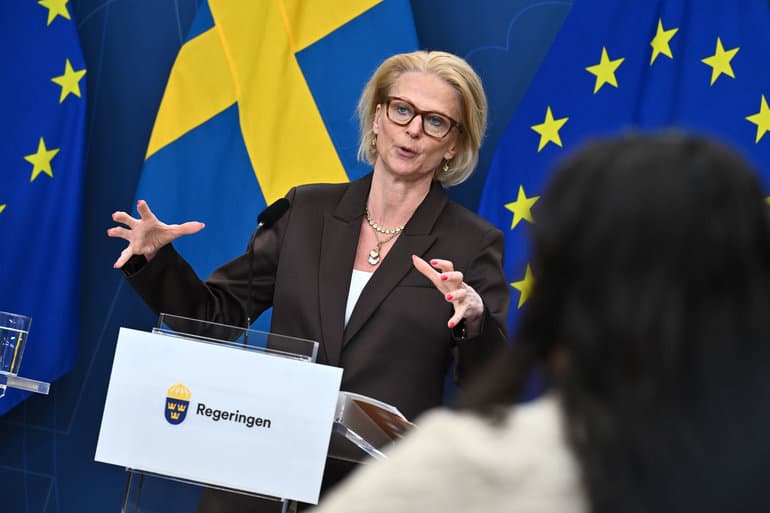
The Swedish government is presenting a crisis package of 17.5 billion Swedish kronor, equivalent to 12 billion Danish kronor. One of the measures in the crisis package is to further reduce taxes on gasoline and diesel. This is reported by the Swedish news agency TT.
This is planned to take place for five months - namely from July to November - and is expected to cost the treasury eight billion Swedish kronor. The measure is expected to result in reduced prices of three Swedish kronor per liter, when compared to what the price would otherwise have been. The package is a response to the global energy crisis.
- The reason we are doing this is, of course, that the war in Iran is affecting Sweden and the Swedes' economy. It is also the worst global energy crisis we have seen, says Sweden's Finance Minister, Elisabeth Svantesson, to TT.
- Even if the war ends tomorrow, it will have economic consequences for a long time, the Swedish minister continues.
During the war in the Middle East, prices for gasoline and jet fuel, among other things, have risen sharply.
Support for cheaper public transport is also part of the package. Among the government parties, it has also been discussed to support agriculture, among other things, due to higher prices for fertilizer - and aviation. However, this has not been presented on Wednesday. All the measures are temporary, writes TT.
A large number of countries around the world are trying to reduce the costs of the energy crisis for consumers and companies with various forms of support and reduced taxes. The EU has also announced that it will temporarily allow governments to spend more money on support for companies hit by the crisis.
IMF has warned against lower taxes
In April, the International Monetary Fund (IMF) warned European countries against lowering fuel taxes in response to rising energy prices as a result of the war in the Middle East.
- When energy prices rise and this hurts people and companies, politicians feel pressure to act, wrote the IMF.
- The temptation is to stop price increases by using price caps, universal compensation or reducing fuel taxes. These are unwise measures, it said.
The IMF explained the call by saying that higher prices are a signal to consume less. If prices are kept down by other means, consumer behavior will not change, wrote the IMF.
/ritzau/
Text, graphics, images, sound, and other content on this website are protected under copyright law. DK Medier reserves all rights to the content, including the right to exploit the content for the purpose of text and data mining, cf. Section 11b of the Copyright Act and Article 4 of the DSM Directive.
Customers with IP agreements/major customer agreements may only share Danish Offshore Industry articles internally for the purpose of handling specific cases. Sharing in connection with specific cases refers to journaling, archiving, or similar uses.
Customers with a personal subscription/login may not share Danish Offshore Industry articles with individuals who do not themselves have a personal subscription to Danish Offshore Industry.
Any deviation from the above requires written consent from DK Medier.