


Port of Hanstholm: The energy cluster of the future could be ready in 2022
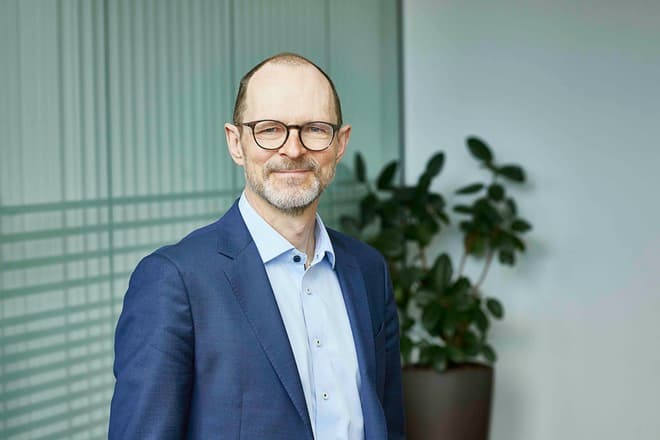
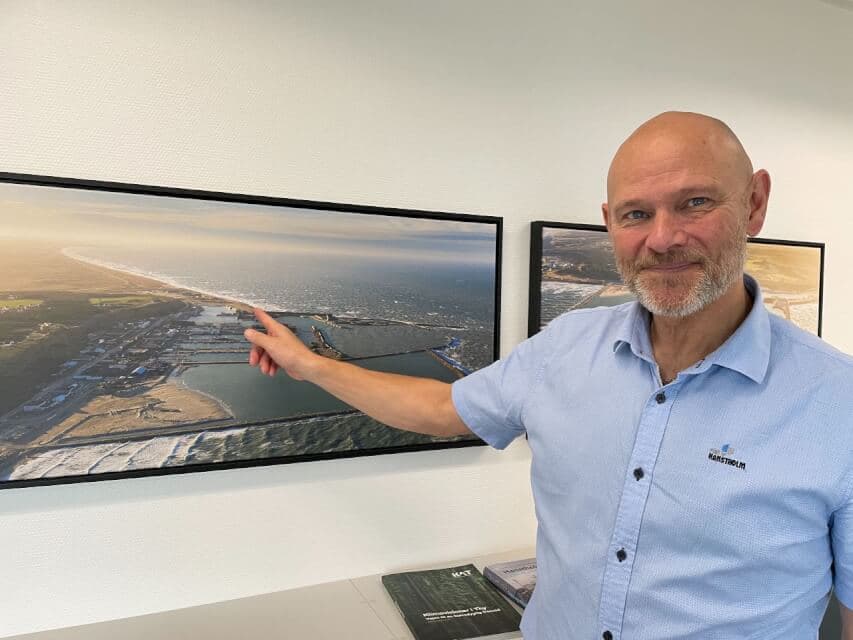
There is no time to waste, and there is no doubt. Managing Director Nils Skeby of Hanstholm Port knows that the green transition requires action here and now. A completed port expansion to 650 million DKK means that the port is ready for the offshore wind farms of the future, both as a shipping port and later as a service port. The first option here is the Thor offshore wind farm, which will be located 20 km off Thorsminde, and the distance to Hanstholm Port will be around 100 km.
- We are far away from Thor, but we have the space and a depth in the port entrance of 11 meters and 10 meters in the basin, says Nils Skeby.
He points out that Hanstholm Port is used to handling the wind turbine blades for the Østerild Test Center, which is only just under 20 kilometers away. Therefore, the infrastructure such as the roundabouts has already been expanded to allow trucks with very long wings to pass through.
Although the Port of Hanstholm is ready and in the running to take on the task, Nils Skeby has other plans that are both visionary and very advanced. There is a reason for this.
- In the Port of Hanstholm, commercial fishing accounts for 90 percent of the income, and it is risky to be so dependent on one industry. That is why it is important that we think about other sources of income, says Nils Skeby.
The wind turbines at the port and the ultimate sector coupling
Other sources of income are something that Nils Skeby has been thinking about for a long time, because there is already action behind the words.
- We have a project where we have just applied to set up a total of six wind turbines. Two 150-meter-high turbines will be built at the harbor, while the last four 180-meter-high ones will be built on the harbor area west of the city, the director says.
Thy Mors Energi will become the owner of the wind turbines, but the harbor will receive rent and a share of the electricity production to house the turbines.
- Wind will be an important part of the harbor's identity in the future, and we expect the application to go through easily, he says.
But it doesn't stop there, because the possibilities seem almost unimaginable on the northwest coast of Hanstholm.
The wind turbine power will be used for hydrogen production, which in turn will be used to make methanol. The green fuel will be used for the fishing fleet in the long term. And a biogas plant will be built to take up residual waste from the fishing industry and agriculture.
The upgraded gas will be used by local companies and the rest will be connected to the natural gas network in Hanstholm. The CO2 that is created in the biogas process will even become a useful resource in methanol production.
The same is true of the enormous amount of residual heat in the form of hot water that is created in the PtX process of making hydrogen and methanol. The hot water will be used for district heating in Hanstholm.
These are the types of projects that are lying around at ports and energy companies. Most often, they fail due to a lack of investors or because the green electricity becomes too expensive when the grid tariff has to be paid. That's not the case in Hanstholm Port.
- Everything will be on one land register, says Nils Skeby.
This means that no grid tariff will be paid for the electricity from the turbines, because they share a land register with the PtX plant. So it's a good green idea and a good business. Even the important investor seems to be in place.
- If everything goes well, we will have an agreement before the end of the year with a Danish partner, says the director, who has only had contact with Danish investors in the process.
Local support
While in other places in Denmark you experience great local resistance to both wind turbines and biogas, it's different in Hanstholm.
- Hanstholm was created around the port, so there is great local support. We think a lot about how we affect the society of which we are a part. It is our task to facilitate society, says Nils Skeby, who sees a great social responsibility as a port.
It is not about accumulating money but contributing to society. Hanstholm Port thus also accounts for 14 percent of the tax base in Thisted Municipality. Overall, there are several reasons why the Port of Hanstholm is so far along in its planning.
- We are currently the only ones who have both the space and the industrial cluster that is needed, says Nils Skeby, explaining that the port has companies that can contribute, for example, with fishing waste to the upcoming biogas plant.
Space is important, because there is even space to build a fish farm, and this is where the surplus oxygen from hydrogen production comes into the picture.
- A fish farm needs 90 tons of oxygen per year, and they come from hydrogen production, says Nils Skeby about the possibility of having oxygen, fish farms and companies in the fishing industry lying side by side.
The future: CCS and possible pipeline for 300 million DKK.
Part of the plans for the future is also the so-called carbon capture & storage (CCS). Storing C02 underground provides good conditions for offshore.
- We have the Hanstholm Formation, located only 15 km from Hanstholm Harbour, which is particularly suitable for storing CO2, says Nils Skeby, who emphasizes the importance of the CO2 being able to be retrieved so that it can be used in energy production later.
But Nils Skeby has an idea of a completely different dimension, and it involves Denmark's largest emitter of CO2, the cement factory Aalborg Portland.
- A CO2 pipeline from Aalborg Portland here to Hanstholm makes a lot of sense. We will be the only ones who can also offer to use the CO2, says the director.
They have already had a meeting with a "listening" Energy Agency about the possibility, which according to him would cost around 300 million kroner to build. There is no doubt about how any possible financing of such a pipeline should look like for the port manager.
- It must be a state task, concludes Nils Skeby, who is well on his way to taking the lead in the green transition to the Port of Hanstholm.
Text, graphics, images, sound, and other content on this website are protected under copyright law. DK Medier reserves all rights to the content, including the right to exploit the content for the purpose of text and data mining, cf. Section 11b of the Copyright Act and Article 4 of the DSM Directive.
Customers with IP agreements/major customer agreements may only share Danish Offshore Industry articles internally for the purpose of handling specific cases. Sharing in connection with specific cases refers to journaling, archiving, or similar uses.
Customers with a personal subscription/login may not share Danish Offshore Industry articles with individuals who do not themselves have a personal subscription to Danish Offshore Industry.
Any deviation from the above requires written consent from DK Medier.