Germany and France are blamed by two think tanks for postponing the 2040 climate target.
Both the Danish climate think tank Concito and the European think tank Strategic Perspectives point to a major shift in the approach to the climate fight in the EU's two largest countries.
The development is worrying for the EU's role as a global climate champion, says Jens Mattias Clausen, who is the program manager for the EU at the think tank Concito.
- Historically, France and Germany have been two of the biggest defenders of the climate.
- Now it seems that they are actively trying to undermine not only the Danish EU presidency, but potentially the EU as a global player in the climate, he says.
Germany tipped the balance
A similar message comes from Linda Kalcher, who is the CEO of the European think tank Strategic Perspectives perspectives.
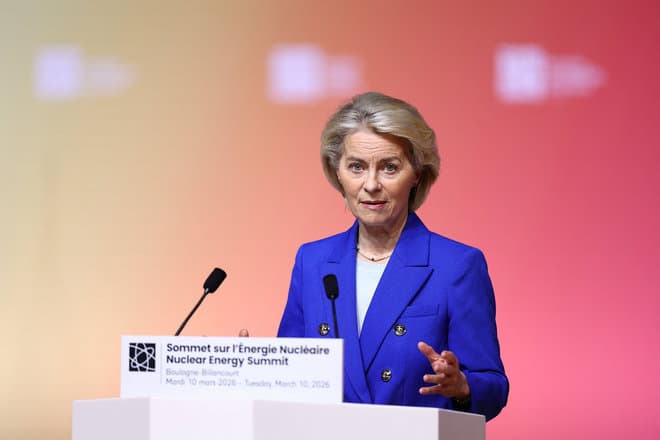
She points the climate finger at German Chancellor Friedrich Merz, German member of the EU Commission Ursula von der Leyen, and French President Emmanuel Macron.
- Germany tipped the balance today. If they had said that we could make the decision next week, the Danish EU presidency would have had a stronger mandate to try to do so, says Linda Kalcher.
Thus, the think tanks do not believe that the Danish EU presidency can be accused of having dropped the important 2040 climate target. On the contrary, the Danes have tried their best to achieve a compromise that takes into account the concerns of the EU countries, the assessment is.
But that only makes the German and French actions even more worrying when viewed through climate glasses, says Jens Mattias Clausen.
He is concerned that Merz and Macron are actually hoping that the EU's enfant terrible - Hungary's Prime Minister, Viktor Orbán, will block the 2040 climate target at the upcoming EU summit.
Here, Orbán has the right of veto if the decision is to be made at an EU summit. If the one that Denmark wanted had been made at next week's ministerial meeting, a qualified majority would have been enough.
- One can easily imagine that that is the strategy. That they will give Orbán and others the opportunity to do the dirty work of blocking the 2040 target.
- This is of course speculation, but it is not unthinkable, says Jens Mattias Clausen.
His statement came before the decision was made on Friday afternoon.
Requires unanimity
After the meeting in Brussels on Friday afternoon, according to an EU diplomat, there is still no agreement on how exactly the issue should be handled at the EU summit.
If the leaders of the EU countries are to make the decision at the summit, it requires unanimity. But if Prime Minister Mette Frederiksen (S) and her European colleagues alone choose to provide guidance on how they want the 2040 target to be decided, it does not require unanimity.
But it could delay the decision further.
- We urgently need the EU Commission and the Danish EU Presidency to confirm that the EU summit will only discuss it and not decide on a figure for 2040, as it is difficult to achieve unanimity on 90 percent, says Linda Kalcher.
She is thus referring to the fact that the EU Commission has recommended a 2040 target of a 90 percent reduction in greenhouse gases in 2040 compared to the level in 1990.
A target that Hungary, among others, believes is far too high. The announcement from Germany and France comes as both Merz and Macron struggle with a weakened domestic economy.
It has led to criticism from parts of the business community and voters in Germany and France of what they perceive as an overly ambitious climate policy that is costing jobs and causing the cost of living to rise.
/ritzau/
Text, graphics, images, sound, and other content on this website are protected under copyright law. DK Medier reserves all rights to the content, including the right to exploit the content for the purpose of text and data mining, cf. Section 11b of the Copyright Act and Article 4 of the DSM Directive.
Customers with IP agreements/major customer agreements may only share Danish Offshore Industry articles internally for the purpose of handling specific cases. Sharing in connection with specific cases refers to journaling, archiving, or similar uses.
Customers with a personal subscription/login may not share Danish Offshore Industry articles with individuals who do not themselves have a personal subscription to Danish Offshore Industry.
Any deviation from the above requires written consent from DK Medier.