
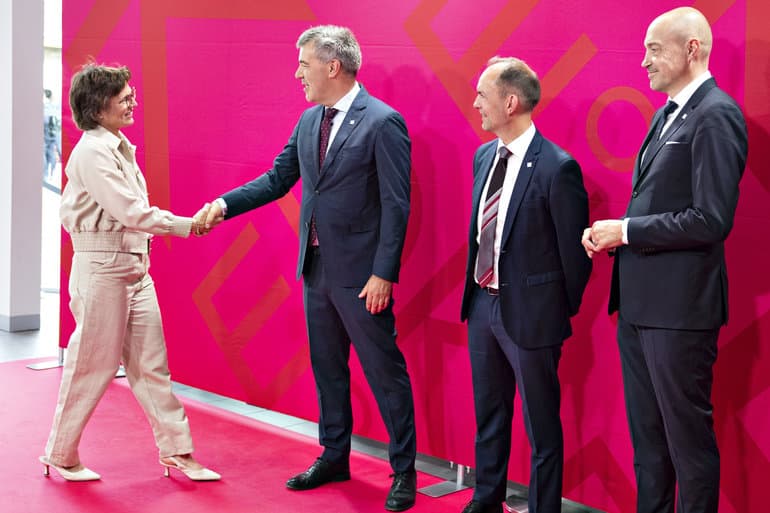
Discarded electronics are piling up around Europe's homes, big and small. And in those dusty drawers and boxes lie the building blocks that can be used to create the digital and green society of the future. At least a significant part of them. That's how the EU's Environment Commissioner, Jessika Roswall, sees it.
She has just visited Denmark, while her officials are working on a proposal later this year for a strengthened circular economy and an internal market for waste.
- Circularity is important in relation to climate change, but today it is also about resilience and security, says Jessika Roswall to Ritzau before a meeting with Danish politicians at Christiansborg.
On Wednesday, May 6, at their weekly meeting, the EU's 27 commissioners are expected to talk about how the EU economy can become more circular. Circular economy is a fight against the classic use and throw away culture.
We work on designing products for recycling, extending their lifespan and repairing instead of producing new ones from virgin raw materials. The crises of recent years have given circular economy a new "reason for existence".
Circular economy is part of the puzzle
In a time of wars and supply difficulties, Europe should reduce its dependence on China, among others, which has all the components needed for green and digital transition, but which has also introduced restrictions on exports, it says.
- Circular economy probably cannot solve everything, but it is an important part of the puzzle in terms of becoming less dependent. In addition, we are also working on other things, including when it comes to permits for new mines and other matters, says Roswall.
At EU level, 12 percent of the economy is circular - although not for critical raw materials, where it is 1 percent.
- The goal is to double it by 2030 (the 12 percent, ed.), and it is absolutely possible. I would say that it is a necessity. When it comes to electronic waste, we do not collect enough. So we practically have a fortune lying around in our homes. And that is no longer an option today, because we need these materials, says Jessika Roswall.
It is a task that comes with challenges. One of them is that it is still more expensive to use recycled materials than it is to produce with unused resources.
Another is that legislation is preventing waste and resources from moving freely, so that recycling can be scaled up to a level where costs can be reduced. The EU can do something about both of these or help member states to make the work easier.
- It's kind of a no-brainer. Why don't we go further? Why aren't we more circular? One reason is probably that we've been in a linear model for a long time. So it's a technological shift in a way, and it always takes some time, says Jessika Roswall.
Backing from Denmark
In Denmark, the initiative has full support from the employers' and business organization Dansk Industri. And it's kind of "a little crazy," as CEO Lars Sandahl Sørensen puts it. Because it costs companies when they have to adapt and when their products are recycled.
- It is certainly thought-provoking that it is we in the industry who are calling for creating the framework so that we can get more recycling. But the business community is ready to do it, says Lars Sandahl Sørensen, who met with Jessika Roswall during the visit to Denmark.
DI has full support for the Commissioner's plan. Lars Sandahl Sørensen is concerned that an internal market for waste is created, so that the price of recycling is also reduced.
- We have national legislation separately, which is simply a barrier to there being a critical mass and a large enough volume for us to work with it collectively in Europe, says the DI director.
He is particularly concerned that the critical raw materials are becoming more and more difficult to obtain.
- The moment we do not have access to these things at all, because they are in Chinese and other hands, we are faced with a huge, colossal problem. Before we get there, we must be self-sufficient to a greater extent, and we can actually do that.
/ritzau/
Text, graphics, images, sound, and other content on this website are protected under copyright law. DK Medier reserves all rights to the content, including the right to exploit the content for the purpose of text and data mining, cf. Section 11b of the Copyright Act and Article 4 of the DSM Directive.
Customers with IP agreements/major customer agreements may only share Danish Offshore Industry articles internally for the purpose of handling specific cases. Sharing in connection with specific cases refers to journaling, archiving, or similar uses.
Customers with a personal subscription/login may not share Danish Offshore Industry articles with individuals who do not themselves have a personal subscription to Danish Offshore Industry.
Any deviation from the above requires written consent from DK Medier.