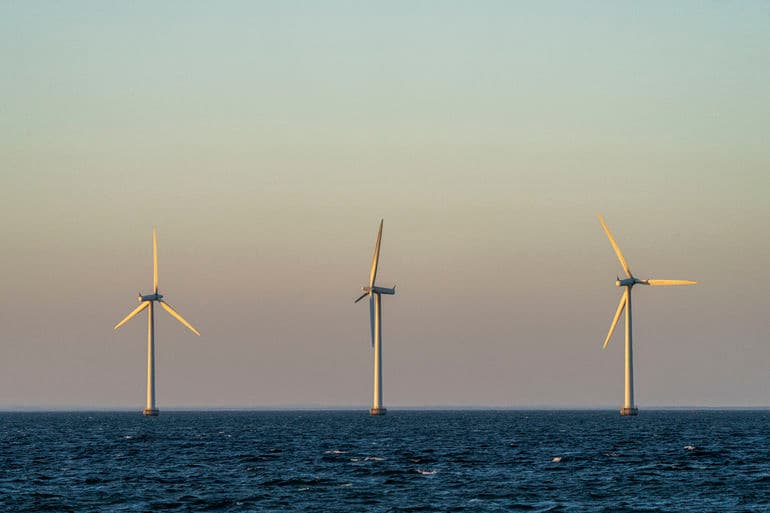
Eight transmission system operators from the countries around the Baltic Sea see significant potential for new electricity connections and offshore wind in the region towards 2040. A new joint system analysis indicates that connections and offshore nodes with a total capacity of 13 GW can be established, while the total offshore wind capacity can be expanded by up to 50 GW compared to the level in 2030. This is stated by the eight TSOs in a joint press release.
The analysis has been prepared under the auspices of the Baltic Offshore Grid Initiative, which brings together the eight TSOs, and goes a step further than previous studies by identifying specific projects and connections that can be technically and socio-economically realised by 2040. According to the TSOs, the connections will make it easier to distribute electricity across national borders and ensure that large amounts of offshore wind can be delivered to where demand is highest.
The report highlights that the new connections will have high utilization rates all year round and help to even out differences in weather, production and consumption between countries. The Baltic Sea region is expected to become a net exporter of electricity overall, although individual countries will continue to both import and export electricity depending on the season.
"The study identifies around 13 GW of new electricity connections, mostly direct connections between countries. These connections show high utilization rates all year round and help to even out differences in weather conditions, production levels and consumption patterns," the report concludes, among other things.
Bornholm is designated as a central connection point
The study also points out that the greatest growth in offshore wind up to 2040 will take place in Poland, Finland and Sweden, while the Baltic countries can also build significant capacity, including for export purposes. Denmark and Germany are considered to be more limited by available sea areas in the Baltic Sea, but Bornholm is highlighted as a possible central hub for future hybrid connections between Denmark, Sweden and Germany.
"Based on the assumptions, most new offshore wind farms are connected radially directly to land, as the distances are relatively short. However, some countries offer hubs that can function as future hybrid hubs, with the Danish island of Bornholm emerging as a central connection point for Denmark, Sweden and Germany," the report also states.
According to the TSOs, the analysis supports the need for closer regional coordination if the potential for offshore wind and electricity infrastructure in the Baltic Sea is to be fully realized.
The eight TSOs behind the analysis are 50Hertz (Germany), AST (Latvia), Elering (Estonia), Energinet (Denmark), Fingrid (Finland), Litgrid (Lithuania), PSE (Poland) and Svenska kraftnät (Sweden).
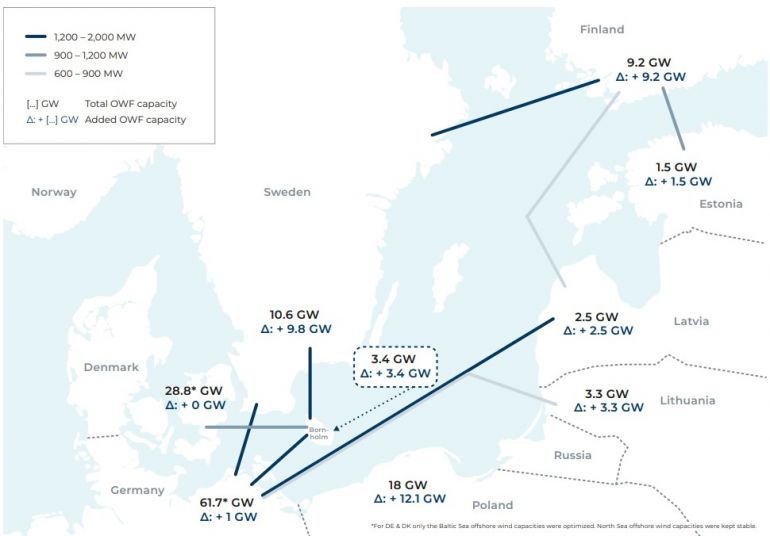
The report has several scenarios with different developments in electricity consumption, energy production
on land and at sea and hydrogen. The map shows the "base case". In all scenarios, a possible
Energiø Bornholm can have a major role as a strategic hub.
Text, graphics, images, sound, and other content on this website are protected under copyright law. DK Medier reserves all rights to the content, including the right to exploit the content for the purpose of text and data mining, cf. Section 11b of the Copyright Act and Article 4 of the DSM Directive.
Customers with IP agreements/major customer agreements may only share Danish Offshore Industry articles internally for the purpose of handling specific cases. Sharing in connection with specific cases refers to journaling, archiving, or similar uses.
Customers with a personal subscription/login may not share Danish Offshore Industry articles with individuals who do not themselves have a personal subscription to Danish Offshore Industry.
Any deviation from the above requires written consent from DK Medier.