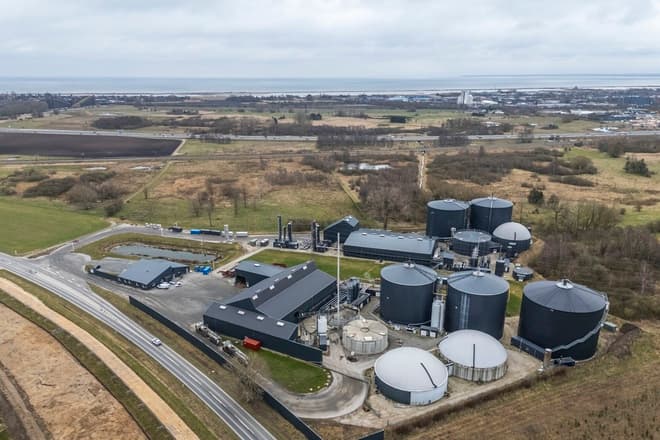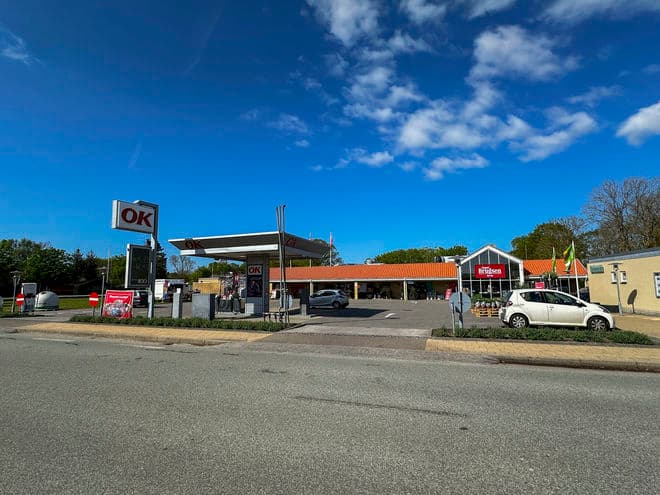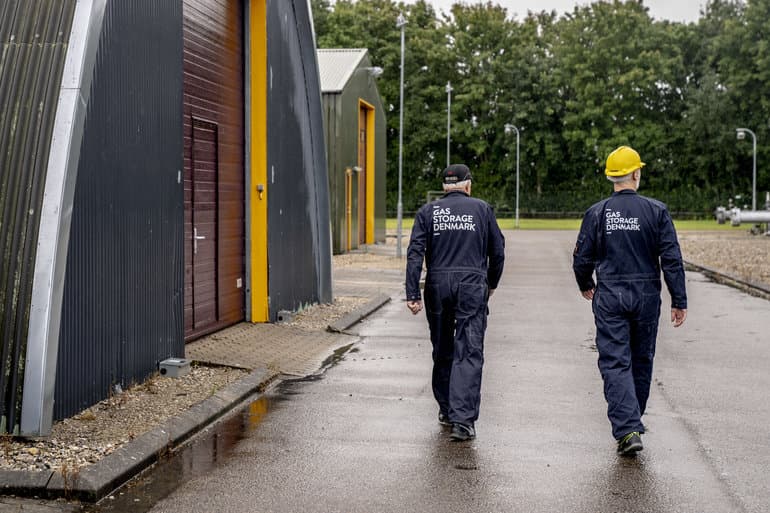
From the deserted central Zealand road at Stenlille, the buildings don't look like much. But like the tip of an iceberg, the surface of one of the country's two underground gas storage facilities can just be glimpsed.
It is precisely here that enormous quantities of natural gas are stored 1.5 kilometers beneath the small village as a cornerstone of Denmark's security of supply. Gas Storage Denmark operates the gas storage facilities, and the company is owned by the Ministry of Climate, Energy and Utilities.
- We sell gas storage capacity, so you can see us as a kind of storage hotel, says Martin Christensen, CEO of Gas Storage Denmark.
Gas Storage Denmark's customers are energy companies that deliver the gas to the more than 300,000 households in Denmark that heat with gas. In addition to the storage facility in Stenlille in Central Zealand, there is a storage facility located under the Jutland town of Lille Torup north of Viborg.
- It's actually relatively simple. The difficult thing is to understand how it is possible to store gas underground, says Martin Christensen.
A whole science in itself
And it is a whole science in itself, as the director himself describes it. The subsoil under Stenlille is particularly well suited for storing natural gas. A special sandstone formation was formed 200 million years ago.
And right there, 1,500 meters below the ground surface, the subsoil forms a kind of inverted bowl. The soil layers "arch" to such an extent that the gas does not disappear from the area. This makes the place ideal for gas storage.
Above the sandstone formation lies a 300-meter-thick layer of claystone, which acts as an effective lid over the gas. The natural gas is transported around the buried Danish gas network that connects the regions of the country.
The storage facility in Stenlille is connected to the gas network, and part of the gas is pumped to and from the underground through large pipelines and compressors. All of this is to alleviate possible crisis situations, or if the gas price skyrockets, as happened when gas deliveries from Russia were significantly reduced in 2022.
Late summer and September have shown their warm side this year. But the cold of autumn will soon arrive, and the heating season is just around the corner. The supply of gas is significantly more stable than two years ago.
Denmark is also no longer dependent on Russian gas, as it has succeeded in finding new supply routes. In addition, Denmark uses significantly less gas now, states Peter Christian Baggesgaard Hansen, Deputy Director General of the Danish Energy Agency.
- Gas consumption has been reduced a lot. Citizens and companies have been good at getting into good saving habits, he says.
Stock levels when targets
The summer period has been used to fill up gas storages, so that they are now ready for cold times. Denmark reached the interim target that gas storages should be at least 75-80 percent full on September 1.
This happened slightly slower than in previous years, partly due to maintenance on the Baltic Pipe. However, in a few days there is expected to be a normal flow of gas in the pipeline again.
- Therefore, we are confident that we will get "back on track", says the deputy director.
A common EU target is that all member states should have filled their gas storages at least 90 percent by November 1. That goal was actually achieved in August across the EU countries.
- The supply looks stable, and access to gas is really reasonable - also at a European level. This makes us optimistic about reaching the goal by November, says Peter Baggesgaard.
The gas storage facilities in Europe function as a coherent market, so Denmark is not only supplied by the storage facilities in Stenlille and Lille Torup. Denmark's two gas storage facilities constitute around one percent of the EU's total gas capacity.
Denmark's two gas storage facilities:
- The two storage facilities are currently approximately 80 percent full. The goal is for that figure to be 90 percent by November 1.
- In total, the storage facilities have a gas capacity of over 900 million cubic meters of natural gas. Their content can cover approximately three winter months of gas consumption in Denmark.
- The underground gas storage facilities are connected to the gas grid, and part of the gas is pumped to and from the underground through enormous pipelines.
- In Stenlille, an underground sandstone formation makes it possible for natural gas to be stored underground. Above the sandstone formation lies a thick layer of claystone, which forms a lid over the gas.
- In Lille Torup, the gas is stored in natural cavities, also called caverns. There are seven caverns in total, each the size of the Eiffel Tower.
- The storage facility in Lille Torup dates from 1987, while the one in Stenlille was established in 1995. The purpose is to ensure Denmark's security of gas supply.
- The storage facilities are monitored around the clock, and the underground is monitored every six days with satellites that register special elevations or changes in the ground.
- It is natural gas that is stored, but Gas Storage Denmark is also working on being able to store other types of gas such as CO2, hydrogen and compressed air in the future.
Source: Gas Storage Denmark and the Danish Energy Agency.
/ritzau/
Text, graphics, images, sound, and other content on this website are protected under copyright law. DK Medier reserves all rights to the content, including the right to exploit the content for the purpose of text and data mining, cf. Section 11b of the Copyright Act and Article 4 of the DSM Directive.
Customers with IP agreements/major customer agreements may only share Danish Offshore Industry articles internally for the purpose of handling specific cases. Sharing in connection with specific cases refers to journaling, archiving, or similar uses.
Customers with a personal subscription/login may not share Danish Offshore Industry articles with individuals who do not themselves have a personal subscription to Danish Offshore Industry.
Any deviation from the above requires written consent from DK Medier.