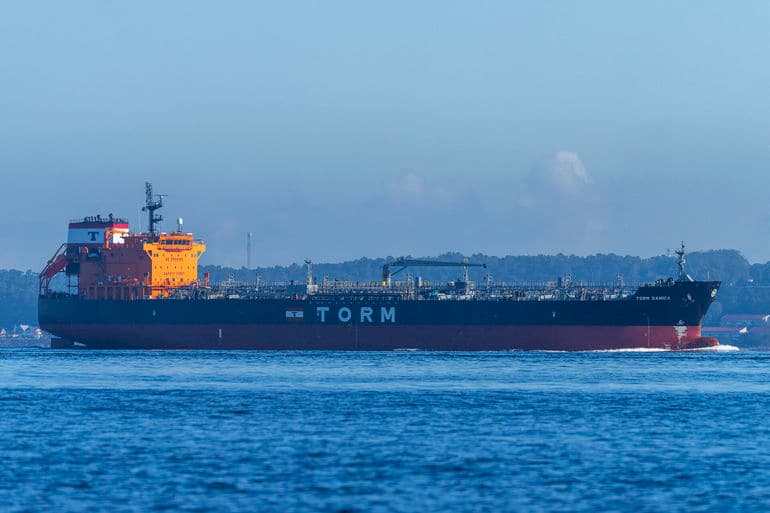
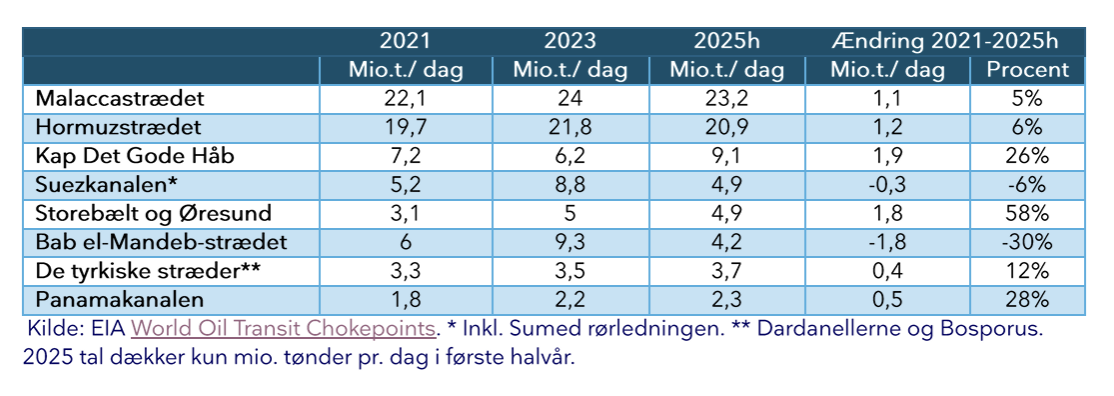
Oil transport through Danish waters has increased significantly in recent years. In the first half of 2025, 4.9 million barrels of oil passed through the Great Belt and the Sound per day, which is the same level as in the Suez Canal. This corresponds to an increase of 58 percent from 2021 to 2025.
This is shown by a new analysis from Danish Shipping, which describes how the traffic of oil through the world's largest main sea lanes has developed from 2021 to 2025.
According to the analysis, the development is related, among other things, to the sanctions against Russia after the invasion of Ukraine, which have changed the routes for oil exports. At the same time, countries such as Germany and Poland have increased their imports of Norwegian and American oil, which also contributes to the increased traffic through the Danish straits.
- The international sanctions imposed on Russia as a consequence of their invasion of Ukraine have meant that a much larger part of Russian oil exports are now being shipped to the world market through the Baltic Sea than before. With the sanctions against Russian oil, countries such as Germany and Poland have increased their imports of Norwegian and American oil. This also explains part of the increased oil traffic in the Great Belt and the Sound, says Anne H. Steffensen, CEO of Danske Rederier, in a press release.
The analysis also indicates that part of the Russian oil is transported on ships in the so-called shadow fleet, where insurance and ownership conditions may be uncertain. According to Danish Shipping Companies, this increases the risk of an oil accident in Danish waters, which is why the industry organization is calling on a future government to rectify the fact that Denmark does not currently have the necessary marine environmental preparedness in place to handle a potential oil spill.
The analysis also shows that the Strait of Malacca and the Strait of Hormuz remain the largest global hubs for oil transport with over 20 million barrels of oil daily. Attacks on shipping in the Red Sea have also led to more oil being shipped around Africa, while traffic through the Bab el-Mandeb Strait and the Suez Canal has decreased.
amp
Text, graphics, images, sound, and other content on this website are protected under copyright law. DK Medier reserves all rights to the content, including the right to exploit the content for the purpose of text and data mining, cf. Section 11b of the Copyright Act and Article 4 of the DSM Directive.
Customers with IP agreements/major customer agreements may only share Danish Offshore Industry articles internally for the purpose of handling specific cases. Sharing in connection with specific cases refers to journaling, archiving, or similar uses.
Customers with a personal subscription/login may not share Danish Offshore Industry articles with individuals who do not themselves have a personal subscription to Danish Offshore Industry.
Any deviation from the above requires written consent from DK Medier.