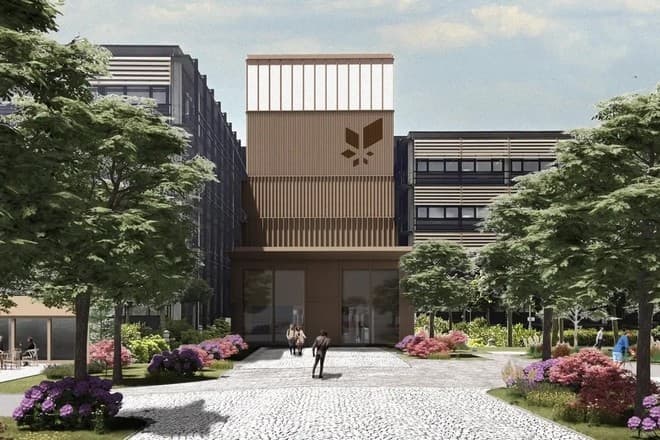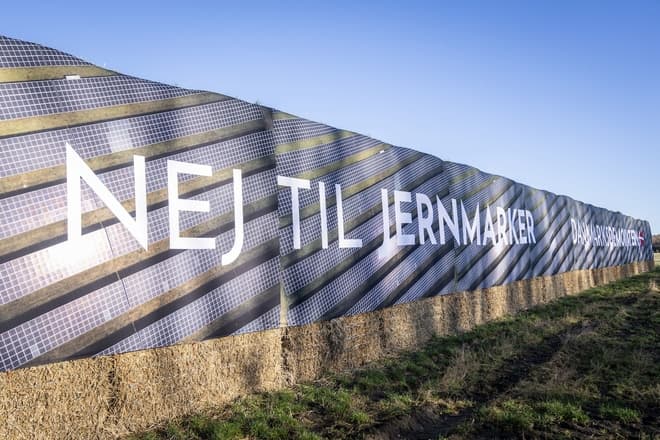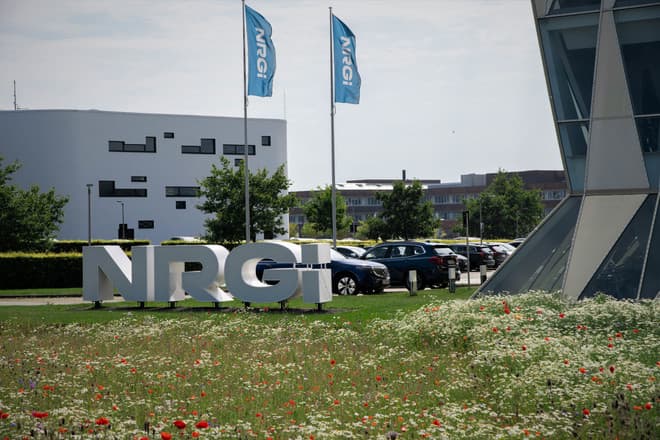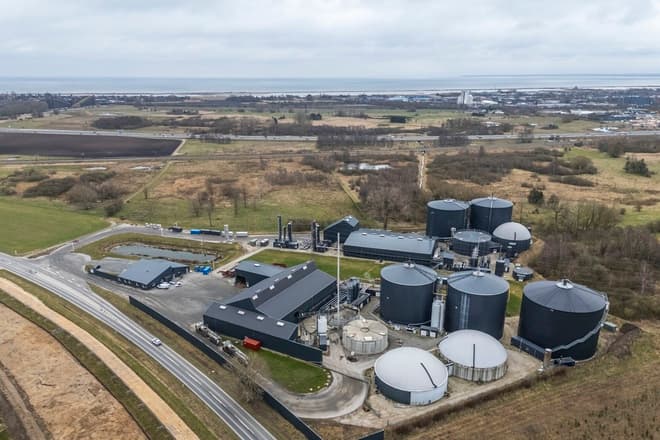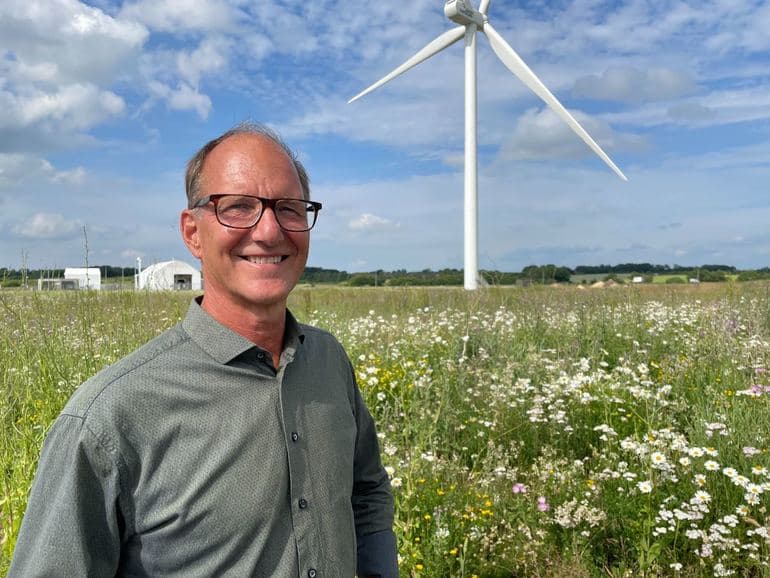
If you expect a traditional energy production building, you will be surprised when you arrive at GreenLab, located 12 km north of Skive. Wild flowers grow here in the summer months, and it is not at all unusual for locals to drive around the area in their cars for sightseeing.
GreenLab is a green circular industrial park. What else belongs to the future, such as PtX and sector coupling, is already here.
In 2021, GreenLab Skive became a regulatory test zone for energy, and this removed a long series of obstacles. The same year, the Brande Brint test zone also came, but on a much smaller scale.
Before GreenLab became a test zone, exemption applications were necessary for all projects. CEO Christopher Sorensen remembers well what it was like when he took office in 2019.
- When I started, there was a stack of still unresolved exemption applications. That's not the case today. Now we have a sandbox to test our ideas in with the test zone, says Christopher Sorensen.
With one stroke, it became possible to unleash innovation and accelerate the sector coupling of the future.
- This is how we got a large-scale energy cluster, it can be easily done, says Christopher Sorensen.
Next-generation energy cluster
The energy cluster provides the opportunity to investigate how electricity from green sources such as offshore wind farms can be used in a closed loop by companies. Here, sustainability is when resources are exchanged in the best possible way in the community. One company's residual products are used by the next company.
The cluster has wind turbines, electricity, electrolysis, hydrogen, PtX, methanol, water supply, biogas production, CO2, pyrolysis of plastic waste, which produces pyrolysis oil that can be recycled in new plastic production. This is the production of protein for animal feed from starfish, the production of fertilizer and the production of 100 percent compostable cardboard made from residual fibers from biogas production. This is just the beginning, and there are already plans to connect GreenLab to the local district heating network.
- The various companies and projects are connected to each other via SymbiosisNet. This is the famous sector coupling, says Christopher Sorensen.
- This is how our society will function in the future. There is no waste because everything is recycled elsewhere in the cluster. It is common sense and a symbiosis.
The future
At the end of March 2023, GreenLab made history when a six MW test module for PtX production was delivered to the cluster.
The 70-ton electrolyzer is a prototype that has been developed by Green Hydrogen Systems. This is a big step towards large-scale production of large-scale green hydrogen production.
- PtX is not only a promising technology and a cleaner way to produce and store energy. It is also the cornerstone of the energy system of the future, where sector coupling is the cornerstone, explains Christopher Sorensen.
GreebLab will produce fuels such as hydrogen and methanol from green power sources. It will be a showroom for Denmark on how technology and economics are important when producing e-fuels on a large scale. This is knowledge that can be used when and if Denmark gets its two energy islands.
It is also a way to gain more knowledge about how energy should be stored in the green energy system of the future. This is knowledge that is needed to be able to achieve Denmark's goal of reducing CO2 emissions. But it still takes time for development.
- We will get a 112 MW electrolyzer in modules of 6 MW, but the factory to produce them would have to be built first. Big is better, but we are not yet able to build a one GW PtX plant, says Christopher Sorensen.
Important infrastructure
In the summer of 2023, GreenLab will have the first hydrogen pipeline laid in Denmark, and it will be part of the SymbiosisNet that connects companies with each other.
It is a network that is reminiscent of the hydrogen backbone that may one day supply the EU with green hydrogen from Denmark.
- Infrastructure is important for the green transition and a hydrogen backbone is one of the important enablers in it. It's like the early days of wind turbines in Denmark, says Christopher Sorensen, noting one thing:
- We need to start before there is a need, and that is now.
Text, graphics, images, sound, and other content on this website are protected under copyright law. DK Medier reserves all rights to the content, including the right to exploit the content for the purpose of text and data mining, cf. Section 11b of the Copyright Act and Article 4 of the DSM Directive.
Customers with IP agreements/major customer agreements may only share Danish Offshore Industry articles internally for the purpose of handling specific cases. Sharing in connection with specific cases refers to journaling, archiving, or similar uses.
Customers with a personal subscription/login may not share Danish Offshore Industry articles with individuals who do not themselves have a personal subscription to Danish Offshore Industry.
Any deviation from the above requires written consent from DK Medier.