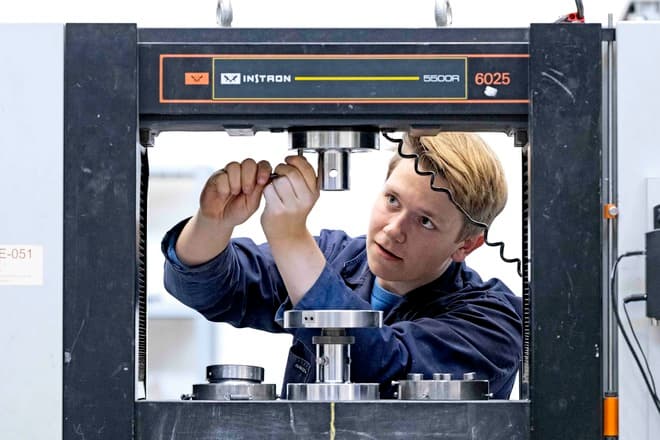
Fewer girls than before are choosing a vocational education when they leave primary school. This is shown by figures that the Danish Employers' Association (DA) has drawn from the Ministry of Children and Education.
This year, 10.7 percent of girls who leave primary school this summer have applied for a vocational education. This is the lowest figure in the years that statistics have been compiled in this area. The statistics go back to 2009. Since 2009, the proportion of girls applying for a vocational education has almost halved.
Jannik Bay, who is the head of education and integration at the Danish Employers' Association, is upset about the development because it helps to limit the talent pool.
- Many companies have incredibly good experiences with women in what is traditionally described as a male profession. In other words, companies are missing out on half of the population's talent, he says.
It is not only among girls that the number of applications for vocational education has fallen. Among boys, the proportion has fallen by almost one and a half percentage points to 26.9 percent for the cohort that will leave primary school this summer. Overall, 19 percent of the cohort has applied for vocational education. In 2025, this was 20 percent.
Since 2015, there has been a political goal that 30 percent of a youth cohort should apply for vocational education. Jannik Bay points out that part of the reason for the skewed gender distribution may be the way in which different subjects are discussed. He therefore encourages parents to think about how to talk to their children about different education programs.
- This is a super-thinker that needs to be turned around. It is difficult for many to enter the present, where there is no such thing as a male subject and a female subject, he says.
Head of Danish Vocational Schools and Upper Secondary Schools: A long, tough journey
Allan Kortnum, who is the head of Danish Vocational Schools and Upper Secondary Schools, also points out that a cultural change must take place, which will take a long time.
- It is a long, tough journey. It requires persistence and continuity from the school management, he says.
A great deal of work has already been done at vocational schools to ensure that the programmes are more gender-equal, says Allan Kortnum.
This means, among other things, that there are more female teachers, clear action plans in relation to sexism and a wider range of social activities.
Regarding this year's decline, he points out that there has been a general decline in applications for programmes within office and trade, where the gender distribution is normally very equal.
If you look at different vocational programmes, there is also a big difference in the number of girls applying. Almost half of the girls have applied for a programme within care, health and education. These can be programmes such as hairdresser, social and health assistant and dental clinic assistant.
On the other hand, only one sixth of the girls have chosen a programme within technology, construction and transport. Here you can train as an electrician, carpenter, or crane operator, for example.
/ritzau/
Text, graphics, images, sound, and other content on this website are protected under copyright law. DK Medier reserves all rights to the content, including the right to exploit the content for the purpose of text and data mining, cf. Section 11b of the Copyright Act and Article 4 of the DSM Directive.
Customers with IP agreements/major customer agreements may only share Danish Offshore Industry articles internally for the purpose of handling specific cases. Sharing in connection with specific cases refers to journaling, archiving, or similar uses.
Customers with a personal subscription/login may not share Danish Offshore Industry articles with individuals who do not themselves have a personal subscription to Danish Offshore Industry.
Any deviation from the above requires written consent from DK Medier.