After a number of projects have been launched in recent years with gas pipelines, network cables and offshore wind farms in the Baltic Sea, there has been a renewed focus on what is hidden beneath the surface.
And in reality, a kind of time bomb lies on the bottom of the Baltic Sea. When it will explode, no one knows. But when it does, it could have serious consequences for the marine environment.
The bomb is not a single bomb in the concrete sense. It is millions of tons of military equipment and ammunition from the Second World War, which together constitute a toxic cocktail of substances that risk being released into the water.
Experts in the field warn that when salt water corrodes the metal shells of rockets, bombs and artillery shells, they will release pollutants such as the explosive TNT into the marine environment. Some of the carcinogenic substances have already seeped into the sea and have been found in shellfish and other animals in the Baltic Sea.
Researchers want to develop clean-up tools
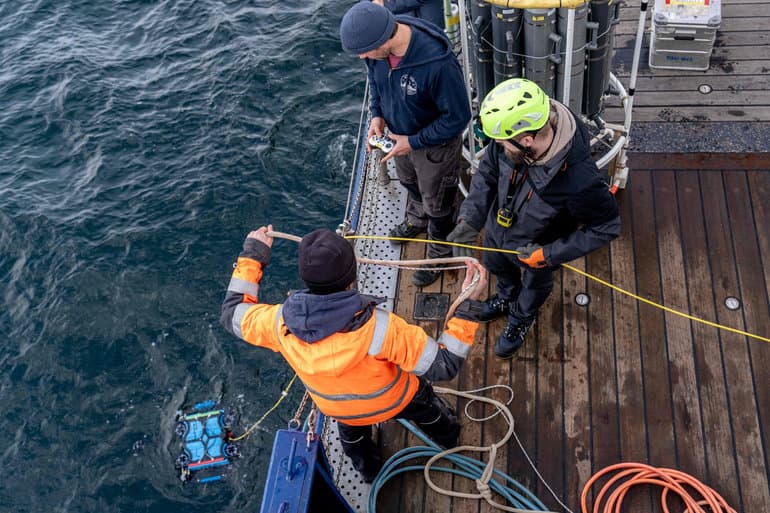
To map the problem and determine where the dangers lurk, a group of researchers from Germany, Poland and Lithuania will sail around the Baltic Sea in the coming weeks, and with the help of an underwater robot they will photograph the seabed.
The researchers are sailing on the research ship "Alkor", which belongs to the marine research center Geomar, located in the northern German city of Kiel.
- One of the goals of the project is to develop new tools for cleaning up, says Aaron Beck, who is leading the expedition.
Another goal is to find out what can be done to prevent the pollution from escaping, he adds.
On the trip, the researchers will find, among other things, a torpedo boat, a destroyer, a minesweepers and a submarine, all of which have been identified from logbooks and other documents in the German military archives.
World War II debris
Along the coast of Germany, around 1.6 million tons of war material - including ammunition - lie on the seabed. There are particularly large concentrations of World War II debris off Kiel and Lübeck.
Most of the war material and weapons were dumped into the sea by the victorious Allies after Nazi Germany was defeated in 1945. The aim was to quickly destroy the remnants of the Nazi war machine.
As the Baltic Sea is relatively shallow and is only connected to the rest of the world's oceans via the Øresund, Storebælt and Lillebælt, which are all relatively narrow passages, pollution tends to accumulate. It is not only the explosives that pose a risk to the marine environment. So does fuel on the vessels that have been sunk.
- On some of these ships there are ten tons of ammunition, but 200 tons of fuel. That is undoubtedly the biggest problem, says research leader Aaron Beck.
In addition to photographing the seabed, the researchers will release groups of mussels, which will later be collected from the Baltic Sea again and examined for toxic substances originating from explosives.
The concentration of hazardous substances is not so high today that it poses a danger to people who eat fish and shellfish from the Baltic Sea, assures Aaron Beck.
But large quantities of explosives and other dangerous chemicals are hidden in the ammunition that has not yet eroded onto the seabed.
/ritzau/AFP/amp
Text, graphics, images, sound, and other content on this website are protected under copyright law. DK Medier reserves all rights to the content, including the right to exploit the content for the purpose of text and data mining, cf. Section 11b of the Copyright Act and Article 4 of the DSM Directive.
Customers with IP agreements/major customer agreements may only share Danish Offshore Industry articles internally for the purpose of handling specific cases. Sharing in connection with specific cases refers to journaling, archiving, or similar uses.
Customers with a personal subscription/login may not share Danish Offshore Industry articles with individuals who do not themselves have a personal subscription to Danish Offshore Industry.
Any deviation from the above requires written consent from DK Medier.