Ørsted: Platforms DKK 4 billion cheaper than energy island

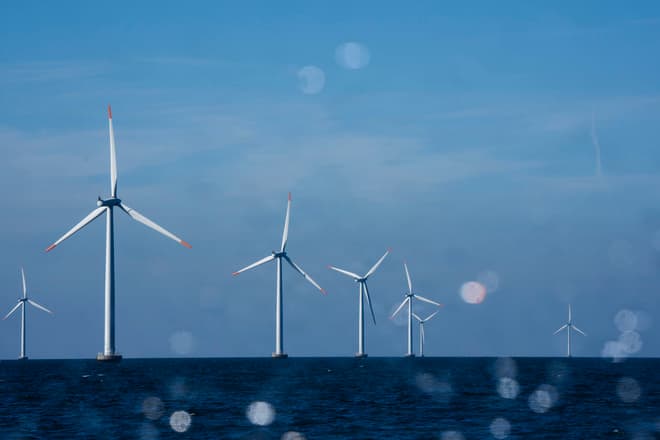
On Monday, the VindØ consortium presented their visualization for a future artificial island, which the consortium hopes will be the solution for future energy islands.
Ørsted has previously criticized an artificial island as a solution in Børsten. The company believes that it is unknown technology that could end up being a very expensive solution for Denmark. Now they are expanding on the criticism at Ingeniøren.
- We are interested in the cheapest possible offshore wind that must be completed on time - i.e. 3 GW in 2030 - and with all the experience that we and our partners have with wind power and platforms, we assess that it is a much more expensive solution to centralize this on a fixed energy island, says Ulrik Stridbæk, head of energy economics at Ørsted.
In a ministerial response to the Climate, Energy and Utilities Committee before Christmas, an estimate of the costs of the various solutions was presented, which COWI had prepared.
Here, an energy island is assessed as the cheapest solution if the effect is to be expanded to 10 GW and at the same price level if 3 GW is to be ready in 2030, as is the plan in the first instance.
A platform solution of 3 GW is estimated at a price of 12 billion. DKK, while a 10 GW platform solution is estimated at DKK 38 billion. This is based on known technology, including that the platforms are established as 1 GW platforms.
The estimated price for a so-called contained island for 3 GW with an associated port is DKK 12 billion. A contained island for 10 GW with an associated port is estimated at DKK 29 billion.
New platforms will save billions
According to Ulrik Stridbæk, the price estimates are incorrect as they are based on 1 GW transformer platforms. Instead, a solution should be based on 2 GW platforms, which are in the pipeline. This could make the 3 GW platform solution DKK 4 billion cheaper.
- The Dutch TSO company TenneT has ordered six of these 2 GW transformers and is basing their expansion with offshore wind on them. With 2 GW transformer platforms, the price for connecting 3 GW of wind power will thus be four billion kroner cheaper than the ministry's calculations. If it concerns connecting 10 GW, the price can be reduced by three billion kroner, says Ulrik Stridbæk.
Copenhagen Industri Partners (CIP), one of the parties behind the VindØ consortium, has always wondered about Ørsted's criticism that an artificial island should be based on unknown technology.
CIP believes that an artificial island is known technology, while everything that needs to be on the island in the form of Power-to-X solutions etc. is new technology.
- A steel platform has one purpose, and that is to be a high-voltage converter. The island creates many more opportunities, and it creates innovative power. Because it is a breakthrough to focus on large-scale energy storage and Power-to-X on the island itself, senior advisor at CIP Michael Ertmann has previously told Børsen.
amp
Text, graphics, images, sound, and other content on this website are protected under copyright law. DK Medier reserves all rights to the content, including the right to exploit the content for the purpose of text and data mining, cf. Section 11b of the Copyright Act and Article 4 of the DSM Directive.
Customers with IP agreements/major customer agreements may only share Danish Offshore Industry articles internally for the purpose of handling specific cases. Sharing in connection with specific cases refers to journaling, archiving, or similar uses.
Customers with a personal subscription/login may not share Danish Offshore Industry articles with individuals who do not themselves have a personal subscription to Danish Offshore Industry.
Any deviation from the above requires written consent from DK Medier.