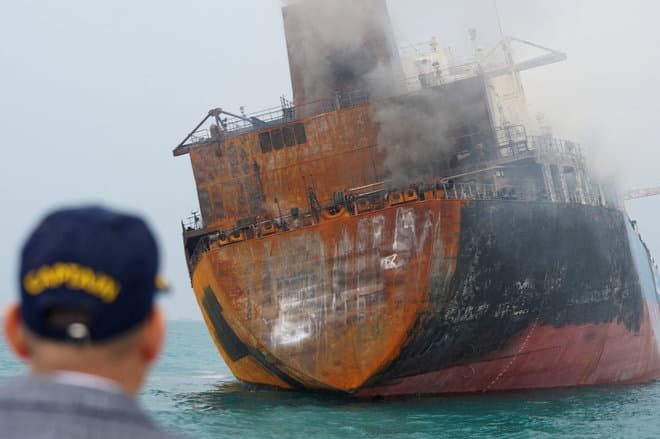



Not only has Russia's war of aggression against Ukraine cost countless lives and created a geopolitical crisis atmosphere not seen since the Cold War.
The war is also significantly fueling atmospheric warming by virtue of large amounts of extraordinary CO2 pollution. On the fourth anniversary of the war, the level of greenhouse gas emissions from war activities has reached 311 million tons of CO2 emissions. This is equivalent to eight times the annual emissions of all of Denmark.
This is shown in a new report from the organization Initiative on Greenhouse Gasses Accounting of War, which maps the climate effect of the Ukraine war year by year.
- Our goal is to show the greenhouse gas emissions that would not have occurred if Russia had not invaded Ukraine, says Lennard de Klerk, lead author of the report from the organization.
In February 2022, Vladimir Putin's tanks with thousands of soldiers rolled across the border into Ukraine. Helicopters tried to take over the airspace, and bombing began. They haven't stopped yet. It's costing lives. And it's emitting CO2, the report reveals.
Here, the organization has concluded that the largest factor in greenhouse gas emissions from the war comes from the warfare itself - 37 percent.
This is particularly the enormous fuel consumption required by war machines such as tanks and fighter jets.
- Although battlefield tactics and the use of equipment have evolved, the armed forces are still heavily dependent on fossil fuels to power tanks, armored vehicles and the growing logistical networks that support military operations, the report notes.
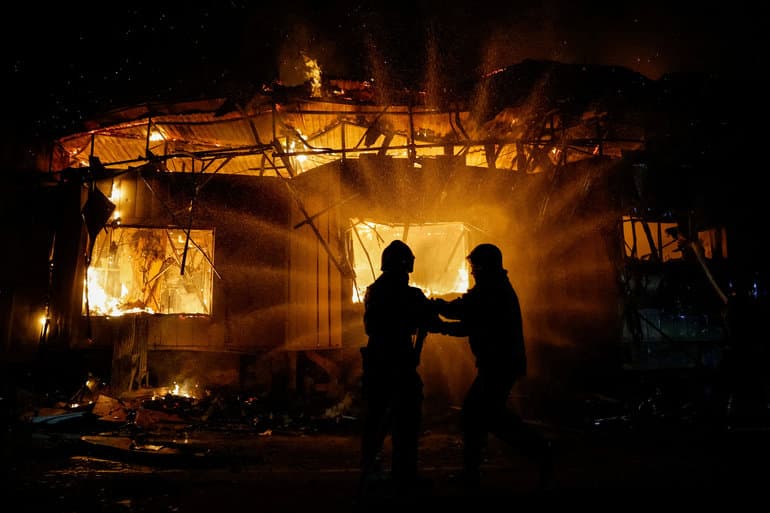
One thing is the emissions from fighter jet fuel. But when the bombs fall, the contribution to global warming continues. The explosions of the war have created such extensive forest fires that they account for 23 percent of the war's total greenhouse gas emissions. A bomb explosion or a hot, fired cartridge can trigger major destruction.
- The sparks of war escalate into major fires, and when firefighters cannot enter the war zones, forest fires can continue unabated, says Lennard de Klerk.
Forest fires have a double negative effect. The burning trees constitute a CO2 emission in themselves - and at the same time the CO2 that the trees have absorbed over decades is released. The lost absorption of CO2 is not calculated in the report, however, which means that the total climate damage is even greater than shown.
Even if the fighting stopped tomorrow, extraordinary CO2 emissions would continue for a long time. The war has brought total destruction to cities. Here, reconstruction requires so many materials that it alone accounts for another 23 percent of the total emissions from the war so far.
Building materials such as concrete and steel are very energy-intensive with large emissions of CO2 in production. This applies to both the construction of new buildings and those that have fallen to bombing.
But the targeted attacks on energy infrastructure are also a climate problem. When power plants and energy networks have been destroyed, rebuilding them is CO2-intensive. From a climate perspective, however, there are a few bright spots, notes Lennard de Klerk.
- There has been a major shift towards renewable energy sources. Ukraine now understands that energy systems based on fossil fuels are much more vulnerable and easier to destroy than decentralized solar and wind farms.
/ritzau/
Text, graphics, images, sound, and other content on this website are protected under copyright law. DK Medier reserves all rights to the content, including the right to exploit the content for the purpose of text and data mining, cf. Section 11b of the Copyright Act and Article 4 of the DSM Directive.
Customers with IP agreements/major customer agreements may only share Danish Offshore Industry articles internally for the purpose of handling specific cases. Sharing in connection with specific cases refers to journaling, archiving, or similar uses.
Customers with a personal subscription/login may not share Danish Offshore Industry articles with individuals who do not themselves have a personal subscription to Danish Offshore Industry.
Any deviation from the above requires written consent from DK Medier.