
In a world where China in particular has placed a heavy emphasis on critical raw materials, Europe has a common goal of becoming more independent. This is evident in Finland, for example.
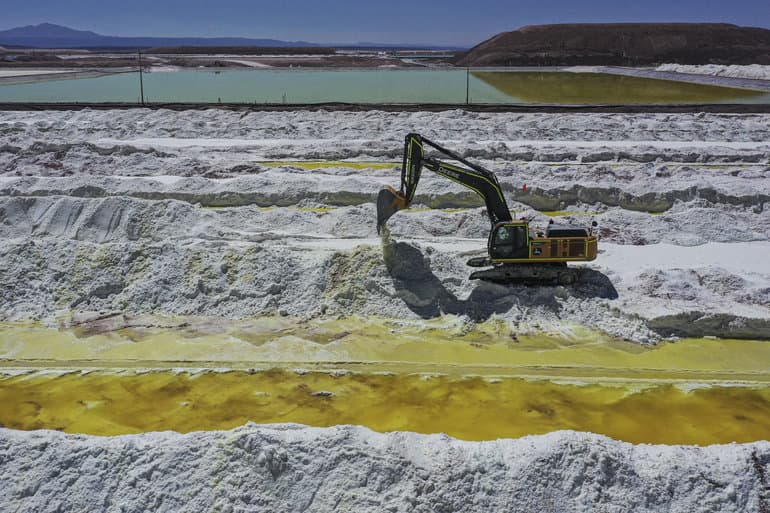
Through a crater-like landscape in the western part of the country, trucks loaded with crushed rock and ore now drive regularly to and from Europe's first complete lithium mine, which has started operations, writes AFP.
The element is essential for the production of modern electronics and has become a strategically important resource. Some compare it to the role that oil played at the beginning of the 20th century.
China currently accounts for the majority of the world's supplies, and several European countries have therefore begun a race to develop their own sources. Lithium reserves are found in other European countries such as Portugal and the Czech Republic.
Finland has large lithium reserves
But Finland's bedrock contains some of the largest reserves in Europe. Bo Langbacka, a specialist at the Geological Survey of Finland, told AFP.
The Finnish plant is also the first in Europe to have the entire production chain from mine to concentration plant and refinery located within 43 kilometers. The CEO of the operating company, Hannu Hautala, told AFP.
The project amounts to around 783 million euros, approximately 8.5 billion Danish kroner. The mine's lithium will ultimately be used for batteries, which are a necessary part of our modern everyday life and are used in everything from mobile phones to electric toothbrushes, electric cars and rail transport.
In the future, they are expected to be increasingly used for large industrial energy storage systems. That is why it is important that the Finnish mining project increases "independence from imports from, for example, Asian countries", Hannu Hautala told AFP.
According to him, it is estimated that 15,000 tonnes of lithium hydroxide for battery use will be produced annually when the mine is fully operational. This accounts for around ten percent of Europe's demand, estimates geologist Bo Langbacka, which means that imports of lithium from other parts of the world will continue to play a central role.
One dependency must not be replaced by another
In March last year, the European Commission published a list of 13 EU countries where projects for the extraction and processing of critical raw materials can take place. Finland was on the list.
According to the Vice-President of the European Commission, Stéphane Séjourné, the EU must not replace its dependence on fossil fuels with a dependence on critical raw materials.
- Chinese lithium must not become tomorrow's Russian gas, he said.
And in March this year, the EU concluded a new agreement with Australia, which will open up increased exports from the EU and imports of critical raw materials. The relationship with China when it comes to raw materials is of "strategic importance" for both Europe and Australia, said the President of the European Commission, Ursula von der Leyen, at the launch of the agreement.
- We must not become too dependent on a single supplier of such important raw materials.
The Finnish mine is scheduled to be fully operational within the next two years. The mining area extends across three municipalities: Kaustinen, Kronoby and Kokkola, where the Syväjärvi quarry itself is located.
According to Finnish public service broadcaster Yle, the long-planned project will create around 350 jobs. In Kaustinen, which is home to just over 4,000 people, however, feelings about the mining project are mixed, local music teacher Pilvi Jarvela told AFP.
- From an employment perspective, it has been positive, she says.
- But of course people are also concerned about the environmental impact and things like that, Jarvela adds.
/ritzau/
Text, graphics, images, sound, and other content on this website are protected under copyright law. DK Medier reserves all rights to the content, including the right to exploit the content for the purpose of text and data mining, cf. Section 11b of the Copyright Act and Article 4 of the DSM Directive.
Customers with IP agreements/major customer agreements may only share Danish Offshore Industry articles internally for the purpose of handling specific cases. Sharing in connection with specific cases refers to journaling, archiving, or similar uses.
Customers with a personal subscription/login may not share Danish Offshore Industry articles with individuals who do not themselves have a personal subscription to Danish Offshore Industry.
Any deviation from the above requires written consent from DK Medier.