Hungary has significantly stepped up its opposition to Ukraine ahead of the anniversary of Russia's invasion. This is clear from a meeting of EU foreign ministers on Monday.
Here, Hungary maintained both a veto against the 20th sanctions package against Russia and a veto against a 90 billion euro loan, which Hungarian Prime Minister Viktor Orbán otherwise gave the green light to at the EU summit in December.
- It is very unfortunate that the agreement that all EU leaders made is now being reversed, says EU foreign policy chief Kaja Kallas after the meeting with EU foreign ministers, referring to the vital loan to Ukraine.
The 90 billion euros correspond to around 670 billion kroner. They are intended to both keep Ukraine's economy running and support the military effort for the next two years. If the first of the funds are not disbursed by April, it could affect Ukraine's efforts on the battlefield, both the European Commission and Ukraine have stated.
The EU countries also failed to agree on the 20th sanctions package against Russia on Monday.
- That was not the signal we wanted to send, but we will continue the talks on the sanctions package, says Kaja Kallas.
The discouraging reports from Brussels come ahead of Ukraine marking the anniversary of Russia's invasion of Ukraine on Tuesday. The war is now entering its fifth year.
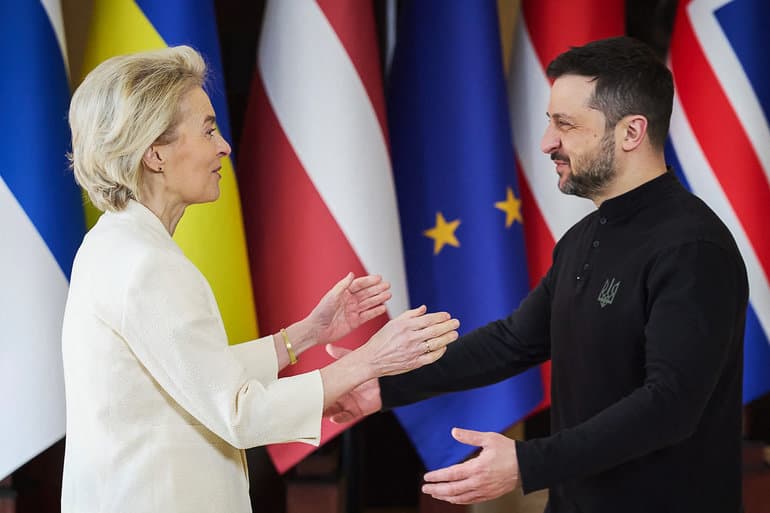
The President of the European Commission, Ursula von der Leyen, will participate in the anniversary ceremony in Kyiv on Tuesday. The expectation was that she would be able to assure the President of Ukraine, Volodymyr Zelenskyj, that the 90 billion euros were on the way. And at the same time, he emphasized that the EU will now hit the Russian oil industry even harder with the 20th package of sanctions.
Foreign Minister hopes elections can influence Orbán
But that will not happen after Hungary's resistance. Kaja Kallas, however, hopes that Viktor Orbán will change course ahead of the upcoming elections in Hungary on April 12.
- We know that elections are coming in Hungary. It is very difficult for me to see that the people of Hungary do not want to help Ukraine. I don't think it will give bonus points in the election campaign, says Kaja Kallas.
She is probably thinking that Hungary itself has bitter experiences with Russian invasion forces, after tanks and artillery were used in 1956 to crush the Hungarian uprising against the then Soviet Union.
At the EU summit in December, Hungary, together with the Czech Republic and Slovakia, chose not to participate in the 90 billion euro loan to Ukraine. In other words, only 24 of the 27 EU countries - including Denmark - are liable for the loan.
However, Orbán approved at the summit that the other EU countries would continue with the loan as long as the three Eastern European countries could avoid contributing. That statement must be respected, says Kaja Kallas.
- It is very unfortunate that Hungary is now going back on the decision that all the leaders made at the summit. I know that Ursula von der Leyen and EU President António Costa will take it up with Orbán, because it is not in line with the EU Treaty's sincere cooperation clause, says Kaja Kallas.
According to Reuters, Hungary and Slovakia blame Ukraine for the delays in the resumption of Russian oil supplies via the Druzhba pipeline. The two countries have the only remaining refineries in the EU that use Russian oil transported via the Druzhba pipeline.
In this connection, Orbán accused Ukraine of "blackmailing".
- When oil transport resumes, normal relations will be restored, Orbán said at the weekend.
Ukraine denies the accusations and states that repair work on the pipeline continues "amid daily threats of new missile attacks".
/ritzau/
Text, graphics, images, sound, and other content on this website are protected under copyright law. DK Medier reserves all rights to the content, including the right to exploit the content for the purpose of text and data mining, cf. Section 11b of the Copyright Act and Article 4 of the DSM Directive.
Customers with IP agreements/major customer agreements may only share Danish Offshore Industry articles internally for the purpose of handling specific cases. Sharing in connection with specific cases refers to journaling, archiving, or similar uses.
Customers with a personal subscription/login may not share Danish Offshore Industry articles with individuals who do not themselves have a personal subscription to Danish Offshore Industry.
Any deviation from the above requires written consent from DK Medier.