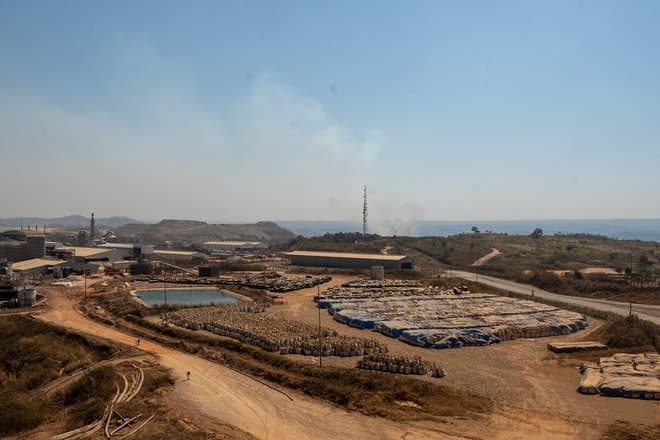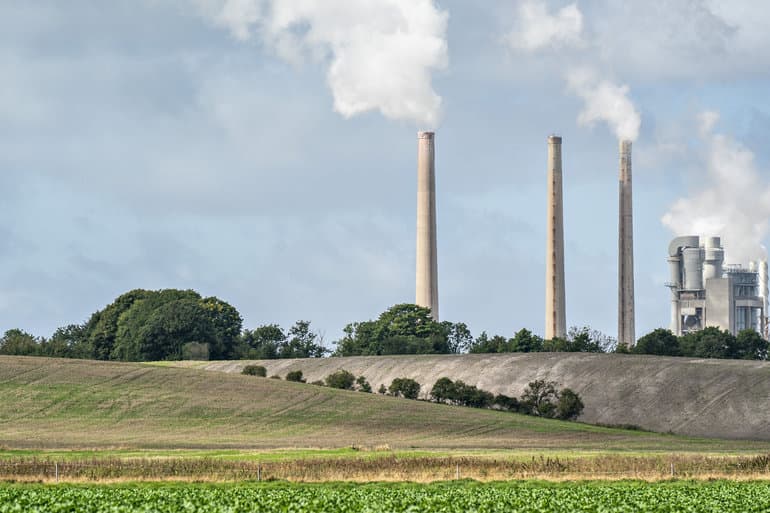
AALBORG: Denmark's largest emitter of CO2, the cement factory Aalborg Portland, is scared.
But the potential of being able to capture virtually all of their pollution, store it in underground chambers and become the first cement factory to sell a climate-neutral product is too great to give up.
After extensive risk assessments, the cement factory is therefore taking the step and applying for the billion-kroner state subsidy for CO2 capture and storage.
This is according to CEO Michael Lundgaard Thomsen, after the company announced their participation in the state tender for the capture and storage of the greenhouse gas.
The deadline is Wednesday. And up until the cut-off date, a large number of players had to give up participating in the race for the billion-dollar subsidy.
Benefits outweigh risks
It is especially the risk of large fines if the deadline is exceeded that has scared bidders away.
- We are very afraid of the fine. We are of course worried about getting it, and we know that it is a large fine that we could face, says Michael Lundgaard Thomsen.
Nevertheless, the company has assessed that the possible gains outweigh the risk of a fine.
The North Jutland factory is therefore now seeking support to establish a capture facility on Portland's chimneys that can filter 1.4 million tons of CO2 out of the smoke.
The company thus hopes to become largely climate neutral, it says.
- We have the ambition to be CO2-neutral by 2030. From there, we can produce a more or less climate-neutral cement that can hopefully give us a competitive advantage in the market, says director Michael Lundgaard Thomsen.
Capturing and storing CO2 from chimneys has for years been seen as playing a key role in the Danish climate change.
The rationale is that some sectors, such as the cement industry and waste incineration, are so difficult to convert to climate-neutral practices that they would rather filter CO2 out of the smoke from the processes.
Here, the Danish Parliament has allocated almost 30 billion kroner to support the technology.
In return, the tender requires that the bidders can deliver the promised CO2 reductions by 2030. If this does not happen, fines of up to three-digit million can be imposed.
An unproven technology
However, it is still a new and relatively unproven technology, where the infrastructure for transport and storage is not yet in place. Aalborg Portland will now establish this.
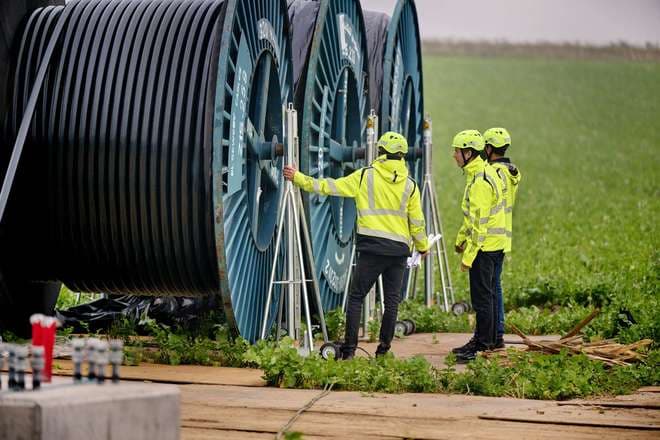
The company aims to create the value chain on land, where it is looking for a suitable underground storage facility in Jutland to pump CO2 into.
Aalborg Portland is thus signaling that it believes more in a quick establishment on land rather than at sea, where oil companies are otherwise struggling to make their old oil fields ready to store the emitted CO2.
- Onshore is, all else being equal, a cheaper solution than offshore, says Michael Lundgaard Thomsen.
If Aalborg Portland is awarded the grant, which will be assessed in April, the company will be responsible for the entire value chain.
Specifically, the cement factory will establish piping to a still undescribed underground storage facility in Jutland. Here, CO2 will be pumped underground, where it will remain for all time.
- We are working towards a very ambitious timetable. We believe we can achieve this by 2030. But we also know that it requires all actors in the value chain to keep it up, says Michael Lundgaard Thomsen.
A pressing challenge will be whether the authorities will succeed in getting the underground storage facilities in Jutland approved to store CO2 in time.
- So there is no doubt that time is a scarce resource.
/ritzau/
Text, graphics, images, sound, and other content on this website are protected under copyright law. DK Medier reserves all rights to the content, including the right to exploit the content for the purpose of text and data mining, cf. Section 11b of the Copyright Act and Article 4 of the DSM Directive.
Customers with IP agreements/major customer agreements may only share Danish Offshore Industry articles internally for the purpose of handling specific cases. Sharing in connection with specific cases refers to journaling, archiving, or similar uses.
Customers with a personal subscription/login may not share Danish Offshore Industry articles with individuals who do not themselves have a personal subscription to Danish Offshore Industry.
Any deviation from the above requires written consent from DK Medier.