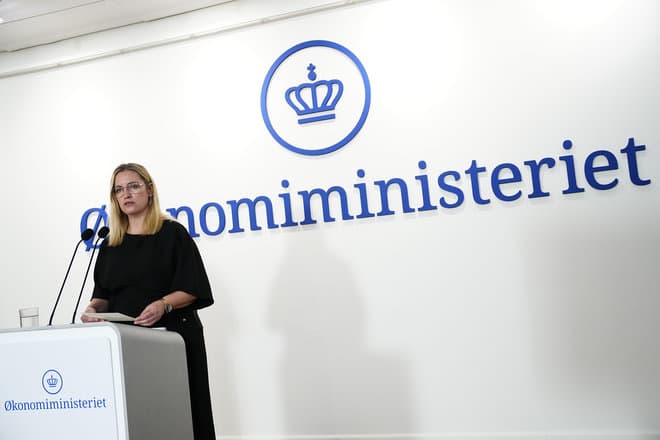
It is devastating for confidence in the government's climate policy that earlier this year the CO2 tax on fishing was postponed by five years. This is the assessment of the economic sages of the Economic Council, who published their spring report on the state of the Danish economy on Tuesday.
Here, the economists have assessed several current economic measures, and the postponement of the CO2 tax falls into the negative category.
- However, by postponing the tax, one risks creating uncertainty about future tax levels in both fisheries and other industries, the economists write in the report.
The CO2 tax on fisheries was in effect for well over the first month of 2025.
A storm of complaints from fishermen against the government quickly resulted in the tax payment being cancelled because the government proposed to introduce compensation for fishermen that directly corresponds to the tax level.
By dropping the CO2 tax for the next five years after just one month of delay, the government has created a credibility problem that could potentially have a detrimental effect on the rest of the transition - also in other industries. The Economic Council points out that actors will have less desire and incentive to pay for more climate-friendly technologies and tools if the requirements could potentially disappear again.
- Reduced credibility about the agreed, future climate policy can reduce the incentive to make profitable, long-term investments in both existing reduction technologies and in the development of new technologies, the council writes.
Fear can delay and increase the cost of measures
Economists call it a distributional policy consideration, because the postponement of the tax benefits fishermen financially. But for Danish society as a whole, the suspended tax could become a cost-increasing measure. If companies and actors who need to adapt do not dare to make the investments early, the overall transition could become more expensive, the council assesses:
- In that case, the costs of achieving Denmark's climate goals will increase.
For Minister of Food, Agriculture and Fisheries Jacob Jensen, the criticism does not shake his ambitions to postpone the tax.
- In my opinion, it does not make sense to pressure the industry with expensive solutions that, according to the report, are not documented to be cost-effective, the minister said in a written response.
It will simply be too expensive for fishermen, and several may risk bankruptcy, he believes.
- The negotiations with the parties in the Danish Parliament are in full swing, and I hope and believe that we will soon be able to present an agreement on a new common course for Danish fishing, where we ensure a competitive, environmentally friendly and climate-friendly industry.
/ritzau/
Text, graphics, images, sound, and other content on this website are protected under copyright law. DK Medier reserves all rights to the content, including the right to exploit the content for the purpose of text and data mining, cf. Section 11b of the Copyright Act and Article 4 of the DSM Directive.
Customers with IP agreements/major customer agreements may only share Danish Offshore Industry articles internally for the purpose of handling specific cases. Sharing in connection with specific cases refers to journaling, archiving, or similar uses.
Customers with a personal subscription/login may not share Danish Offshore Industry articles with individuals who do not themselves have a personal subscription to Danish Offshore Industry.
Any deviation from the above requires written consent from DK Medier.