


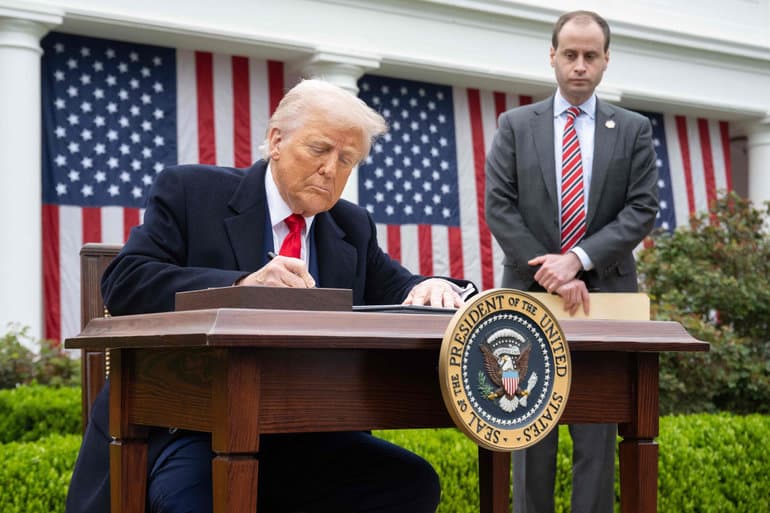
A US trade court on Thursday struck down Donald Trump's global import tariff of 10 percent, which took effect in February. The news agencies Reuters and AFP report.
According to the court, there is no legal basis for the tariff. The decision from the trade court came after two smaller companies had filed the case. The companies believe that the tariff is an attempt to circumvent an earlier decision by the Supreme Court.
In February, the US Supreme Court declared that the increased tariffs that US President Donald Trump introduced last year were illegal. The day after the decision, the global import tariff of ten percent came into effect.
Trump imposed import tariffs of ten percent in reference to section 122 of the Trade Act of 1974. According to Reuters, the law allows tariffs to be in effect for 150 days if the purpose is to correct serious balance of payments deficits or to avert an imminent devaluation of the dollar.
Does not remove tariffs for all companies
The trade court ruled on Thursday that the law is not intended to address the kind of trade deficits that Trump had referred to in his decree in February.
The court's decision does not automatically remove the tariffs for all companies, writes Reuters. The decision applies only to the two companies that filed the case. One of them is the American toy company Basic Fun!
- This decision is an important victory for American companies that rely on global manufacturing to provide safe and affordable products, said Jay Foreman, CEO of Basic Fun!, in a statement according to Reuters.
- We are pleased that the court has recognized that the president exceeded his authority with these tariffs. This decision provides much-needed clarity and stability for companies navigating global supply chains.
/ritzau/
Text, graphics, images, sound, and other content on this website are protected under copyright law. DK Medier reserves all rights to the content, including the right to exploit the content for the purpose of text and data mining, cf. Section 11b of the Copyright Act and Article 4 of the DSM Directive.
Customers with IP agreements/major customer agreements may only share Danish Offshore Industry articles internally for the purpose of handling specific cases. Sharing in connection with specific cases refers to journaling, archiving, or similar uses.
Customers with a personal subscription/login may not share Danish Offshore Industry articles with individuals who do not themselves have a personal subscription to Danish Offshore Industry.
Any deviation from the above requires written consent from DK Medier.