Then the day came. American Liberation Day, as US President Donald Trump has called it.
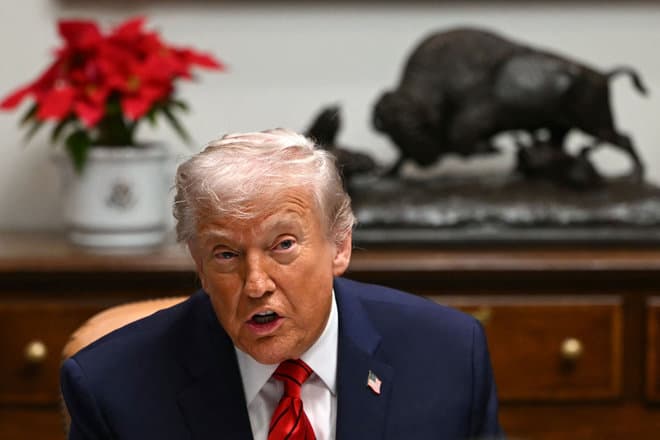
- In my opinion, it is one of the most important days in American history. It is our declaration of economic independence, Trump said on Wednesday evening Danish time in the Rose Garden at the White House.
With him he had a large board showing the extensive tariffs that the US is imposing on imports from abroad. As a base, there is a ten percent tariff on imports from countries around the world. In addition, there are higher tariffs on imports from selected countries. And extra high tariffs, some of over 40 percent - targeted at "nations that treat us badly".
Trump sees tariffs as a crucial weapon to increase production in the US. It should give a boost to the US economy. Many economists in the US and around the world see it differently.
The US's average tariff rate on all imports has increased to 22 percent under Trump from 2.5 percent. in 2024. That is a level that was last seen around 1910, Olu Sonola, head of economic research at credit rating agency Fitch Ratings, told Reuters.
- It is a game changer. Not just for the US economy, but for the global economy. Many countries are likely to experience recession, he says.
Kristalina Georgieva, head of the International Monetary Fund (IMF), said earlier this week that she does not expect a global recession for now. But she added that the IMF, which is working to stabilize the global economy, will soon downgrade its forecast for global growth in 2025.
There is a big difference in how the US tariffs will hit the economies of different countries. The scale goes from ten percent for the UK, for example, to 49 percent. for a country like Cambodia.
- Asian economies will be hit harder than most by the US retaliatory tariffs, Marcel Thieliant, head of Asia and the Pacific at the analysis company Capital Economics, told Reuters.
And there is more bad news for Asian countries.
- Asian economies not only face higher tariffs than many others. They are also more dependent on American demand for goods than most.
For some countries that are deeply dependent on trade with the US, the world's largest economy, the tariffs could be disastrous. This is reported by The Guardian. But the US and its consumers will also be hit hard, according to economists in a row. The BBC describes the move as an enormously risky one of a kind from the US president.
Ken Roggoff is a former chief economist at the IMF. He predicts that the risk of the US ending up in recession - economic decline - has risen to 50 percent. after Trump's press conference.
- He has dropped a nuclear bomb on the global trading system, Roggoff tells the BBC, adding that the consequences are "unimaginable".
In the American business community, which Trump wants to support with the tariffs, the measures are generally poorly received. This is what AFP writes.
- The high costs of new tariffs threaten investment, jobs, supply chains and America's ability to compete with other nations as the leading superpower in manufacturing, Jay Timmons, head of the American Association of Manufacturers, tells AFP.
Neil Bradley, policy director at the largest US business organization, calls the tariffs "a tax increase that will raise prices for American consumers and hurt the economy".
A recent analysis from Yale University estimated that a broad tariff of 20 percent on imports across the board would cost the average American household $3,400. That's equivalent to $23,000 and is a painful expense for most Americans.
jel /ritzau/
Text, graphics, images, sound, and other content on this website are protected under copyright law. DK Medier reserves all rights to the content, including the right to exploit the content for the purpose of text and data mining, cf. Section 11b of the Copyright Act and Article 4 of the DSM Directive.
Customers with IP agreements/major customer agreements may only share Danish Offshore Industry articles internally for the purpose of handling specific cases. Sharing in connection with specific cases refers to journaling, archiving, or similar uses.
Customers with a personal subscription/login may not share Danish Offshore Industry articles with individuals who do not themselves have a personal subscription to Danish Offshore Industry.
Any deviation from the above requires written consent from DK Medier.