Climate fight against oil and gas :
"The Last Generation" demands an end to fossil fuels by 2030
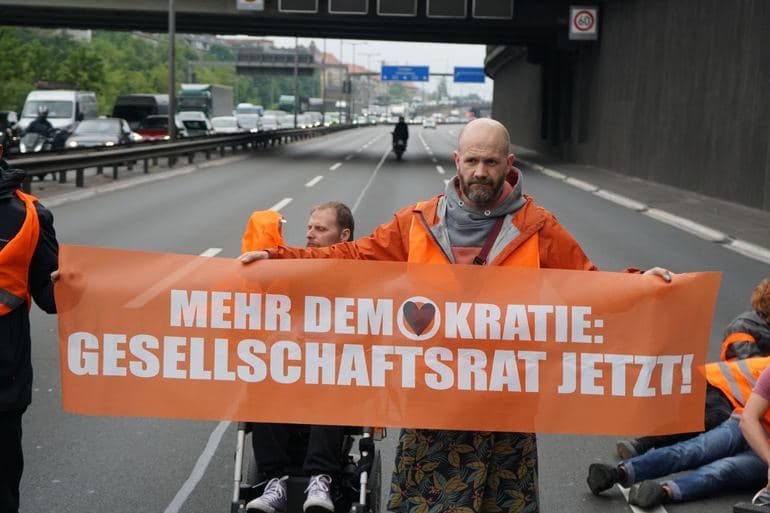
They are best known for sticking themselves to roadways, artworks and for smearing orange paint on the Brandenburg Gate and most recently on Tuesday on the World Clock at Alexanderplatz in Berlin. This is “Die Letzte Generation” or The Last Generation as the German activist movement is called.
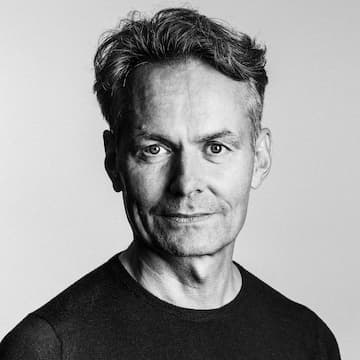
In Flensburg, DOI.dk meets 41-year-old activist Lars Schäfer to understand what the movement, which just arrived in Denmark two weeks ago, wants to achieve. Lars Schäfer has himself participated in several actions where he has stuck himself to roadways in Germany and the Netherlands.
The last action in Flensburg, where we meet today, was in early February. On social media, drivers can be seen overtaking the activists, hitting them, spitting on them, spraying pepper spray on them or even running them over around Germany.
- The drivers have become more aggressive, but this is only the first wave of drivers that we are stopping. In Flensburg this winter it was around four degrees, and the police were completely unprepared, so we ended up stuck for almost four hours. It was very cold, so people who lived nearby brought us blankets, tea and chocolate. We experience that people really sympathize with our actions and are friendly, says Lars Schäfer about the climate campaign, which aims to create a fossil-free Germany.
- We want Germany to completely stop using fossil fuels by 2030, he says, explaining what the demand is here and now to stop blocking the roads by gluing themselves to the road and carrying out other actions.
- We have three demands now. Firstly, the government will introduce a nine-euro ticket, so that it only costs nine euros per month to use public transport with buses, S-trains and regional trains throughout Germany. Secondly, we want a speed limit of 100 km per hour on the roads, he says and continues:
- And then we want a council of randomly selected citizens to be set up to advise the government on how Germany can stop using fossil fuel sources by 2030. The government will make the laws, says Lars Schäfer.
He is well aware that some of the requirements may be difficult to implement here and now.
- Of course there is a capacity problem, because public transport is not scaled for everyone to use it. The speed limit, on the other hand, can be introduced here and now without any problems, and that will immediately reduce CO2 emissions. And there is already a nutrition council of 160 randomly selected people of different ages who will make recommendations to the government. So it can also be done with the climate, he explains.
However, the North German activist believes that cars with fossil combustion engines should be completely banned now.
- Personally, I would rather do without cars now, but that is not Letzte Generation's position, says Lars Schäfer.
Only gets into a car for a reason
The choice not to have cars is also something that Lars Schäfer himself adheres to, but there is an exception.
- I only get into a car to drive out and do actions by gluing myself to highways, where you can't get to otherwise, he says.
But it is possible to take the train and other public transport.
- I have just been to Fanø by train, bus and ferry, so it is possible. And I even had my bike with me. The ferry was so silent, it must have been an electric ferry, says Lars Schäfer.
He thinks more people should look at how they live.
- I hope more people will see and understand our message. We have become accustomed to overconsumption, but we have to live with consuming less, says Lars Schäfer.
Preventive detentions
So far, Lars Schäfer has participated in actions in Berlin, Hamburg, Kiel and The Hague, as well as in Flensburg. The police in Germany use preventive detention or detention of activists from Letzte Generation, depending on the state. Here, the conservative German state of Bavaria leads the way in detentions, but it also happens to a lesser extent in other states.
- I have been preventively detained in Kiel, Berlin, Hamburg and The Hague, where it was in a single cell. In the Netherlands, it was a luxury to have both a bed and a toilet. Otherwise, you have to call when you need to use the toilet, and it can easily take an hour, he says.
There is also a big difference in how and with what the activists dissolve the glue that has stuck them to the asphalt.
- In Berlin, the police use cooking oil to dissolve the glue, and in Hamburg they use acetone, while others do not use mineral oils. Sometimes the police take an hour to dissolve the oil, and other times the hand is torn off after ten minutes, so some of the skin comes off. It is different from time to time, says Lars Schäfer and makes one thing clear:
- I am not beaten or subjected to abuse.
Danish branch opened
The climate fight continues for Die Letzte Generation, and the group has already gained sister organizations abroad.
- Die Letzte Generation just opened in Denmark 14 days ago, says Lars Schäfer.
Whether the North German activist will participate in any actions in Denmark is still open.
- I will not rule out that I will participate in actions in Denmark, he says.
Text, graphics, images, sound, and other content on this website are protected under copyright law. DK Medier reserves all rights to the content, including the right to exploit the content for the purpose of text and data mining, cf. Section 11b of the Copyright Act and Article 4 of the DSM Directive.
Customers with IP agreements/major customer agreements may only share Danish Offshore Industry articles internally for the purpose of handling specific cases. Sharing in connection with specific cases refers to journaling, archiving, or similar uses.
Customers with a personal subscription/login may not share Danish Offshore Industry articles with individuals who do not themselves have a personal subscription to Danish Offshore Industry.
Any deviation from the above requires written consent from DK Medier.