A delegation from the Australian mining company Energy Transition Minerals is landing in Nuuk, Greenland, on Monday to "seek clarity" about a reported mining project. This is what the company's director, Daniel Mamadou, told TV 2.
In front of the media, Mariane Paviasen, who is a member of the Greenlandic parliament for the IA party, calls the timing sensational. This is because parliamentary elections are to be held in Greenland no later than April 6.
But Daniel Mamadou says that the timing is "completely coincidental"
- If it is perceived as political interference, that is certainly not our intention. We are not there to interfere, but we are there to defend the interests of our investors and to seek clarity, he tells the media.
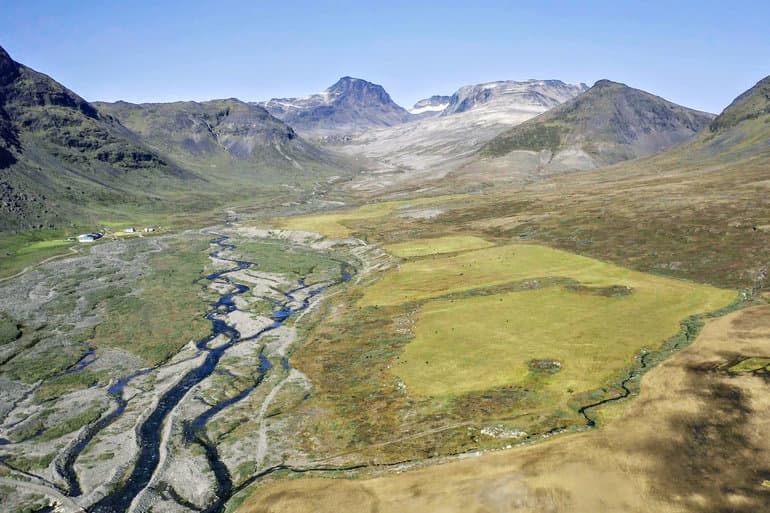
Energy Transition Minerals has been looking for rare earths at the southern Greenland mountain Kuannersuit, known in Danish as Kvanefjeld, since 2007. But in November 2021, the newly elected government in Greenland passed a new law that prohibits the extraction of uranium.
This meant that Energy Transition Minerals was refused permission to carry out the project at Kuannersuit, as radioactive uranium will be extracted at the same time as the extraction of rare earths.
Has sued Denmark and Greenland for billions
The mining company has since sued both the Ministry of Climate, Energy and Utilities and the Greenlandic self-government. The company is demanding compensation of around 76 billion. from Denmark and Greenland.
Rare earths are crucial in the batteries that are to be used in modern technologies and in the green transition. They are indispensable substances for the production of solar cells, wind turbines, batteries for electric cars and many other things. It is a field that China has a strong hold on, which increases dependence.
Denmark was involved in granting the exploration license to Energy Transition Minerals in 2007, because the raw material area had not been formally taken over by Greenland at that time.
However, the Attorney General argues in an assessment of the case that Denmark has effectively only functioned as a "rubber stamp" since 1998, when the parties agreed that the area belongs to Greenland. According to the Attorney General, the purpose of the case is to put "undue" pressure on the self-government in Greenland in the hope of obtaining a permit for the project.
Defense lawyer specializing in international law Poul Hauch Fenger has previously told DR that, in his opinion, the mining company has a good case against Denmark and Greenland.
/ritzau/
Text, graphics, images, sound, and other content on this website are protected under copyright law. DK Medier reserves all rights to the content, including the right to exploit the content for the purpose of text and data mining, cf. Section 11b of the Copyright Act and Article 4 of the DSM Directive.
Customers with IP agreements/major customer agreements may only share Danish Offshore Industry articles internally for the purpose of handling specific cases. Sharing in connection with specific cases refers to journaling, archiving, or similar uses.
Customers with a personal subscription/login may not share Danish Offshore Industry articles with individuals who do not themselves have a personal subscription to Danish Offshore Industry.
Any deviation from the above requires written consent from DK Medier.