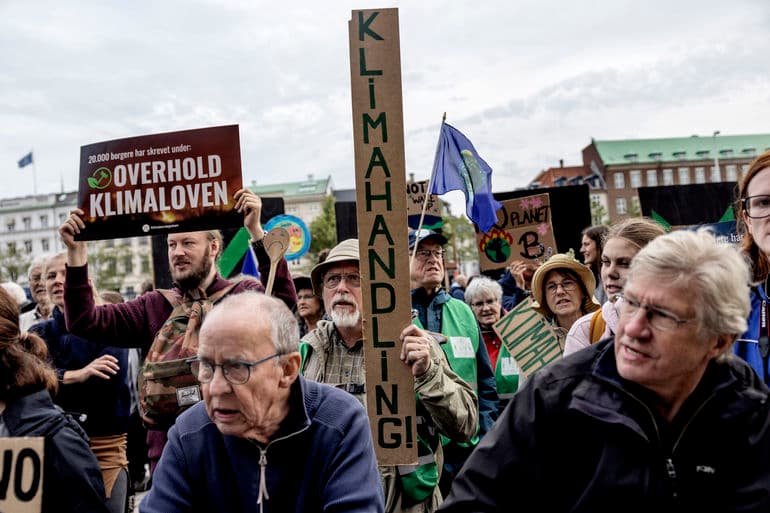
The climate issue has divided the populations in the United States and several European countries, such as France and Great Britain, and created a highly polarized debate, where large parts of the population, especially on the right, do not recognize climate change.
However, this is not the case in Denmark. Here, a large majority across political divides recognize climate science and are very concerned. This is shown by a new study from the University of Copenhagen.
- There are obvious political differences between the United States and Denmark, but we tend to see American social phenomena and believe that it is the same in Denmark. But when it comes to climate skepticism, we still have to look at American conditions, because our study shows that a very large majority of Danes recognize climate change as man-made, and that most support a green transition in one form or another, says Andrea Veggerby Lind.
The study was conducted as part of her PhD thesis Beyond Climate Scepticism – an exploration of climate attitudes and political orientation in Denmark. It was conducted among a representative sample of the Danish population. 1,365 people responded to the survey.
- Concern is also seen among the part of Danes who identify with bourgeois values; in other words, we do not have the same polarization in the political system, and several parties on the right take climate change seriously.
Different willingness to transition
According to the researchers, this is only a group of around seven percent. of Danes who believe that climate change is not man-made. While there is agreement in a large part of the Danish public about the seriousness of climate change, there is disagreement about how far one should go to tackle the problems.
Andrea Veggerby Lind and her colleagues divided the respondents into segments that represent different degrees of concern about climate change and the degree of willingness to change society.
- We have chosen to call the largest group Cautious – ‘the cautious’ – and it makes up a full 27 percent of the adult population. They are interesting because they all recognize climate change as man-made. They also want to change society, but not in the same dramatic way as those who are most committed to climate change; for example, they do not necessarily vote for the parties that want to implement the most far-reaching climate solutions, explains Andrea Veggerby Lind.
The segmentation model can, among other things, used to target communication about climate solutions to specific groups in the population. Also groups that do not necessarily share political views on other issues.
- The group we have called 'the ambivalent', which makes up 13 percent of the population, is, for example, very concerned about climate change, but is at the same time reluctant to change behavior or support climate measures such as taxes on food - and thus difficult to communicate with. But because this group is more pessimistic about the effect of climate action, a possible approach could be to focus on concrete success stories that show that climate measures can have an effect, says Andrea Veggerby Lind.
amp
Text, graphics, images, sound, and other content on this website are protected under copyright law. DK Medier reserves all rights to the content, including the right to exploit the content for the purpose of text and data mining, cf. Section 11b of the Copyright Act and Article 4 of the DSM Directive.
Customers with IP agreements/major customer agreements may only share Danish Offshore Industry articles internally for the purpose of handling specific cases. Sharing in connection with specific cases refers to journaling, archiving, or similar uses.
Customers with a personal subscription/login may not share Danish Offshore Industry articles with individuals who do not themselves have a personal subscription to Danish Offshore Industry.
Any deviation from the above requires written consent from DK Medier.