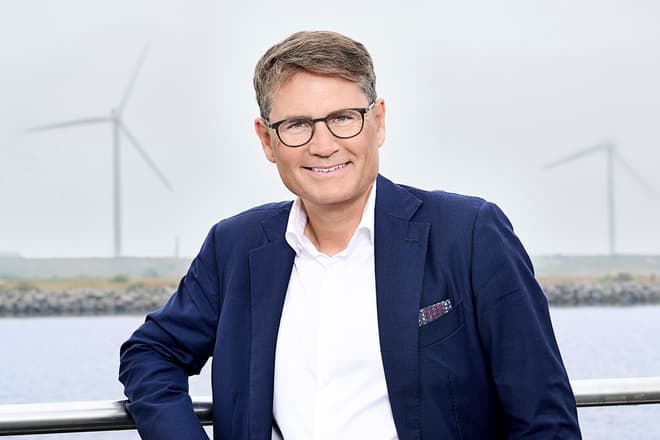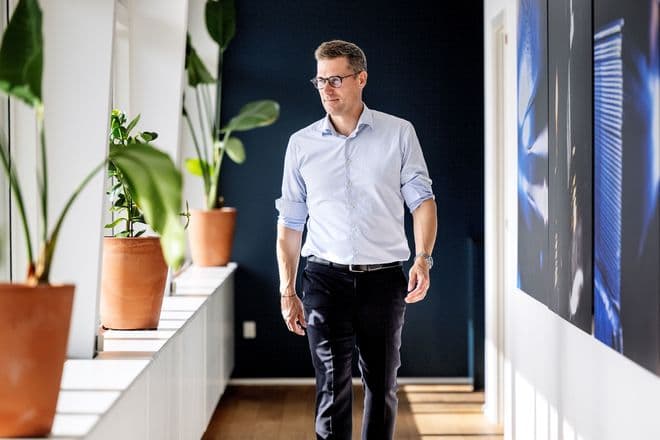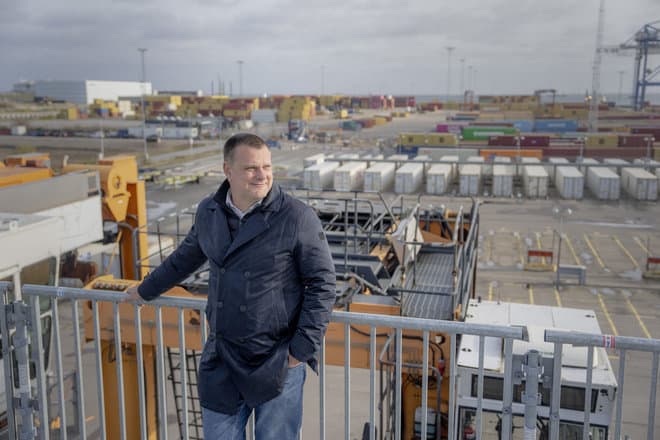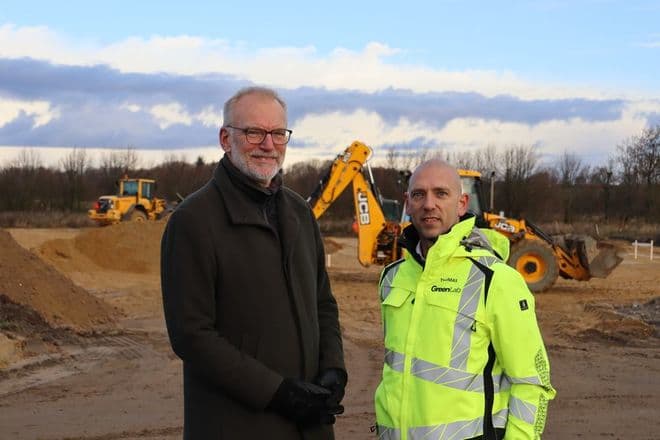
He has just returned from a conference in Bonn, and in fact, Gunnar Boye Olesen, a civil engineer specializing in energy, already has one foot on the road to the People's Assembly on Bornholm. The final slides of his presentation are being prepared in the office in Aarhus when we meet.
A more sustainable future with more renewable energy, without the use of carbon capture and storage (CCS) and with less nuclear power in Europe. This is something that Gunnar Boye Olesen has calculated in International Network for Sustainable Energy – Europe (INFORSE).
Here, a number of environmental organizations and researchers have a new scenario, CLEVER, which stands for "Collateral Low Energy Vision for the European Region."
The result shows how the EU can reduce emissions to the union's fair share of keeping global temperatures below 1.5 degrees, as prescribed by the Paris Agreement. The scenario is based on the expansion of renewable energy, energy efficiency and a more sustainable and healthier lifestyle. This requires action that also begins with the individual.
For Gunnar Boye Olesen, this means, for example, that he himself has chosen to take the train to the latest conference in Bonn, Germany. It is a distance of 775 km to Aarhus, which takes almost ten hours by train.
One of the things that is necessary to achieve the climate goals without CCS and nuclear power is that we need to take the train much more than the plane or car.
- More and more people will go over and take the train in the future, and it should be relatively cheaper to take the train than the plane, explains Gunnar Boye Olesen and makes a comparison between the Danes and two of their neighbors:
- There are no flight taxes in Denmark, and you can see that the Danes fly more per person than both the Germans and the Swedes. That's because we don't have the flight taxes.
In general, the Danes should think sustainably about their holiday choices.
- You can, for example, choose to go to a summer house in Denmark every other year, and then take the train when it is possible to go on holiday abroad. We need to transport ourselves 21 percent less, says Gunnar Boye Olesen.
Living close to work
In Denmark, more and more people commute longer to work, but that is not good for the environment either.
- You should preferably live close to your work and take your bike to work. It should be more attractive to travel less, he says.
The municipalities actually also want to expand the cycle paths, but they encounter a problem in something that would benefit mobility by bicycle.
More cycle paths are needed, and the municipalities are already applying for ten times more than there is in the cycle path pool, Gunnar Boye Olesen explains about a political decision that would benefit.
Deep renovation of the housing stock
But it is not only travel habits and mobility that need to be changed.
- We must focus on a policy where less is built. We do not need to build more housing, instead The construction industry is starting to deeply renovate existing homes, says Gunnar Boye Olesen.
Here he has several things in mind.
- By deeply renovating, I mean that the homes must be insulated close to current levels, and they switch to district heating or heat pumps, he says.
And he also has a solution for the part of the homes that are far from the main road in rural areas.
- Subsidies must be given in the form of government guarantees for the outer areas, he says.
A large proportion of Danish tenants live in public housing, where there is often good control over both insulation and district heating, but there is also another group.
- You must demand insulation from private landlords, as is the case in other EU countries. At the same time, municipalities can also promote tiny houses, as has been done in Vejle and Middelfart.
The Danes must live smaller and more people together if the scenario is to succeed.
- There must be support for dividing up large homes and renting out rooms. If you remove the tax on renting out rooms, more people would rent out. Then you won't have to build more homes, Gunnar Boye Olesen points out.
Wind and solar will take over
There is also little doubt for the engineer about where future energy will come from.
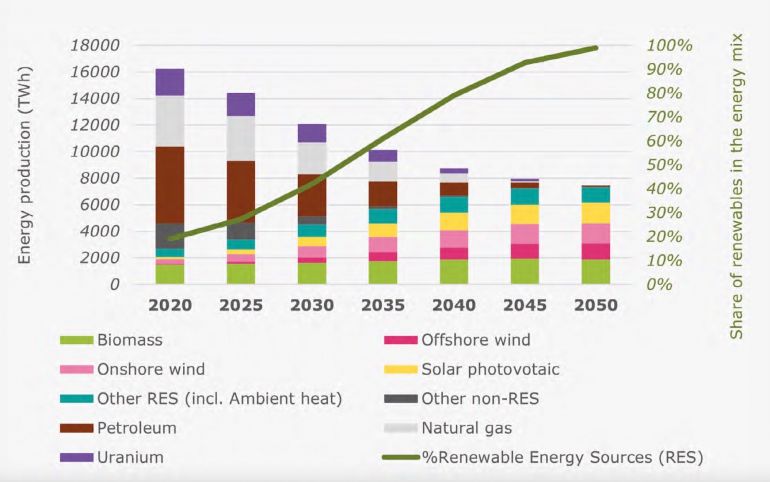
- Solar and wind have found a price level where it is so cheap that it will replace nuclear power, says Gunnar Boye Olesen and shows a diagram from CLEVER that shows a phase-out of both fossil fuels and nuclear power towards 2050.
Both the Danish government and the oil and gas industry are focusing on CCS, as part of the 2030 climate goals and a future business that could even become a very good business with a CO2 backbone with a CO2 pipeline to the heavy industry in southern Germany.
Gunnar Boye Olesen has a different opinion on where the money would have been better spent.
- It would be better to open more pools for conversion to heat pumps, he says and adds about CCS:
- We have nothing against using CO2 from biogas plants for CCS, but you just shouldn't use CO2 from flue gas.
The diagram below from the CLEVER scenario shows how the share of fossil fuels can be reduced together with the use of nuclear power in the EU's 27 member states up to 2050, if citizens live more sustainably.
Title: Figure 31: Evolution of primary energy production by source and share of renewables
in final energy consumption for the EU27 in the CLEVER scenario
Text, graphics, images, sound, and other content on this website are protected under copyright law. DK Medier reserves all rights to the content, including the right to exploit the content for the purpose of text and data mining, cf. Section 11b of the Copyright Act and Article 4 of the DSM Directive.
Customers with IP agreements/major customer agreements may only share Danish Offshore Industry articles internally for the purpose of handling specific cases. Sharing in connection with specific cases refers to journaling, archiving, or similar uses.
Customers with a personal subscription/login may not share Danish Offshore Industry articles with individuals who do not themselves have a personal subscription to Danish Offshore Industry.
Any deviation from the above requires written consent from DK Medier.