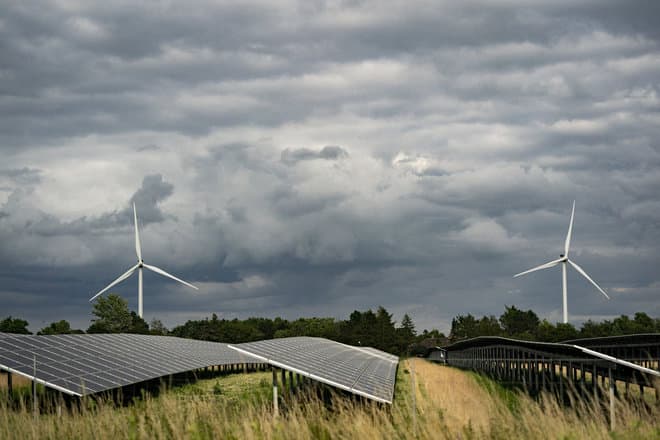
Solar cells on industrial buildings are met with broad public support, according to a questionnaire survey from DTU, which documents citizens' acceptance of green technologies.
In the survey, 93 percent of Danes responded that they are in favor of more solar cells on industrial roofs. The same trend is evident in support for offshore wind farms, which receive positive support from a total of 87 percent of those surveyed in the survey, the university said in a press release.
- The results show that the public support for solar cells gives the technology great potential on industrial roofs. Citizens think it is a fantastic idea and society should act on it and investigate whether there is a need to give the owners of industrial buildings better incentives to install solar cells, remove any regulatory barriers and make it possible for energy companies to be responsible for the installation and operation of solar cells on industrial roofs, says Professor Jacob Ladenburg from DTU Management.
The questionnaire survey from DTU is based on answers from 1,589 respondents and maps their attitude towards green technologies such as district heating, energy savings, wind turbines, solar cells, CO2 capture and storage, and nuclear power. A common feature of the responses is that the further away the technologies are placed from the respondents' residence, the higher the acceptance of the technologies.
- We know from several construction projects that public acceptance is important for us to achieve a smooth introduction of new green technologies. And if there is resistance to the geographical location of the technologies, we have seen that it has created significant delays, large financial costs or even cancellation of several projects with both onshore wind turbines, hydropower and solar cells, says Jacob Ladenburg.
Variable support in different age groups
The survey shows that in addition to solar cells on industrial roofs, district heating, energy-saving technologies and offshore wind farms are the most accepted technologies and are positively received by 93 percent, 91 percent, 91 percent and 87 percent of those surveyed, respectively. In addition, there is also positive support for CO2 capture and storage offshore, from 54 percent in the survey.
This is despite the fact that it is a completely new technology that Danish citizens have only little knowledge of. The least popular technologies in the survey are CO2 capture and storage in urban, rural and coastal areas, which are only positively received by 25%, 32% and 35% of respondents respectively. Nuclear power was the fourth least accepted technology with 40% support.
Finally, the survey shows that there are significant differences in the acceptance of the technology across age groups. Younger respondents are more positive towards nuclear power, while older respondents are more positive towards district heating.
The survey is funded with funds from the EUDP-funded CO2 transport and storage project “Bifrost”, where partners in TotalEnergies, Ørsted, Nordsøfonden, BlueNord and DTU are investigating the potential for offshore CO2 transport and storage.
amp
Text, graphics, images, sound, and other content on this website are protected under copyright law. DK Medier reserves all rights to the content, including the right to exploit the content for the purpose of text and data mining, cf. Section 11b of the Copyright Act and Article 4 of the DSM Directive.
Customers with IP agreements/major customer agreements may only share Danish Offshore Industry articles internally for the purpose of handling specific cases. Sharing in connection with specific cases refers to journaling, archiving, or similar uses.
Customers with a personal subscription/login may not share Danish Offshore Industry articles with individuals who do not themselves have a personal subscription to Danish Offshore Industry.
Any deviation from the above requires written consent from DK Medier.