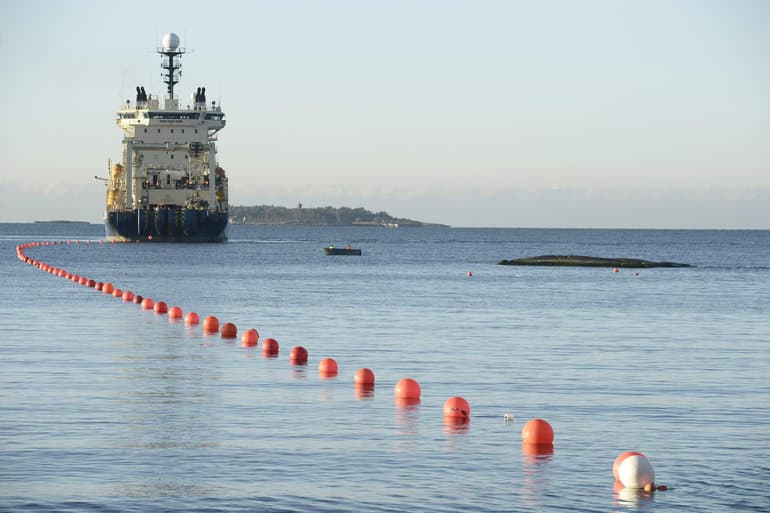
Germany and Finland have declared themselves "deeply concerned" about a rupture in an undersea data cable between the two countries. In a joint statement, the countries' foreign ministers said that a data cable running from Helsinki to Rostock in Germany stopped working on Monday morning. The cause has not yet been clarified.
- The fact that such an incident immediately raises suspicions of deliberate damage says a lot about the changeability of these times, the statement says.
An investigation is underway, it says.
- Our European security is not only threatened by Russia's war of aggression against Ukraine, but also by hybrid warfare from malicious actors.
A data cable between Sweden and Lithuania has also been affected by disruptions. This was reported by a technology director at Telia to the Lithuanian public service media LRT. The connection went down on Sunday morning at 10 am. There are no major disruptions to data traffic in Lithuania, as there are several other cables.
Sabotage cannot be ruled out in the Finnish case
In Finland, the state-owned data company Cinia discovered the fault on Monday morning. The company says the fault is due to external influences, but the cause is not yet known. The assumption of external influences is that the cable suddenly stopped working. The company informed the news agency Reuters. The company previously said that it was too early to say whether it could be sabotage.
The cable is called C-Lion1 and runs from Helsinki to Rostock in Germany. It is 1,173 km long. The problem - as in Lithuania - does not immediately affect internet operations in Finland to a greater extent, as there are more cables.
Cinia's communications director, Henri Kronlund, says according to the media YLE that the location of the damage is east of the southern tip of the Swedish island of Öland, outside the most frequently used shipping routes.
The Finnish security police Skypo states that it is too early to determine the cause. According to Skypo, around 200 submarine cables break every year. Often the cause is human error.
Last year, several cables were damaged in the Baltic Sea - both telecommunications cables and a gas pipeline. Finnish police have a Chinese ship as the main suspect in the case from last year. The ship is believed to have dragged its anchor behind it. However, according to the Reuters news agency, the police have not said whether they believe it was an accident or a deliberate act.
The Nord Stream gas pipelines were blown up in 2022 in the Baltic Sea near Bornholm. That case is still under investigation by German authorities.
/ritzau/
Text, graphics, images, sound, and other content on this website are protected under copyright law. DK Medier reserves all rights to the content, including the right to exploit the content for the purpose of text and data mining, cf. Section 11b of the Copyright Act and Article 4 of the DSM Directive.
Customers with IP agreements/major customer agreements may only share Danish Offshore Industry articles internally for the purpose of handling specific cases. Sharing in connection with specific cases refers to journaling, archiving, or similar uses.
Customers with a personal subscription/login may not share Danish Offshore Industry articles with individuals who do not themselves have a personal subscription to Danish Offshore Industry.
Any deviation from the above requires written consent from DK Medier.