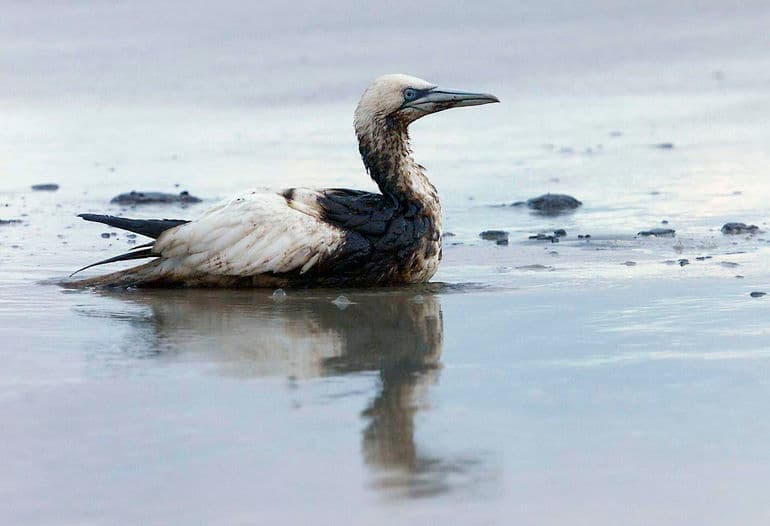
The Ministry of Defence does not have what it takes to handle pollution accidents with oil and chemicals at sea, the State Auditors concluded in a report on Monday. And according to the six auditors, this is "disturbing".
- The State Auditors find it objectionable that the Ministry of Defence's preparedness to combat oil and chemical pollution of the sea does not meet the legislation in the area and international obligations, the auditors stated after a meeting on Monday.
The criticism is in the category of "sharp criticism" on the State Auditors' own grading scale. The investigation of the preparedness shows that the preparedness cannot handle all types of pollution required by law. And the capacity is not sufficient. Furthermore, the emergency response cannot act quickly enough.
- The State Auditors take it very seriously that the Ministry of Defence is thereby exposing the Danish marine environment to an unnecessary risk of pollution accidents, the State Auditors write.
Large periods of inadequate emergency response
According to DanPilot, which is the state pilot in Denmark, around 70,000 ships sail through the Great Belt and the Sound annually. And due to narrow passages and shallow areas, there is a risk that the ships may collide or run aground in the heavily trafficked waters.
The Ministry of Defence is responsible for the emergency response. This follows from the Marine Environment Act and the Helsinki Convention. The 1974 convention between the countries in the Baltic Sea aims to protect the region against all forms of pollution.
The Ministry of Defence's emergency response primarily consists of four environmental ships. In 1996, the ships were assessed as obsolete.
The report on Monday shows that one or more of the four environmental ships were out of service for 97 days in the first half of 2023, while the readiness was sufficient for 84 days. That is, the readiness was insufficient for more than half of the time.
/ritzau/
Text, graphics, images, sound, and other content on this website are protected under copyright law. DK Medier reserves all rights to the content, including the right to exploit the content for the purpose of text and data mining, cf. Section 11b of the Copyright Act and Article 4 of the DSM Directive.
Customers with IP agreements/major customer agreements may only share Danish Offshore Industry articles internally for the purpose of handling specific cases. Sharing in connection with specific cases refers to journaling, archiving, or similar uses.
Customers with a personal subscription/login may not share Danish Offshore Industry articles with individuals who do not themselves have a personal subscription to Danish Offshore Industry.
Any deviation from the above requires written consent from DK Medier.