The club, as it is called in everyday speech among the dock workers at the Port of Esbjerg and others, is actually called: The Landing Club of 1944 at the Port of Esbjerg. It is a club that is known for ensuring its members good working and wage conditions far beyond the city limits of Esbjerg.
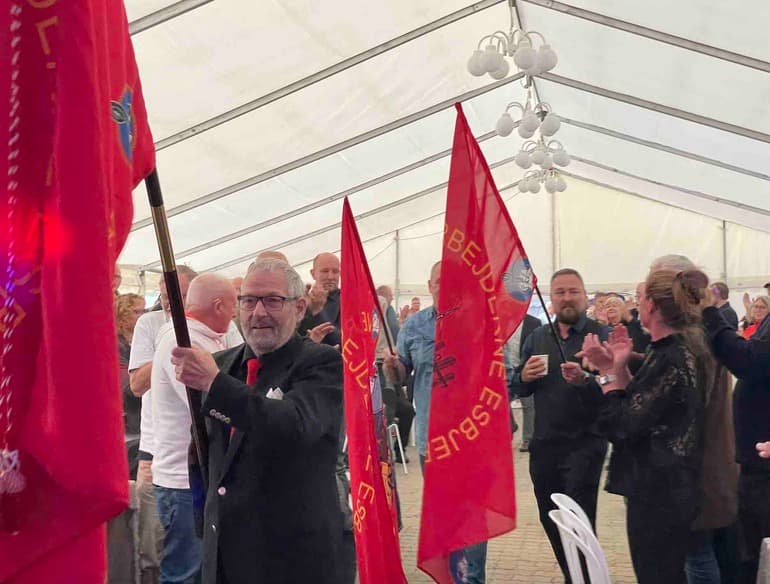
On Saturday, the club celebrated its 80th anniversary, where members with partners, together with the invited employers, trade unionists and the director of the Port of Esbjerg, participated in a tent in front of the Muster House at the port.
Despite the 80 years, the club has only now received its own red flag, and it was inaugurated by hammering three nails into it for freedom, equality and fraternity. Chairman of the club, Brian Reichle, hammered in one of the nails, and he wanted to talk about a year-long design work that also has something to do with offshore wind.
- It has taken almost four years to design the flag, and it should have both something old and something new. That is why we have both trucks like the old one and installation ships on it, explains Brian Reichle, who also knows where the flag's logo, which is also on the club's vests, will be used:
- We will use it and the vests when we go to collective bargaining negotiations and demonstrations. We are already known for that.
The installation ship for wind turbines on the flag is very much part of the future.
- We already know that 80 percent of the new offshore turbines for the North Sea will be installed here from the Port of Esbjerg. So we are going to be really, really busy, and we are also training people for that, says Brian Reichle.
A future with more work
Many of the dockworkers at the Port of Esbjerg are casual workers, but that in no way means that they lack qualifications. This is something that the dock and terminal worker training has helped with.
- Dockworkers are now a recognised profession like blacksmiths, carpenters and electricians, explains Brian Reichle.
So far, 215 dock and terminal workers have been trained out of around 1,000 dockworkers in Denmark. It is a figure that the chairman would like to see much higher, and he links it to the community in the 80-year-old club.
- We only have a strong club because we are 100 per cent organised. We stand together, and that matters when we negotiate wages and working conditions. That is why we are also campaigning for all dock workers in Denmark to be educated, says Brian Reichle.
However, the close unity does not mean that there is a bad relationship with the employers.
- You can see here that we have a really good relationship with the owners of the companies. They are here today, like Kurt Skov, says Brian Reichle about the founder of Blue Water Shipping.

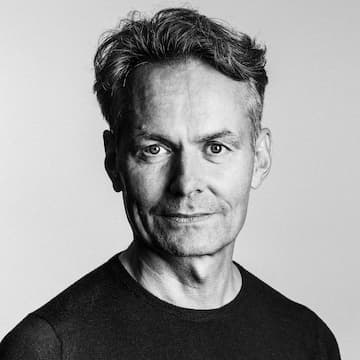
Chairman of the dock workers Brian Reichle took the time to tell DOI.dk about the future,
where much more specialized work within offshore wind awaits the dock workers.
Photo: Jesper Ernlund Lassen - Danish Offhshore Industry - DOI.dk.
Text, graphics, images, sound, and other content on this website are protected under copyright law. DK Medier reserves all rights to the content, including the right to exploit the content for the purpose of text and data mining, cf. Section 11b of the Copyright Act and Article 4 of the DSM Directive.
Customers with IP agreements/major customer agreements may only share Danish Offshore Industry articles internally for the purpose of handling specific cases. Sharing in connection with specific cases refers to journaling, archiving, or similar uses.
Customers with a personal subscription/login may not share Danish Offshore Industry articles with individuals who do not themselves have a personal subscription to Danish Offshore Industry.
Any deviation from the above requires written consent from DK Medier.