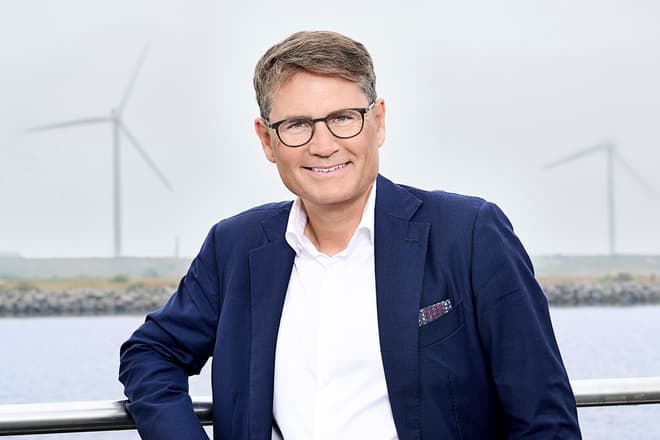

Søren Bjerregaard Pedersen is CEO of Hydrogen Valley and CEMTEC, which is located on the outskirts of Hobro in North Jutland. CEMTEC stands for Center for Energy and Materials Technology and was established in 2001 as a non-profit organization. Hydrogen Valley specializes in hydrogen, PtX and CO2. Right now, there is a stumbling block that worries the CEO in relation to the green transition. It is largely about how to store the energy, and hydrogen has an advantage here.
- What do we do on a cold February day without energy from the sun and wind, when we no longer have coal-fired power plants? Batteries are only good for large amounts of energy for short periods, but hydrogen allows us to store large amounts of energy for long periods, explains Søren Bjerregaard Pedersen, who also sees another connection:
- The expansion of wind on- and offshore is going far too slowly. It is also my assessment that we will not see the energy companies set up more offshore wind farms before a hydrogen pipeline is decided. Here, “overplanting” is important. It is an integral part of the offshore wind supply that is out right now.
Overplanting means that we set up more turbines in each park, in order to be able to supply enough electricity even on days when the wind is only blowing at 80 percent. power. But this requires that you can get rid of the electricity in the form of hydrogen when the wind is blowing at 100 percent.
A hydrogen pipeline must help create flexibility in several ways, and the Danish underground plays a role. A hydrogen pipeline would make it possible to export hydrogen to German heavy industry – but there would also be the possibility of creating Danish energy storage, and here depleted salt caverns in the Danish underground play a central role.
- There are salt caverns in Lille Torup, Hvornum and Suldrup. If a hydrogen pipeline were built for them, two salt caverns could constitute a hydrogen power plant the size of the Nordjyllandsværket or the Esbjergværket. One of the salt caverns could be used as hydrogen storage for the combustion of the hydrogen, while the other would be used for compressed air that could drive a turbine. Here, hydrogen from renewable green energy can be stored, but this requires a hydrogen pipeline, Søren Bjerregaard Pedersen states.
Not enough with the electricity grid
An expansion of the electricity grid must be carried out and preferably as quickly as possible – but it cannot stand alone, it continues.
- This is the only way we can create an efficient energy system, and it is 100 percent necessary when we no longer have coal-fired power plants. It is significantly more expensive to transport electricity than hydrogen, says Søren Bjerregaard Pedersen and reminds us that there is an absolute need for both electricity and hydrogen.
- There is a need for both hydrogen and electricity. But where we can use electricity, we must do so, because it is far more efficient. However, there are some heavy-duty things where we need hydrogen, says the CEO, who also has an electric car parked in the parking lot.
That's why he also sees a mutual need between both wind and solar power and a hydrogen pipeline.
- Hydrogen is an enabler for getting both solar cells and offshore turbines up and running. The same is true the other way around, because there is no need for a hydrogen pipeline without solar and wind energy. Hydrogen and offshore wind are a necessity for each other, it says.
Possible energy storage for Norway, Sweden and Finland
The Danish capacity for hydrogen storage in salt caverns is even so large that it allows Denmark to store for Norway, Sweden and Finland, where there is no subsoil suitable for storing hydrogen.
- We in Denmark can become a storage facility for the entire Nordic region, because we are the northernmost country with suitable subsoil and salt caverns. Norway, Sweden and Finland have good opportunities to produce green hydrogen from hydropower – but there is no possibility to store the hydrogen, says Søren Bjerregaard Pedersen and gets to the main message for politicians and the billion-dollar investment in a Danish hydrogen pipeline:
- That's 16 billion DKK to make an even more green transition, and compared to that, it's not a lot of money.
Text, graphics, images, sound, and other content on this website are protected under copyright law. DK Medier reserves all rights to the content, including the right to exploit the content for the purpose of text and data mining, cf. Section 11b of the Copyright Act and Article 4 of the DSM Directive.
Customers with IP agreements/major customer agreements may only share Danish Offshore Industry articles internally for the purpose of handling specific cases. Sharing in connection with specific cases refers to journaling, archiving, or similar uses.
Customers with a personal subscription/login may not share Danish Offshore Industry articles with individuals who do not themselves have a personal subscription to Danish Offshore Industry.
Any deviation from the above requires written consent from DK Medier.