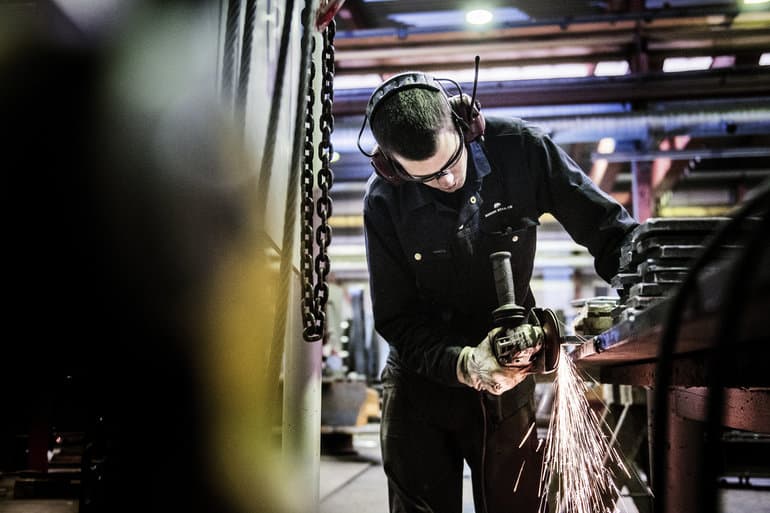
The government wants to allocate 260 million DKK annually from this year, and from 2029 the amount will increase to 330 million DKK annually to strengthen vocational education. This is part of the initiative "Prepared for the Future VII", which is the government's third initiative in the area of vocational education.
Four out of ten students drop out of vocational education, but there is a very large difference in how many stop at the slightly more than 100 vocational education programs in Denmark.
- With this initiative, we want to reduce dropout rates from education programs. Together with the funds from the epx reform, we are spending around 50 percent more on training a skilled worker in Denmark, says Minister of Children and Education Mattias Tesfaye (S) to the website of the Ministry of Children and Education.
Some education programs have a dropout rate of 20 percent, while the dropout rate is as high as 70 percent. on other education programs.
Educations to be allowed to distribute the money themselves
Because the dropout rate is different for the individual education programs, the government will give the education programs the freedom to assess where the money is best spent.
- This will give the schools a significant boost to their finances and the freedom to locally assess how to create the best framework for educating the skilled workers of the future.
- To further support the schools' freedom to find the best solutions themselves, the government wants to abolish the four goals from the vocational education reform (from 2014, ed.) as national goals for the education programs, as well as a number of rules and process requirements, according to the proposal.
A total of half of the financial resources in the proposal will be distributed to the vocational schools without restrictions.
However, the schools will not be given carte blanche. According to the government's proposal, they must enter into collaboration with the social partners to set a direction for the efforts of individual schools. The proposal is also intended to ensure that the level of teaching is higher in schools.
- Only one in three of the teachers covered has completed the mandatory diploma in vocational education (DEP).
- Therefore, the government will invest in strengthening the teachers' professional and pedagogical competencies, the proposal states.
Greater flexibility
The government will also ensure greater flexibility in vocational education, so that more young people with special needs and disabilities have better opportunities.
Here, the government has been inspired by the fact that, according to the Upper Secondary School Act, it is possible to organize an upper secondary school course over four years instead of three, for example for students on the autism spectrum (ASF).
- Therefore, the government will appoint three vocational schools to test ASF teams.
- The possibility of ASF teams can, for example, be established in the office education, agricultural education and warehouse and terminal education, it appears from the proposal.
/ritzau/
Text, graphics, images, sound, and other content on this website are protected under copyright law. DK Medier reserves all rights to the content, including the right to exploit the content for the purpose of text and data mining, cf. Section 11b of the Copyright Act and Article 4 of the DSM Directive.
Customers with IP agreements/major customer agreements may only share Danish Offshore Industry articles internally for the purpose of handling specific cases. Sharing in connection with specific cases refers to journaling, archiving, or similar uses.
Customers with a personal subscription/login may not share Danish Offshore Industry articles with individuals who do not themselves have a personal subscription to Danish Offshore Industry.
Any deviation from the above requires written consent from DK Medier.